Lying Flat Hip Raise
Lying Flat Hip Raise is a bench-supported core exercise that trains you to curl the pelvis upward instead of simply lifting the legs. In the shown setup, your upper back and hands stay anchored on the bench while the legs point straight up and the abs drive the motion. The rep starts from a quiet, stacked position and finishes with the hips briefly peeling off the bench as the lower abdomen shortens.
That detail matters because the exercise is easy to turn into a leg swing if the torso is loose or the grip is passive. The bench gives you a fixed base, but the real work comes from controlling the pelvis, keeping the ribs down, and resisting the urge to arch through the lower back. When done well, the movement feels like a crisp posterior pelvic tilt with a small hip lift rather than a big, sloppy crunch.
This makes the exercise useful for people who want direct abdominal work without loading the spine heavily. It fits well in core training, warm-up circuits, or accessory work when you want a strict bodyweight drill that rewards precision. The top position should be brief and deliberate: lift the hips only as high as you can without momentum, then lower slowly until the back settles back onto the bench.
Setup is the main limiter. If the bench edge is unstable, the shoulders are too far off, or the neck is doing the job of the abs, the rep stops being a hip raise and turns into a compensation pattern. Keep your support points firm, keep the legs quiet, and let the pelvis move in a controlled arc. Beginners can use a smaller range of motion or slightly bent knees, but the goal stays the same: a clean curl of the hips driven by the core, not a throw of the legs.
[ Workout Log & Planner ]
Put your next workout in Fitwill
Keep your plan and training log ready when you are.


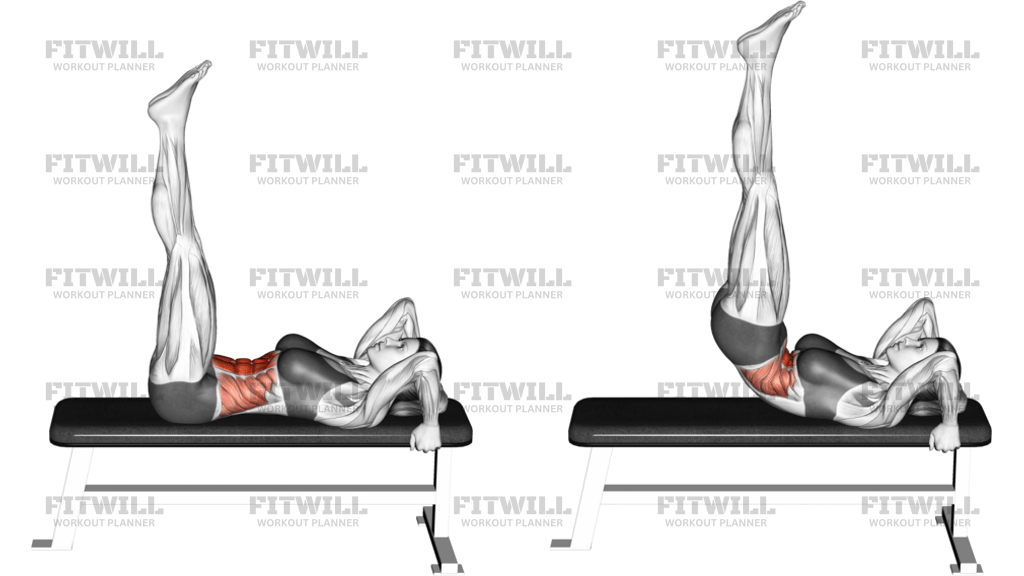
Instructions
- Lie on a flat bench with your upper back and head supported, and grip the bench beside or behind your head for stability.
- Bring your hips close to the bench edge, keep your legs extended straight up, and stack your ankles over your hips.
- Press your shoulders down, keep your neck long, and brace your abs so your ribs stay pulled toward your pelvis.
- Set your knees softly straight and keep your feet together or close together so the legs stay quiet.
- Exhale and curl your pelvis upward, lifting your hips off the bench instead of swinging your legs.
- Finish the rep by tucking the tailbone and bringing the lower abdomen in hard at the top.
- Pause briefly in the raised position with control and without losing tension through the shoulders.
- Lower your hips slowly until your back settles back onto the bench and the pelvis returns to neutral.
- Reset the brace before the next repetition and keep the breathing steady through the full set.
Tips & Tricks
- Think about curling your tailbone toward the ceiling; that cue keeps the rep focused on the pelvis instead of the feet.
- Keep your hands light on the bench so you do not yank your head or shoulders into the movement.
- If your lower back arches as soon as the legs lower, shorten the range and stop the descent earlier.
- A small hip lift done cleanly is better than a big swing that pulls the bench support out of position.
- Keep the knees nearly straight, but soften them slightly if locking out your legs causes the hips to rock.
- Exhale as the hips rise and inhale on the controlled lowering so the brace stays organized.
- If the bench edge feels awkward, slide your torso a little farther onto the pad until the shoulders feel secure.
- Do not chase speed; the eccentric should be slow enough that you can place each vertebra back onto the bench.
Frequently Asked Questions
What does Lying Flat Hip Raise train most?
It mainly trains the abs to posteriorly tilt the pelvis, with the lower abdominal area doing most of the visible work.
What should I feel on the bench during the rep?
Your upper back and hands should stay anchored while the hips curl upward a few inches off the pad.
How high should the hips rise?
Only high enough for a clean pelvic curl. If you need to swing the legs or arch the back to go higher, the range is too big.
Is this the same as a straight-leg raise?
No. A straight-leg raise lifts the legs, while this movement is about curling the pelvis and raising the hips from the bench.
Can beginners do this exercise?
Yes. Beginners usually do best with a smaller range of motion and a slower lowering phase until they can keep the pelvis controlled.
What is the biggest form mistake?
The most common mistake is using momentum from the legs instead of curling the pelvis with the abs.
Why does the neck matter on a flat bench?
If the neck tenses up or the hands pull hard, the rep stops being a core-driven hip raise and becomes a strainy crunch pattern.
How do I make it harder without adding weight?
Slow the lowering phase, pause at the top, or reduce the amount of help from the hands while keeping the same clean pelvic curl.