Skater Hop Tap
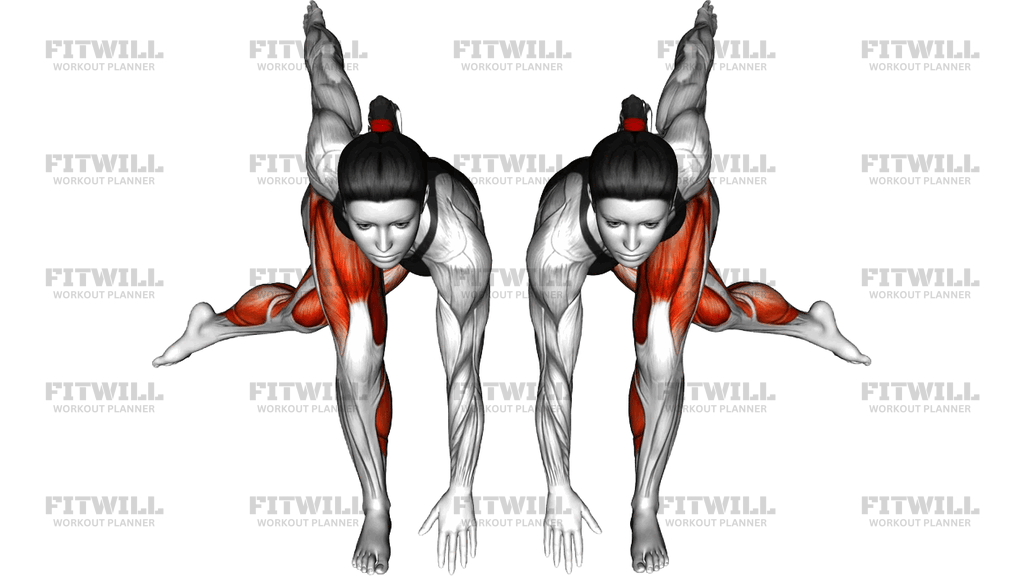
The Skater Hop Tap is a single-leg balance and hinge drill that borrows its shape from the position a speed skater holds coming out of a push. You stand on one leg, hinge forward from the hips, extend the free leg long behind you, and reach one hand down to tap the floor beside your standing foot. From there you either reset slowly or drive back up to standing, which is where the hop element comes in for more advanced versions.
This movement earns its place in a program because it stacks three demands at once: single-leg stability, a deep hip hinge, and controlled trunk rotation. The standing leg's hamstrings and glutes work hard to control the forward fold and pull you back upright, while the glute of the lifted leg keeps that leg extended and the hips square. Meanwhile, the deep core and obliques resist the twist as your opposite hand reaches across, which is exactly the anti-rotation control you need for running, cutting, and skating itself.
Setup matters more here than in most body weight drills because everything happens over a narrow base of support. Your standing foot should be planted firmly with the toes spread, weight balanced across the whole foot rather than dumped into the heel. The knee stays soft and tracks over the middle of the foot — if you set up with a locked knee or collapsed arch, the tap becomes a wobble contest instead of a hinge.
To execute it well, think of the free leg and your torso as one rigid line that pivots together at the hip. Reach the hand toward the floor as the back leg swings up and back; the tap should be light and deliberate, a checkpoint rather than a weight-bearing brace. Keep your neck long and your eyes on a spot on the floor a foot or so ahead of you instead of craning up.
The Skater Hop Tap fits neatly into warm-ups, single-leg strength blocks, and balance work for runners, skaters, and field-sport athletes. It is also a useful screening tool — the difference between your left and right side often reveals an asymmetry worth addressing before you load up heavier single-leg work like lunges or step-ups.
As for safety, the main risks are losing balance sideways and letting the standing knee cave inward. Start with a shallow range and a slow tempo, and keep something sturdy nearby until the balance feels automatic. If a floor tap is beyond your current hamstring flexibility, reach toward your shin instead — the pattern matters more than the depth.
[ Workout Log & Planner ]
Put your next workout in Fitwill
Keep your plan and training log ready when you are.


Instructions
- Stand on your right foot with your knee slightly bent and your weight spread evenly across the whole foot, toes gripping the floor.
- Brace your core and set your hips square to the front before you start moving, then pick a fixed spot on the floor about a foot ahead of you to anchor your gaze.
- Hinge forward at the hips, pushing your hips back and letting your torso lower toward the floor while your left leg swings back behind you.
- Reach your left hand down toward the floor beside your right foot, keeping your right knee tracking over the middle of that foot.
- Tap the floor lightly with your fingertips at the bottom of the reach, with your left leg extended long behind you and your hips level, not rotated open.
- Push through the standing foot and squeeze the right glute to pull your torso back up to a tall single-leg stand.
- For the hop variation, drive off the standing leg with a small controlled hop as you rise, landing softly on the same foot before the next rep.
- Exhale as you hinge and tap, and inhale as you drive back up to standing.
- Complete all reps on the right side, then reset your stance and switch to the left foot, keeping the same tap position beside the working leg.
- If you lose your balance, step the free leg down, re-brace, and restart the rep rather than fighting through a sloppy position.
Tips & Tricks
- The most common mistake is rounding the lower back to reach the floor faster. Hinge from the hips instead and stop at whatever depth lets you keep a long, neutral spine — tapping your shin is a valid rep.
- Watch for the standing knee drifting inward as you fold. Cue your knee toward the pinky side of that foot to keep the glutes engaged through the whole hinge.
- If your hips twist open as the back leg lifts, turn the toes of your lifted leg down toward the floor. This small adjustment squares the pelvis and lights up the glute of the working leg.
- Do not let the tapping hand take your body weight. Rest only your fingertips on the floor; if you find yourself pressing down hard, reduce the depth or slow the descent.
- Keep your neck relaxed and look slightly forward rather than straight down at your hand, which helps your balance system orient instead of tumbling.
- Move deliberately through the bottom of the rep. Rushing the tap-and-return is where most people lose the hinge pattern and start squatting with the torso instead.
- For the hop version, land with a bent knee and a quiet foot. A loud, stiff landing means you are dropping rather than sticking the rep.
- Practice near a wall with one hand hovering over it for the first few sessions on each side, since the balance deficit is usually worse on your non-dominant leg.
- Hold the bottom tap position for two or three seconds on some reps to build the isometric hamstring strength that makes the dynamic version smoother.
Frequently Asked Questions
What muscles does the Skater Hop Tap work?
The hamstrings and glutes of the standing leg do most of the work through the hinge, while the glute of the lifted leg and your ankle stabilizers control the balance. The obliques and deep core work to keep your trunk from rotating as the hand reaches down.
Is the Skater Hop Tap suitable for beginners?
Yes, as long as the range is scaled. Beginners can tap the shin or knee instead of the floor, skip the hop, and keep a wall or chair within reach until single-leg balance feels steady.
Why does one hand reach down to tap instead of both arms?
The single-arm reach with the opposite leg extended creates rotational demand, so your core has to resist twisting. It also matches the diagonal, skating-like body position that gives the drill its name.
My hamstring flexibility limits how low I can reach. Is a shorter range still effective?
Absolutely. The training effect comes from the hinge pattern and single-leg control, not from touching the floor. Reach only as far as your spine stays long, and flexibility will improve gradually over time.
Should my back stay flat or rounded during the tap?
Keep the spine long and hinge from the hips. A rounded lower back shifts work away from the hamstrings and puts unnecessary load on the spine.
Do I have to include the hop, or is the tap alone enough?
The tap and return alone build balance and hinge strength, so start there. Add the hop only once you can complete controlled taps without wobbling, since landing mechanics matter more than height.
How is the Skater Hop Tap different from a single-leg deadlift?
Both use a single-leg hinge, but the Skater Hop Tap adds the floor tap with one hand and a skating-style leg extension, which increases the anti-rotation and balance demands. A single-leg deadlift is typically loaded and more strength-focused.
How many reps and sets should I do?
Two to three sets of six to ten controlled reps per side works well for balance and strength. Balance drills respond to quality, so stop a set when your foot starts wandering or your form degrades.
What can I use instead if the balance component is too hard?
Stand closer to a wall with fingertips lightly touching it, or perform the same hinge and reach with the toe of your back leg resting on the floor behind you. Both preserve the pattern while reducing the stability requirement.
Is it safe if I have knee problems?
The movement keeps the standing knee bent but not heavily loaded, which many people tolerate well. Still, keep the bend shallow, make sure the knee tracks over the foot, and stop if you feel pain rather than muscular effort.