Exercise Ball Leg Curl
Exercise Ball Leg Curl is a bodyweight hamstring exercise built around one simple demand: keep the hips lifted while you pull the ball toward you. It trains knee flexion for the hamstrings while also asking the glutes, core, and upper back to stabilize the body so the ball does not roll away. Because the feet are on an unstable surface, the movement rewards control more than brute force.
The Exercise Ball Leg Curl is especially useful when you want hamstring work without a machine. It fits well in lower-body sessions, posterior-chain circuits, core-focused workouts, or as an accessory after squats and deadlifts. The stability ball changes the feel of the rep: the hamstrings must both hold the bridge position and curl the ball, so the exercise becomes harder as soon as the hips drop or the feet drift apart.
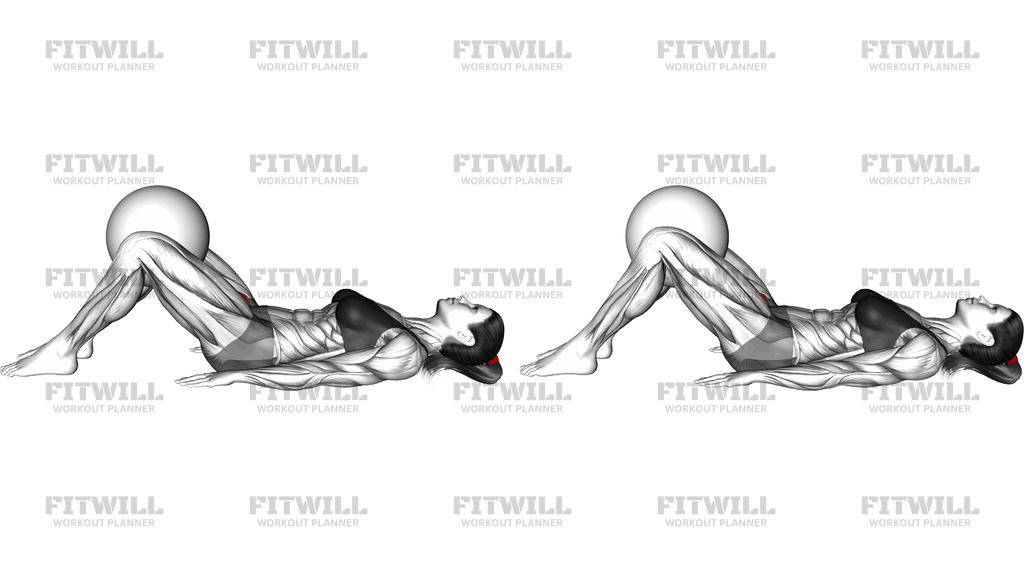
Setup matters a lot. Start on your back with both heels on the ball, legs straight enough to keep tension, and arms pressed into the floor for balance. Before you curl, lift your hips into a strong bridge so your torso forms one line from shoulders to knees. If the ball is too far away, the curl gets sloppy; if it is too close, the hamstrings lose tension before the rep even begins.
Each repetition should feel like a smooth pull rather than a kick or a yank. Curl the ball toward your glutes by bending the knees, keep the hips high as long as you can, and then reverse the path with control. The torso should stay quiet while the lower legs move. If the hips sag, the low back arches hard, or the ball shoots forward, the set is too heavy or the range is too ambitious.
This exercise is a strong option for intermediate lifters, but beginners can still use it if they start with small ranges or do bridge holds before full curls. It is also a useful regression when you want hamstring training without loading the spine. Treat the last few reps as a test of body position: the set is productive only while the hips stay lifted and the ball tracks in a straight line.
[ Workout Log & Planner ]
Put your next workout in Fitwill
Keep your plan and training log ready when you are.


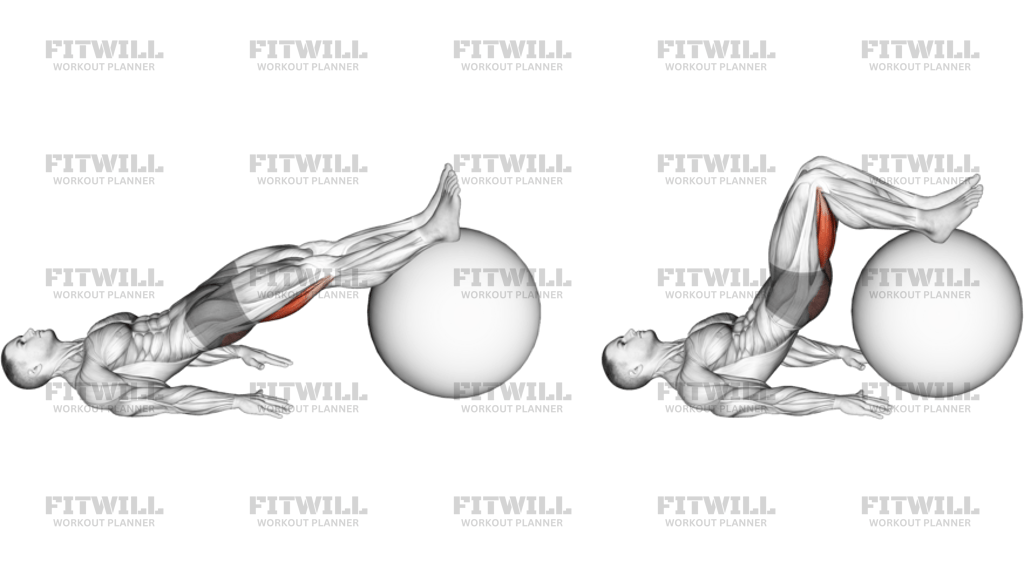
Instructions
- Lie on your back with your heels on a stability ball and your arms flat on the floor at your sides for support.
- Straighten your legs enough to create tension on the ball, then press your heels lightly into the top of it.
- Lift your hips into a bridge until your shoulders, hips, and knees form a long line.
- Brace your midsection and keep your ribs down so the lower back does not take over.
- Pull the ball toward your glutes by bending your knees and dragging the heels through the ball.
- Keep your hips as high as possible while the ball rolls in, and stop when your heels are close to your seat.
- Slowly extend your legs to roll the ball back out without letting your hips collapse.
- Reset the bridge at the end of each rep and repeat for the planned number of repetitions.
Tips & Tricks
- If your hips drop on the first curl, start with shorter reps and keep the ball closer to your feet at the top of the bridge.
- Press through the heels, not the toes; toe pressure usually turns the movement into a calf-dominant roll instead of a hamstring curl.
- Keep the ball under the lower legs, not the arches, so you can pull with the heels and keep the line of force consistent.
- Do not let the knees flare wide as the ball comes in; keep them tracking roughly hip-width so the curl stays smooth.
- A small pause with the ball near your glutes makes the hamstrings work harder than bouncing through the top.
- If your low back cramps, reduce the bridge height slightly and focus on keeping the ribs down rather than arching higher.
- Use a slower return than the curl-in phase so the hamstrings keep tension as the ball rolls away.
- Stop the set when you can no longer keep the hips level, even if the legs are not fully fatigued yet.
Frequently Asked Questions
What does the Exercise Ball Leg Curl work most?
It mainly targets the hamstrings, with the glutes, core, and upper back helping to keep the bridge stable.
Is the Exercise Ball Leg Curl good for beginners?
Yes, but beginners should keep the range short at first and focus on holding the hips up before chasing a bigger curl.
Where should my heels sit on the stability ball?
Your heels should sit on the top half of the ball so you can pull it toward you without losing contact or slipping forward.
Why do my hips drop during the curl?
The set is probably too hard or the bridge is too low. Shorten the range, slow the return, and keep the ribs tucked so the hips stay lifted.
Should I feel this in my hamstrings or my lower back?
You should feel the hamstrings doing most of the work. A little core effort is normal, but lower-back strain usually means the hips are sagging or the ribs are flaring.
Can I do the Exercise Ball Leg Curl without a bench or machine?
Yes. That is one of the main advantages of the movement, since the stability ball provides the resistance and the floor supports your body.
What is the biggest mistake in the Exercise Ball Leg Curl?
Letting the hips collapse while the ball rolls in. Once that happens, the exercise turns into a sloppy bridge instead of a true hamstring curl.
How can I make the Exercise Ball Leg Curl harder?
Use a slower lowering phase, pause with the ball close to your glutes, or progress to single-leg variations once your two-leg reps stay clean.