Standing Straight Leg Hamstring Contract Relax On Exercise Ball
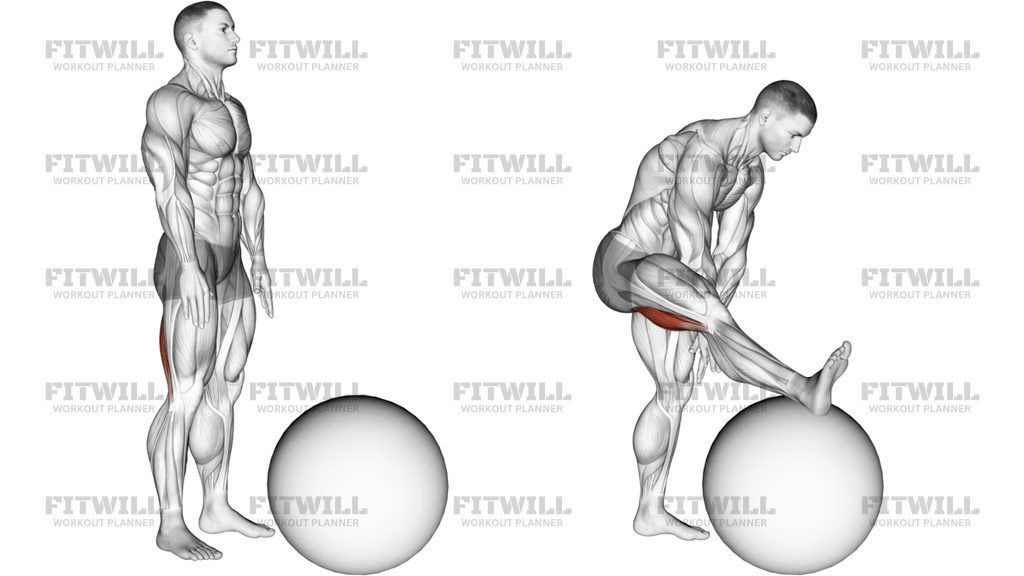
Standing Straight Leg Hamstring Contract Relax On Exercise Ball is a standing contract-relax hamstring stretch using a stability ball as the raised surface. The image shows one heel supported on the ball while the other leg stays planted on the floor, so the exercise should be coached as a mobility drill rather than a strength lift. The goal is to find a long hamstring line, contract the hamstring gently, then use the relaxation phase to move a little deeper without losing balance or pelvic control.
The setup matters because the ball changes both balance demand and stretch angle. Stand tall beside the ball, place one heel on top with the knee nearly straight, and keep the standing leg softly bent so you can hinge from the hips instead of collapsing through the lower back. A light hold on a wall or rack is fine if it helps you stay square and stable. The stretch should be felt mainly along the back of the lifted thigh, not in the knee joint or low back.
The contract-relax pattern is what makes this version different from a passive hamstring stretch. After settling into the starting position, gently press the heel down into the ball as if you are trying to drag it toward you without actually moving it. That small isometric contraction should last only a few seconds and should not cause cramping. When you relax, exhale and hinge forward a little farther or dorsiflex the foot to invite a deeper stretch while keeping the pelvis level.
This exercise fits well in a warm-up, cool-down, or mobility block when the hamstrings feel tight from running, hinging, sprinting, or prolonged sitting. It is also useful between lower-body sessions when you want to improve length and control without loading the spine. Keep the movement smooth, avoid forcing range, and treat each repetition as a controlled reset of tension and posture. If the ball rolls or the hamstring starts to cramp, reduce pressure and shorten the stretch before continuing.
Fitwill
Log Workouts, Track Progress & Build Strength.
Achieve more with Fitwill: explore over 9600 exercises with images and videos, access built-in and custom workouts, perfect for both gym and home sessions, and see real results.
Start your journey. Download today!




Instructions
- Stand beside the stability ball and place one heel on top with the knee nearly straight and the toes pulled up.
- Keep the other foot planted firmly on the floor and hold a wall or rack lightly if you need help balancing.
- Square your hips and hinge forward from the hips until you feel a mild stretch along the back of the raised leg.
- Keep your chest open and your lower back long instead of rounding to chase more range.
- Press the heel gently down into the ball for 5 to 10 seconds without bending the knee or twisting the pelvis.
- Exhale, relax the contraction, and let the hamstring soften so you can move a little deeper into the stretch.
- Hold the deeper position for a slow breath or two while keeping the standing leg softly bent and stable.
- Return to upright with control, step the heel off the ball, and repeat on the other side.
Tips & Tricks
- Use only a light contract phase; if the hamstring starts to cramp, the effort is too high.
- Keep the heel centered on the ball so the foot does not slide off as you press.
- A soft bend in the standing knee usually gives better balance and lets the hamstring stretch more cleanly.
- Think of reaching the hips back over the standing heel instead of folding the rib cage toward the thigh.
- Keep both hip bones pointed forward so the stretch stays on the hamstring instead of turning into a twist.
- If the ball feels unstable, shorten the range and use one hand for balance before increasing the stretch.
- Breathe out during the relax phase to help the hamstring release and accept a slightly deeper position.
- Stop if the sensation moves behind the knee or feels sharp instead of like a broad pull in the thigh.
Frequently Asked Questions
What does the heel-on-ball position train most?
It primarily stretches the hamstrings of the raised leg while challenging balance and pelvic control.
How is this contract-relax stretch different from a regular hamstring stretch?
You briefly press the heel into the ball, then relax and deepen the stretch, which often gives more range than a passive hold.
Should my knee be completely locked out on the ball?
No. Keep it nearly straight, but avoid forcing a hard lock so the stretch stays on the muscle and not the joint.
Where should I feel the stretch?
You should feel a strong but controlled pull in the back of the raised thigh, not a sharp sensation in the knee or low back.
Can I hold onto something while doing this exercise?
Yes. A light touch on a wall, pole, or rack is useful if the ball makes balance difficult.
What causes the ball to roll away while I stretch?
Usually too much pressure or an uneven foot position. Keep the heel centered and press only lightly during the contraction.
Is this a good warm-up or cool-down exercise?
It works well in both, but it is especially useful after training or after running when the hamstrings feel tight.
What should I do if I feel a hamstring cramp?
Back off the effort, shorten the stretch, and use a gentler contraction before trying again.