Standing Hands Position Pronation-Supination-Neutral
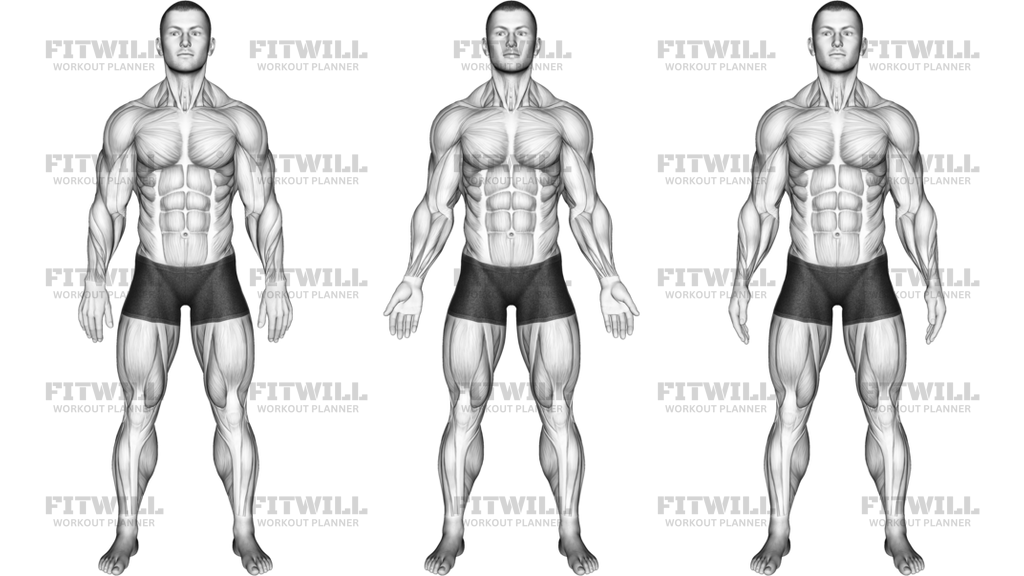
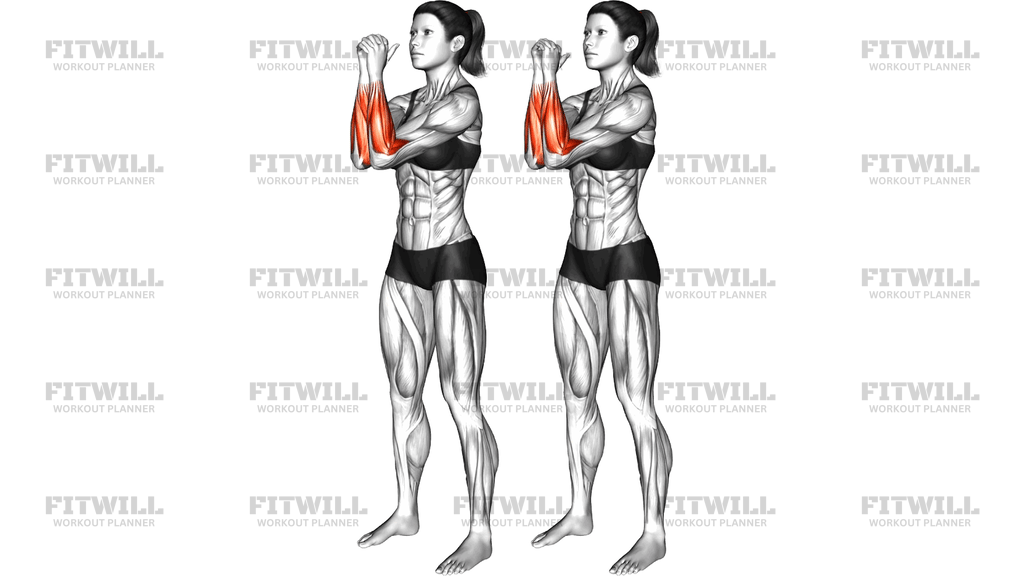
Standing Hands Position Pronation-Supination-Neutral is a simple standing forearm rotation drill. The image shows the same upright stance with the hands turned through three forearm positions: neutral with the thumbs forward, pronated with the palms turned back, and supinated with the palms turned forward. The exercise is less about moving a load and more about learning to control forearm rotation cleanly while the upper arm, shoulder, and trunk stay quiet.
It trains the muscles that rotate the radius and ulna, especially the pronator and supinator muscles around the elbow and forearm, while the shoulder girdle and core stabilize the body. That makes it useful for warm-ups, rehab-style preparation, grip work, climbing, racket sports, throwing, and any program that needs better wrist and forearm control.
The setup matters because the elbow and shoulder can easily cheat the motion. Stand tall, keep the ribs stacked, and let the rotation happen from the forearm instead of twisting the torso. The elbow can stay by the side, slightly bent or straight, but the upper arm should remain still so the hand position is the only thing changing.
Move slowly between neutral, pronation, and supination. The hand should turn smoothly without bending the wrist backward or forward, shrugging the shoulder, or letting the elbow drift. Pause briefly in each end position to feel the difference between palm-down, palm-up, and thumb-forward alignment, then return under control.
Use it as a low-load technique drill, a warm-up between heavier lifts, or a corrective accessory when forearm stiffness or asymmetry is limiting other work. Keep the motion pain-free and stop short if the wrist, elbow, or forearm feels irritated. Clean positioning matters more than speed or range on this one.
Fitwill
Log Workouts, Track Progress & Build Strength.
Achieve more with Fitwill: explore over 9600 exercises with images and videos, access built-in and custom workouts, perfect for both gym and home sessions, and see real results.
Start your journey. Download today!




Instructions
- Stand tall with your feet about hip-width apart and let your arms hang at your sides.
- Keep your elbows close to your ribs with your shoulders relaxed and level.
- Start in neutral with your thumbs pointing forward and your palms facing in.
- Rotate both forearms outward until your palms face forward and your thumbs point away from your body.
- Rotate both forearms inward until your palms face back toward your thighs.
- Pass back through neutral on every rep and keep your wrists straight instead of bending them.
- Use a slow, even tempo and breathe steadily while the hands turn.
- Stop the set if the motion starts coming from your shoulders, trunk, or wrists instead of your forearms.
Tips & Tricks
- Keep the upper arms frozen so the rotation comes from the forearm, not a shoulder turn.
- Think "rotate the palm" rather than "move the whole hand" to avoid wrist bending.
- A slight elbow bend is fine if it helps you keep the shoulders relaxed and the motion smooth.
- The thumb-forward neutral position is the reset point; return there before changing direction.
- If one side feels stiffer, slow that side down and match the same end range on both arms.
- Stay out of painful range at the elbow if full pronation or supination irritates the joint.
- Use the motion as a quality drill, not a speed drill; jerky turns defeat the purpose.
- Keep your neck long and your ribs down so the shoulders do not rise as the hands turn.
Frequently Asked Questions
What muscles does this exercise work?
It mainly targets the forearm pronators and supinators, with the upper arm, shoulder girdle, and core helping stabilize the standing position.
Is this a strength exercise or a mobility drill?
It can serve both, but it is usually used as a low-load mobility and control drill rather than a heavy strength movement.
Should my elbows stay straight?
They can stay straight or have a small bend, but they should not swing away from your sides.
What is the difference between pronation, supination, and neutral?
Neutral is thumbs-forward, pronation turns the palms backward or down, and supination turns the palms forward or up.
Can beginners do this movement?
Yes. It is beginner-friendly because it uses body weight and a small, controlled range of motion.
Why does my wrist want to bend during the motion?
That usually means the movement is coming from the wrist instead of the forearm; keep the wrist long and let the forearm rotate under it.
Can I do this seated or with my arm supported?
Yes, a seated version can help if standing posture is hard to hold, but keep the same slow forearm rotation.
When should I avoid it?
Skip it or shorten the range if the wrist, elbow, or forearm pain increases as you turn from neutral into pronation or supination.