Standing Chest Stretch Against Door
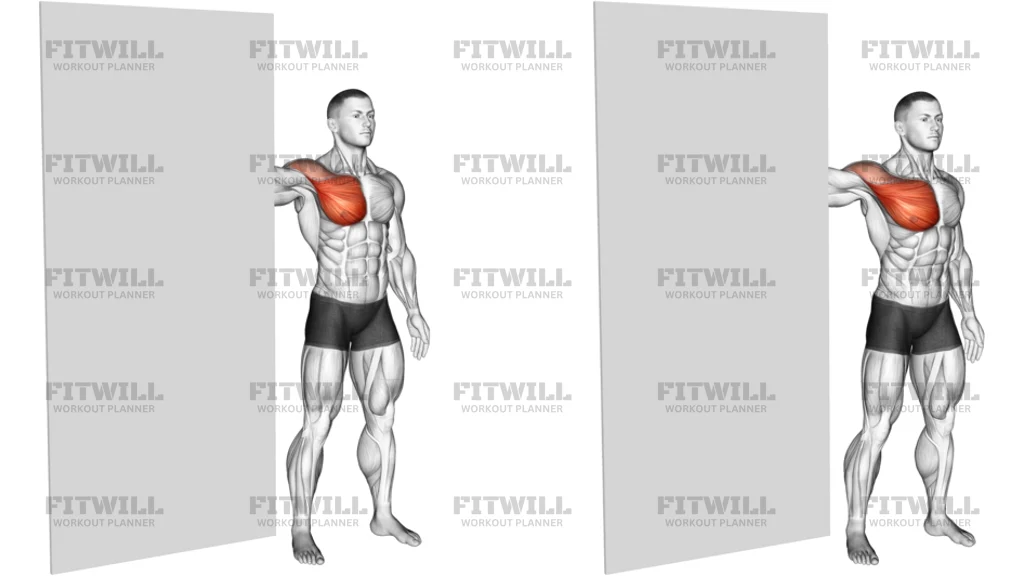
Standing Chest Stretch Against Door is a doorway stretch for the pecs and front of the shoulder. The exercise uses a fixed hand or forearm on the door frame while the torso turns away, creating a controlled opening through the chest, shoulder, and upper arm. It is not about forcing a big range. The goal is to find a position where the stretch is strong, steady, and repeatable without pinching the shoulder or twisting the low back.
The image shows a classic standing doorway setup: one arm is placed at shoulder height against the frame, the chest faces forward at the start, and the body rotates away from the anchored arm. That setup matters because the angle of the elbow and the height of the hand change where the stretch lands. A higher elbow usually increases the stretch across the upper chest and front delt, while a slightly lower elbow often shifts some tension away from the shoulder joint and feels easier to control.
This stretch is useful before pressing, push-ups, dips, or any session where the chest and shoulders need to move freely. It can also be used after training when the pecs feel tight from prolonged sitting or pressing volume. Because it is a bodyweight mobility drill, the quality comes from posture and breathing: keep the ribs stacked over the pelvis, turn from the torso instead of cranking the shoulder forward, and let the exhale help the chest soften into the doorway.
A good repetition should feel like a smooth opening across the front of the chest, not a joint squeeze in the front of the shoulder. Step only far enough to create tension you can breathe through, then come back out with control. If one side is tighter, spend a little longer there, but keep the position honest and symmetrical. When done well, this stretch leaves the upper body warmer, freer, and better prepared for pressing or overhead work.
Fitwill
Log Workouts, Track Progress & Build Strength.
Achieve more with Fitwill: explore over 9600 exercises with images and videos, access built-in and custom workouts, perfect for both gym and home sessions, and see real results.
Start your journey. Download today!




Instructions
- Stand beside a doorway and place one palm or forearm on the frame at about shoulder height.
- Keep the elbow bent comfortably and position the upper arm slightly behind the line of your torso.
- Take a small split stance with the anchored-side foot a little closer to the door than the other foot.
- Lift the chest without flaring the ribs and keep the head tall and neck long.
- Brace lightly through the midsection so the lower back does not arch as you turn.
- Slowly rotate the torso away from the anchored arm until you feel a clear stretch across the chest and front shoulder.
- Breathe out and let the chest soften into the stretch without pushing into pain or numbness.
- Hold the end position for the desired time, then step back out and reset before repeating on the other side.
Tips & Tricks
- Keep the shoulder blade on the stretched side from riding forward; let the stretch come from turning away, not collapsing the shoulder.
- If the front of the shoulder feels pinched, lower the hand a little on the frame and try again.
- A forearm-on-frame variation is often easier on the wrist and gives a broader pec stretch than a straight arm.
- Do not twist through the low back to get farther away from the door; the torso should rotate as one controlled unit.
- A slow exhale usually deepens the stretch more safely than pulling harder with the arm.
- If the upper chest feels tight near the collarbone, move the elbow slightly higher; if the front delt feels overstressed, lower it slightly.
- Keep the neck relaxed and avoid jutting the chin forward while you hold the position.
- Use shorter holds and repeat them if you are very tight instead of forcing one long, aggressive stretch.
Frequently Asked Questions
What does Standing Chest Stretch Against Door target?
It mainly targets the pectorals, especially the chest fibers near the front of the shoulder, with some stretch through the anterior deltoid and upper arm.
Should my arm be straight or bent on the door frame?
A bent elbow or forearm-on-frame setup is usually more comfortable and easier to control. A straighter arm can increase the stretch, but it also makes shoulder position more important.
How far should I rotate away from the doorway?
Only far enough to feel a strong stretch that you can breathe through. If you have to lean, twist, or grimace to get there, you have gone too far.
Where should I feel the stretch most?
You should feel it across the front of the chest and into the front of the shoulder on the anchored side. A little sensation in the upper arm is normal, but sharp shoulder pain is not.
Can I use this before pressing workouts?
Yes. It is a common warm-up or between-set mobility drill before bench press, push-ups, dips, and overhead work.
What if my shoulder feels pinched in this stretch?
Reduce the arm height, bend the elbow more, and step a little less aggressively into the doorway. If it still pinches, stop and choose a gentler chest-opening variation.
Do I need to hold my breath to feel it more?
No. A slow exhale is better because it helps the ribcage settle and usually lets the chest open without forcing the position.
Is there a way to make the stretch easier?
Yes. Keep the hand lower, reduce the step-through distance, and use a forearm on the frame instead of a fully extended arm.