Side Plank Pull
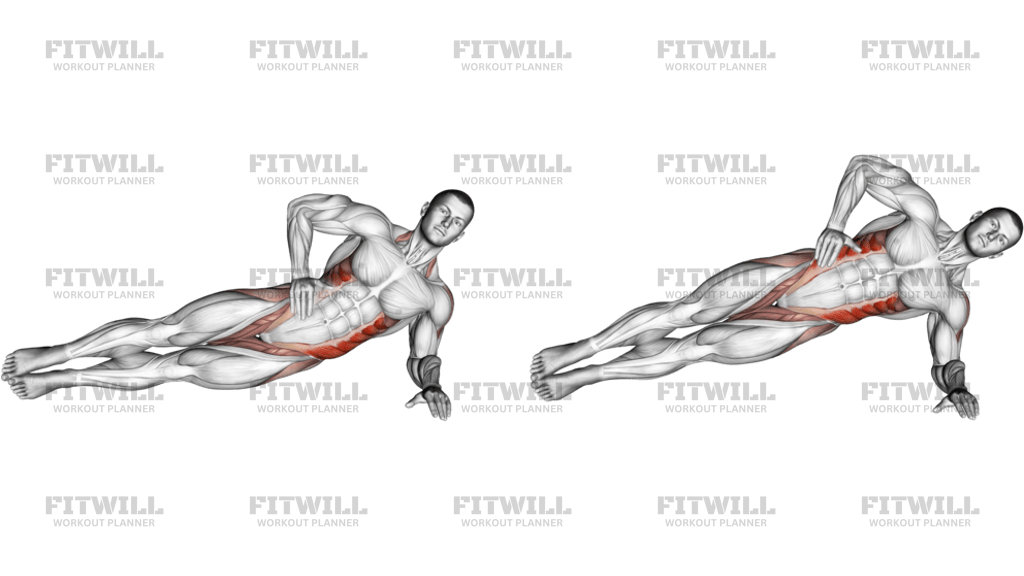
Side Plank Pull is a challenging core exercise that blends a side plank with an upper-body pull. You support yourself on one forearm and the outer edge of one foot while the top arm moves from an extended position toward the ribs or waist. The result is a strong demand on the obliques, side glutes, shoulder stabilizers, and the muscles that resist twisting through the trunk.
The setup matters more than it looks. If the elbow is too far from the shoulder, if the feet drift apart, or if the hips are already rotated before you start, the pull turns into a shaky hold instead of a clean rep. A stacked, straight body line gives the working side of the waist a fair chance to control the movement, and the shoulder stays in a safer position when the forearm is planted firmly and the neck stays long.
Use a smooth pulling path rather than a big reach or a fast yank. As the top arm comes down, keep the ribs from flaring and keep the pelvis from tipping forward or back. The arm should move because the trunk stays organized, not because the torso twists to chase the hand. That makes Side Plank Pull useful for athletes and anyone training lateral core strength, anti-rotation control, and shoulder stability in the same rep.
Side Plank Pull works well in core circuits, athletic warmups, accessory blocks, or home sessions where you want a bodyweight movement that still feels intense. It is usually best as a controlled set of short reps or timed holds, especially if you are still learning to keep the hip line steady. If the shoulder, elbow, or lower back starts to take over, shorten the lever, reduce the load, or switch to a plain side plank until the position feels solid.
When performed well, Side Plank Pull builds more than abdominal endurance. It trains the body to hold a narrow base, keep the torso stacked, and move the arm without losing pelvic control. That combination makes it a useful drill for improving side-to-side stability, cleaner overhead mechanics, and better control through rotation-prone positions.
Fitwill
Log Workouts, Track Progress & Build Strength.
Achieve more with Fitwill: explore over 9600 exercises with images and videos, access built-in and custom workouts, perfect for both gym and home sessions, and see real results.
Start your journey. Download today!




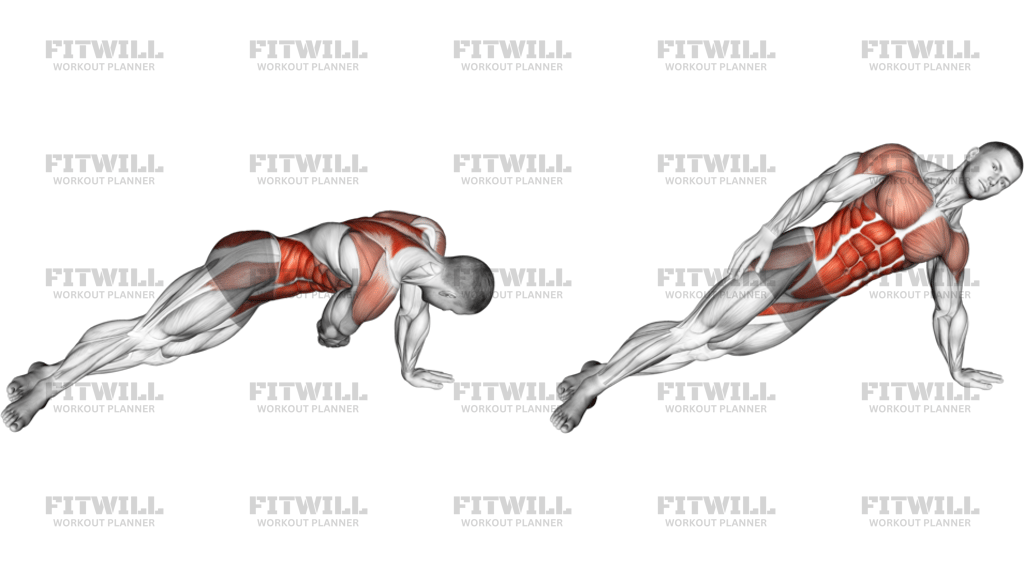
Instructions
- Lie on your right side with your right forearm on the floor, your elbow directly under your shoulder, and your legs straight with your feet stacked or slightly staggered.
- Press through your forearm and the outer edge of your bottom foot to lift your hips until your body forms a straight line from head to heels.
- Reach your left arm straight up so your shoulder stays stacked over your right shoulder and your chest stays open.
- Set your ribs down, squeeze your glutes, and keep your chin in a neutral position before you start the pull.
- Pull your left hand or elbow down toward your left ribcage or waist without letting your hips roll forward or backward.
- Exhale as the arm pulls down and keep the side of your torso from collapsing toward the floor.
- Pause briefly at the bottom of the pull, then reverse the path and reach the arm back toward the ceiling under control.
- Finish the set by lowering your hips to the floor with control, then repeat on the other side.
Tips & Tricks
- If stacked feet make you wobble, stagger the top foot a few inches in front of the bottom foot.
- Keep the pulling hand close to your side; a wide arc usually turns the rep into a shoulder swing.
- Think about lifting through the bottom waist before you think about pulling with the arm.
- The top shoulder should stay away from the ear; shrugging usually means the position is too hard or the pull is too fast.
- Stop the set as soon as the pelvis starts to drift backward or the lower rib flares toward the floor.
- A small, clean pull is better than a bigger range that twists the torso.
- If you add resistance, keep it light enough that the wrist stays straight and the elbow does not bend to cheat the rep.
- A slow return to the top arm position usually exposes more core work than a rushed pull.
Frequently Asked Questions
What muscle does Side Plank Pull target most?
It mainly challenges the obliques and the side of the core, with the shoulder stabilizers and side glutes helping you keep the body stacked.
Do I need a dumbbell or band for Side Plank Pull?
No. The bodyweight version is already demanding, but a light dumbbell or band can be added later if you want more pulling resistance.
Should my feet be stacked or staggered in Side Plank Pull?
Stacked feet make the exercise harder, while a slight stagger gives you a wider base if balance is the limiting factor.
How do I keep my hips from rotating during Side Plank Pull?
Keep the forearm under the shoulder, squeeze the glutes, and pull the arm without letting the chest or pelvis chase the hand.
Where should my top hand travel during Side Plank Pull?
Draw it from the vertical line above your shoulder down toward the side of your ribcage or waist, not across your stomach.
Is Side Plank Pull hard on the shoulder?
It can be if you shrug or collapse into the supporting shoulder, so keep the shoulder packed and shorten the range if it feels pinchy.
Can beginners do Side Plank Pull?
Yes, but they should start with short holds or a plain side plank first, then add the pulling motion once the side line stays steady.
What is the easiest way to make Side Plank Pull easier?
Use a staggered foot position, shorten the pull, or remove the resistance and focus on holding a clean side plank shape.