Eagle Pose Garudasana
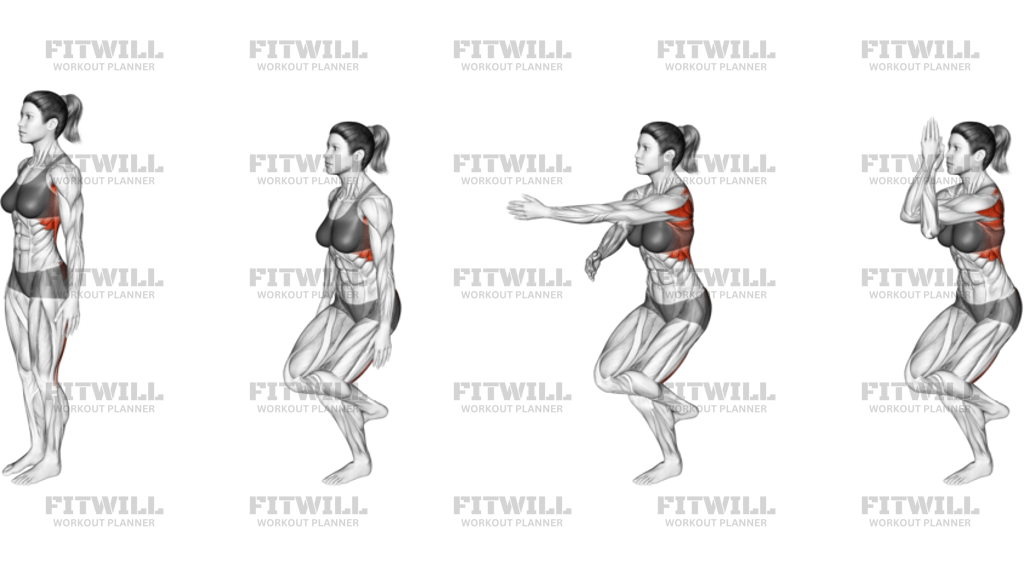
Eagle Pose Garudasana is a standing yoga balance that wraps one thigh over the other and one arm under the other to create a compact, coordinated hold. In the image, the exercise is shown as a progression from tall standing into the crossed-leg and crossed-arm position, which is the key idea behind the pose: narrow your base, organize the joints, and stay steady while the body works against wobble.
This pose trains balance, ankle and foot control, hip stability, shoulder positioning, and upper-back control at the same time. The standing leg has to support your weight while the crossed leg keeps the knees and thighs active, and the arms challenge shoulder mobility and scapular control. The result is less about lifting a heavy load and more about maintaining a clean shape under tension.
Setup matters because Garudasana can turn into a knee twist or a forward collapse if you rush it. Start from a tall stance, shift weight into one foot, then cross the opposite thigh over the standing thigh and either hook the top foot behind the calf or lightly tap the floor if you need more support. At the same time, wrap the arms, stack the elbows in front of the chest, and bring the hands toward each other without forcing the shoulders.
Once you are in position, keep the chest lifted, the hips level, and the standing knee pointed over the toes. Sink only as far as you can while staying stable, breathe smoothly, and keep the gaze fixed so the pose feels controlled instead of shaky. Hold the shape for a few breaths, then unwind slowly and repeat on the other side with the same amount of control.
Garudasana is useful in warmups, mobility work, yoga flows, and balance-focused conditioning because it exposes side-to-side differences quickly. It is usually friendly for beginners if they use a wall or keep the toes of the lifted foot on the floor, but the pose should still feel organized, not jammed. If the standing knee or wrapped shoulder feels pinched, shorten the range and simplify the wrap before trying to deepen the hold.
[ Workout Log & Planner ]
Put your next workout in Fitwill
Keep your plan and training log ready when you are.


Instructions
- Stand tall with your feet under your hips and shift your weight into one foot before you start crossing anything.
- Soften the standing knee slightly and fix your gaze on one point straight ahead to help your balance.
- Cross the opposite thigh over the standing thigh; if full wrapping is not comfortable, keep the top toes on the floor as a kickstand.
- Squeeze the thighs toward each other so the knees stay close and the hips do not drift open.
- Sweep the opposite arm under the other arm, then stack the elbows in front of your chest.
- Bring the forearms together and press the palms if you can do so without shrugging the shoulders up.
- Lift the elbows slightly, draw the shoulders down, and keep the chest broad while the spine stays tall.
- Sink a little deeper by bending both knees, then hold the pose for a few steady breaths without wobbling or collapsing forward.
- Unwind slowly, place both feet back on the floor with control, and repeat the same sequence on the other side.
Tips & Tricks
- If the wrapped foot cannot hook behind the calf without twisting the knee, keep the toes on the floor and treat it as a balance variation.
- Press the standing foot into the floor through the big toe, little toe, and heel so the ankle does not collapse inward.
- Keep the top knee close to the midline instead of letting it flare away from the body.
- Do not force the hands to meet if the shoulders are tight; stacked elbows are enough to get the upper-back work.
- Keep the ribs from flaring forward when you lift the elbows, or the pose turns into a backbend instead of a balance hold.
- A fixed gaze point is more useful than staring at the floor, especially when the crossed legs feel unstable.
- Use the wall with one fingertip if the pose is new or if the standing ankle keeps rolling.
- Switch sides with the same setup and hold time so one hip or shoulder does not get all the work.
Frequently Asked Questions
What does Eagle Pose Garudasana train most?
It mainly trains balance, ankle and foot control, hip stability, and shoulder positioning while the body stays wrapped and upright.
Do I have to hook the top foot behind the standing calf?
No. If the wrap is too tight, keep the top toes on the floor or use a light toe touch until your hips and knees feel steadier.
Why do my elbows feel more limited than my legs?
The arm wrap depends on shoulder external rotation and upper-back control. Keep the elbows stacked in front of the chest if the palms do not meet.
What should I feel in the standing leg?
You should feel the standing foot, calf, outer hip, and glute working to keep you upright, not sharp pain in the knee.
Can I use a wall for Eagle Pose Garudasana?
Yes. A fingertip on the wall is a practical way to keep the pose clean while you learn the leg wrap and weight shift.
Why does my standing knee drift inward?
That usually means the foot tripod is collapsing or the pose is too deep. Shorten the bend and keep the knee tracking over the second and third toes.
Is this a good warm-up exercise?
Yes. It works well before yoga, lower-body training, or single-leg work because it wakes up the feet, hips, and shoulders without needing equipment.
What is the biggest mistake in Eagle Pose?
Forcing the wrap by twisting the knee or shrugging the shoulders. The pose should feel compact and stable, not jammed.