Dumbbell Standing Hands Torsion
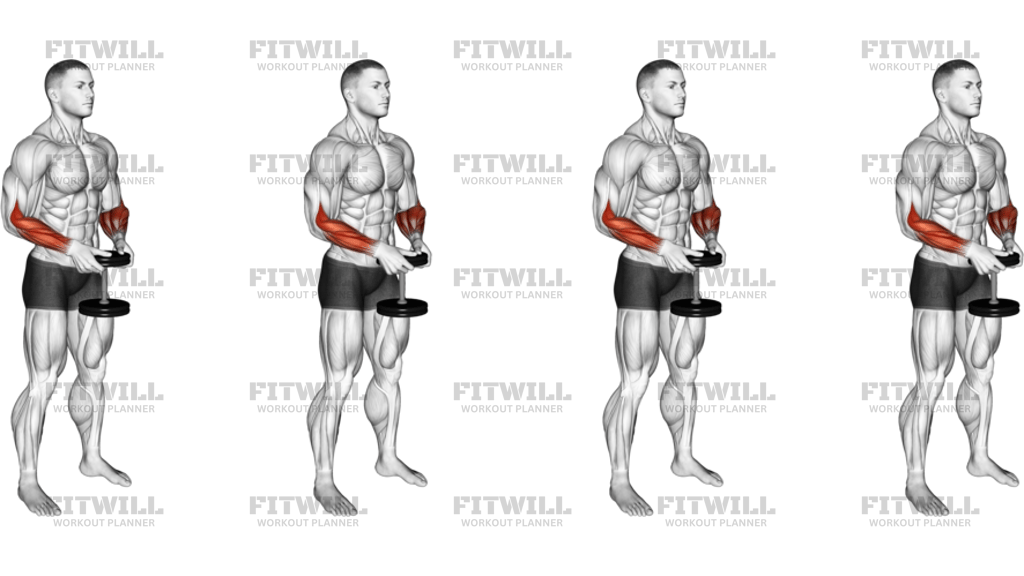
Dumbbell Standing Hands Torsion is a standing forearm drill built around controlled twisting of a dumbbell in front of the body. The goal is not to swing the weight or to turn it into a torso rotation; the work should stay in the hands, wrists, and forearms while the shoulders stay quiet and the stance stays solid.
The exercise loads the wrist flexors and wrist extensors while the brachioradialis and biceps help steady the elbow and keep the handle under control. Because the movement is small, the setup matters a lot: if the elbows drift, the shoulders shrug, or the torso twists, the forearms stop doing the job and the set turns into compensation.
Use a light dumbbell and hold it vertically in front of the thighs with both hands on the handle. Keep the elbows close to the ribs, wrists stacked, and the chest tall. From there, twist the hands outward through a smooth, short range as if you are trying to turn the handle against resistance, then reverse the motion slowly back to center without losing tension.
This exercise fits well as a forearm accessory, a grip primer before pulling work, or a small-volume finish after curls and rows. It is also useful when you want wrist control without loading the elbows with a full curl pattern. The main training effect comes from clean, repeatable torsion reps, not from chasing load.
Treat any sharp wrist pain, shoulder shrugging, or elbow flare as a sign to reduce the range or the weight. The best reps look almost effortless from the outside while the forearms stay continuously engaged, the body stays upright, and the dumbbell returns under control every time.
[ Workout Log & Planner ]
Put your next workout in Fitwill
Keep your plan and training log ready when you are.


Instructions
- Stand tall with your feet hip-width apart and hold a single dumbbell vertically in front of your thighs with both hands on the handle.
- Keep your elbows close to your ribs and let your upper arms stay still.
- Stack your wrists in line with your forearms and keep your shoulders down.
- Brace lightly through your midsection so the movement stays in the forearms.
- Twist the dumbbell outward by rotating through the wrists and forearms, not by swinging the arms.
- Move only as far as you can while keeping the elbows pinned and the torso quiet.
- Pause briefly at the end range, then reverse the twist slowly back to the start.
- Repeat for the planned reps, then lower the dumbbell with control.
Tips & Tricks
- Use a very light dumbbell first; this is a wrist-control drill, not a heavy strength lift.
- Keep the handle close to your hips so the lever stays short and the shoulders do not take over.
- If your elbows drift forward, lower the load and pin the upper arms to your sides.
- Think of turning a screwdriver or a doorknob rather than curling the weight.
- Keep the wrists neutral at the start; do not let them bend back before the twist begins.
- Stop before any pinching sensation at the wrist or elbow.
- Slow the return phase to keep tension on the forearm extensors and brachioradialis.
- Exhale during the twist and inhale as the dumbbell comes back to center.
Frequently Asked Questions
What muscles does Dumbbell Standing Hands Torsion work most?
It mainly trains the forearms, especially the wrist flexors, wrist extensors, and brachioradialis, with the biceps helping to stabilize the elbow.
Do I need one dumbbell or two?
Use one dumbbell held with both hands as shown; the key is controlled torsion, not alternating curls.
Should my elbows stay by my sides?
Yes. Keeping the elbows tucked prevents the shoulders from stealing the movement.
How far should I twist the dumbbell?
Only through the range you can control without wrist pain, torso rotation, or shoulder shrugging.
Is this a beginner-friendly exercise?
Yes, but start very light and keep the motion short and deliberate.
What does it mean if I feel it in my shoulders?
The load is probably too heavy or the handle is drifting away from your body.
Can I use it to warm up for deadlifts or rows?
Yes. It works well as a grip and forearm primer before pulling sessions.
What is the biggest mistake to avoid?
Rushing the twist and letting the body sway instead of keeping the forearms doing the work.