Resistance Band Bulgarian Squat
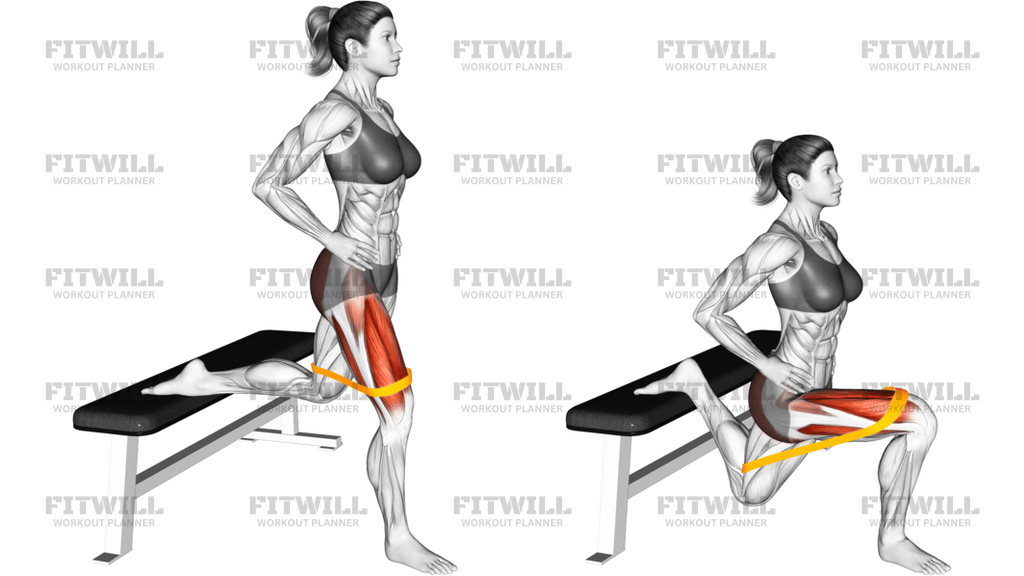
Resistance Band Bulgarian Squat is a rear-foot-elevated split squat that turns a classic single-leg leg exercise into a more demanding thigh and hip drill. One foot stays on the floor and the back foot rests on a bench, so the working leg has to control your body through a long range of motion while the band keeps tension on the rep. That combination makes the exercise useful for building quadriceps and glute strength, improving balance, and teaching the front leg to stay organized under load.
The setup matters because the bench, front-foot distance, and band tension all change where you feel the movement. If the front foot is too close, the knee can jam forward and the heel may lift. If it is too far away, you lose depth and the working leg stops getting a clean training stimulus. The best position lets you lower smoothly, keep the front heel planted, and maintain a level pelvis while the band keeps the working side under constant tension.
During the descent, the front knee should track in line with the toes while the back knee travels down toward the floor. A slight forward torso lean is normal, but the chest should stay long and the lower back should not overarch. At the bottom, keep tension through the front foot and avoid bouncing off the bench or swinging out of the hole. On the way up, drive through the midfoot and heel of the front leg and finish tall without pushing off the rear foot.
This exercise fits well in lower-body accessory work, unilateral strength blocks, or hypertrophy sessions when you want a controlled thigh emphasis with extra stability demand. It is also useful when you want to clean up left-right differences, because the split stance exposes side-to-side control gaps very quickly. Use a band setup that you can control for the full set, because the exercise is only as good as the rep quality.
If the band pulls your knee inward, the bench setup feels unstable, or your front heel keeps lifting, shorten the stance or reduce the band tension before adding more load. The goal is a smooth, repeatable split squat pattern where the working leg does the work and the band simply raises the challenge, rather than turning the movement into a balance recovery exercise.
Fitwill
Log Workouts, Track Progress & Build Strength.
Achieve more with Fitwill: explore over 9600 exercises with images and videos, access built-in and custom workouts, perfect for both gym and home sessions, and see real results.
Start your journey. Download today!




Instructions
- Set a bench behind you and place the top of your rear foot on it so you can stand on your front leg without twisting your hips.
- Plant your front foot far enough forward that you can lower straight down with your heel still flat and your knee tracking over your toes.
- Position the resistance band so it stays taut through the working leg and does not ride into the knee joint or twist around the thigh.
- Stand tall with your hips square, chest up, and most of your weight centered over the front foot.
- Brace your trunk, then lower by bending the front knee and hip until the rear knee moves toward the floor.
- Keep the front knee in line with the second or third toe and let the back leg stay relaxed on the bench.
- Descend until the front thigh is near parallel, or as deep as you can go without losing heel pressure or pelvic control.
- Drive through the front midfoot and heel to stand back up without pushing off the rear foot.
- Reset at the top, keep the band under steady tension, and repeat for the planned reps.
Tips & Tricks
- If your front heel pops up, move the front foot slightly farther away from the bench before adding more band tension.
- Keep the back foot quiet on the bench; it is there for balance, not for bouncing you out of the bottom.
- A small forward torso lean is fine, but do not let the ribs flare or the lower back arch to chase depth.
- If the band changes the line of pull, make sure it stays flat and centered so it does not tug the knee inward.
- Control the lowering phase for a full count instead of dropping into the bottom and relying on the stretch reflex.
- Use a bench height that lets your rear knee travel down comfortably without forcing the pelvis to twist.
- The front knee should move naturally forward, but the foot should stay rooted through the big toe, little toe, and heel.
- Stop the set when you can no longer keep the pelvis level, because hip shift ruins the single-leg loading.
- Exhale as you drive up and keep the torso stacked instead of turning the rep into a standing lunge.
Frequently Asked Questions
What muscles does Resistance Band Bulgarian Squat work?
It mainly trains the quadriceps and glutes, with the hamstrings, adductors, and core helping to stabilize the split stance.
Is the front leg or back leg supposed to do most of the work?
The front leg should do almost all of the lifting. The rear foot is only there to support balance and let you keep the working leg loaded.
How do I set up the back foot on the bench?
Rest the top of the rear foot or the laces on the bench and keep the hip relaxed so the back leg does not push you forward.
How far in front of the bench should my working foot be?
Far enough that you can lower under control with the front heel flat and the knee tracking over the toes, without feeling jammed at the bottom.
Why use a resistance band for this Bulgarian squat?
The band keeps tension on the working leg and makes the rep harder without needing a heavy external load.
What is the most common form mistake?
Letting the front heel lift, the knee cave inward, or the pelvis twist away from the working leg.
How deep should I go on each rep?
Go as low as you can while keeping the front foot planted, the hips square, and the band tension under control.
Can beginners do this exercise?
Yes, but start with a low bench, light band tension, and a short set until you can keep your balance and knee tracking clean.