Lying Shoulder Flexion Extension
Lying Shoulder Flexion Extension is a floor-based mobility drill performed on your back with your knees bent and feet flat. Starting with your arms resting at your sides, you slowly sweep them along the floor up and overhead until they reach past your head, then return them along the same path to your hips. Because the floor supports your arms the entire way, you get a guided, low-load arc of shoulder flexion and extension that is easy to control and hard to cheat.
This movement is especially useful for anyone whose shoulders feel restricted in overhead positions: desk workers with rounded upper backs, people warming up before pressing or pulling sessions, and those rebuilding comfortable shoulder range after long periods without training. The bent-knee setup matters more than it looks — it flattens your lower back against the floor, which locks your ribcage in place so the motion comes from your shoulders instead of your spine arching to fake extra range.
The primary work happens in the front of the shoulders as they lift the arms overhead, with the chest and the muscles across the front of the torso lengthening as the arms travel back. Your upper back and the stabilizing muscles around the shoulder blades stay engaged to keep the arms tracking smoothly along the floor rather than flaring or shrugging. It trains range of motion and control first, muscle activation second — do not expect it to feel like a heavy lift.
To execute it well, keep the backs of your hands, forearms, and elbows in light contact with the floor throughout the sweep. Move slowly enough that you could stop at any point; most people benefit from a two-to-three-second journey in each direction. When your arms reach overhead, let the backs of your hands hover just above or lightly touch the floor without forcing them down, then reverse the path with the same control.
The most common faults are arching the lower back as the arms pass head level, shrugging the shoulders toward the ears, and letting the elbows bend to squeeze out extra distance. All three steal work from the shoulders and mask your true available range. Keep the ribs down, the neck relaxed, and treat any point where contact with the floor breaks as your honest current endpoint — that endpoint typically improves week to week with consistent practice.
[ Workout Log & Planner ]
Put your next workout in Fitwill
Keep your plan and training log ready when you are.


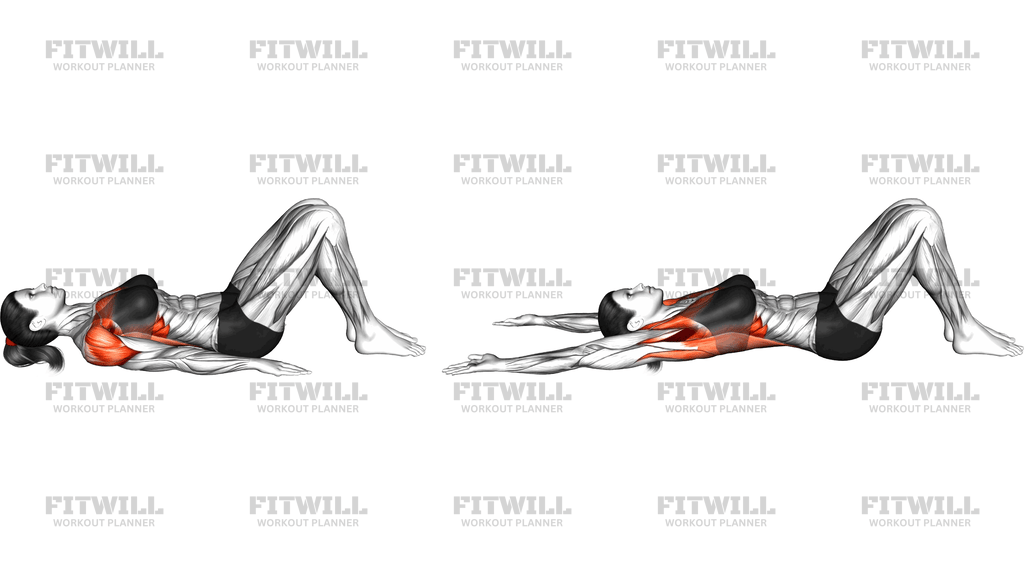
Instructions
- Lie on your back on an exercise mat or the floor with your knees bent and feet flat, hip-width apart, so your lower back rests comfortably against the ground.
- Place your arms at your sides with your palms facing down and the backs of your hands lightly touching the floor next to your hips.
- Gently brace your abdominals to press your lower back toward the floor and keep your ribcage from flaring upward.
- Keeping your elbows straight and your arms in light contact with the floor, slowly slide both arms away from your hips along the floor toward your head.
- Continue the arc until your arms extend overhead, reaching as far past your head as you can while keeping your ribs down and shoulders relaxed away from your ears.
- Pause briefly at the overhead position, letting the backs of your hands hover at or just above the floor without forcing them down.
- Reverse the path with the same slow speed, tracing your arms back along the floor until they return to the starting position beside your hips.
- Breathe steadily throughout — inhale as the arms travel overhead, exhale as they return to your sides.
- Reset your abdominal brace between repetitions if you feel your lower back lifting, then complete your set of smooth, continuous sweeps.
Tips & Tricks
- If your lower back arches as the arms pass head level, stop the sweep at that point — that is your real shoulder range, and pushing past it with spinal arch just borrows fake mobility.
- Watch for elbows bending mid-arc; this usually means the chest or shoulders are tight. Straighten the arms fully and shorten the range rather than compensating with a bend.
- Shrugging toward the ears is a common giveaway of upper trap takeover. Keep a little space between your shoulders and the floor by actively reaching the arms long instead of lifting them.
- Light contact with the floor is the quality check here: the moment a hand, forearm, or elbow lifts, you have either gone too fast or too far for your current range.
- Do not force the backs of your hands to the floor overhead. Hovering a centimeter above it with a straight arm is better than jamming the shoulders to touch down.
- Bend the knees only enough to flatten your lower back comfortably. If your hips or lower back feel strained, adjust the knee bend before starting the arm sweep.
- Keep your neck relaxed and your gaze straight up; craning the chin forward to watch your hands overhead disturbs the rib and shoulder position.
- If one side travels noticeably farther than the other, slow down and work to the range of the stiffer arm so both sides progress evenly.
- A set of eight to ten slow, controlled sweeps before pressing, pulling, or overhead work is usually enough — this is a warm-up and mobility drill, not an endurance challenge.
Frequently Asked Questions
What muscles does the Lying Shoulder Flexion Extension work?
The front shoulders do most of the active work as they lift the arms overhead, while the chest and lats lengthen through the arc. The muscles that stabilize the shoulder blades and upper back control the path throughout.
Is the Lying Shoulder Flexion Extension suitable for beginners?
Yes, it is one of the most beginner-friendly shoulder drills because the floor guides the arm path and there is no external load. Beginners should simply work within the range where their arms keep contact with the floor.
Why are the knees bent during this exercise instead of lying flat?
Bending the knees and planting the feet flattens the lower back against the floor, which stops your spine from arching to fake extra shoulder range. It keeps the movement honest and focused on the shoulders.
Should my hands stay touching the floor the whole time?
Ideally yes — the backs of your hands, forearms, and elbows should trace lightly along the floor for the entire sweep. Contact breaking is a signal that you have exceeded your controllable range or are moving too fast.
How is the Lying Shoulder Flexion Extension different from a standing arm raise?
Lying down removes gravity's downward pull along the final arc and blocks compensations like leaning back or arching. It makes the drill safer and more precise for improving overhead range.
What is the most common mistake with this movement?
Arching the lower back as the arms pass head level is the fault that shows up most. Brace your abdominals, keep the ribs down, and stop the sweep where the back starts to lift.
Can I use the Lying Shoulder Flexion Extension as a warm-up?
Absolutely — it works well before any pressing, pulling, or overhead training session. Eight to ten slow sweeps with steady breathing prepare the shoulders without fatiguing them.
What can I substitute if lying on the floor is uncomfortable?
A wall slide is the closest substitute: stand with your back against a wall and slide your arms up and overhead while keeping contact. Both drills constrain the spine and guide the shoulder arc in a similar way.
How far overhead should my arms reach?
Reach only until your arms stay straight, your lower back stays flat, and your shoulders stay relaxed — for many people that is well short of the hands touching the floor overhead. Range typically improves gradually with regular practice.
Is it safe to do this exercise if my shoulders click or feel pinchy?
Mild, pain-free clicking is common and not a problem by itself, but if you feel sharp pain or pinching, shorten the range or stop. Persistent discomfort during overhead motion is worth having assessed before continuing.