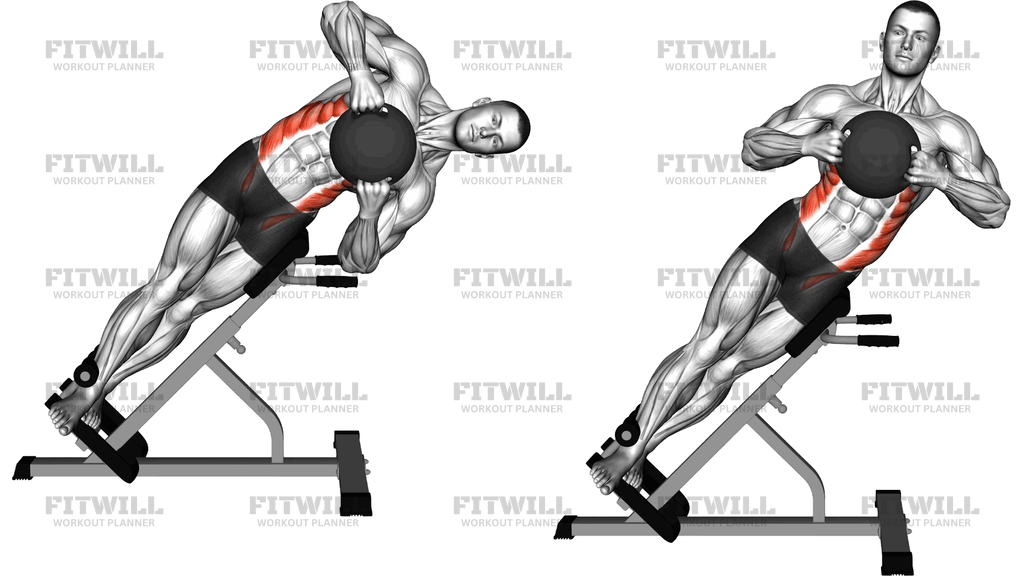
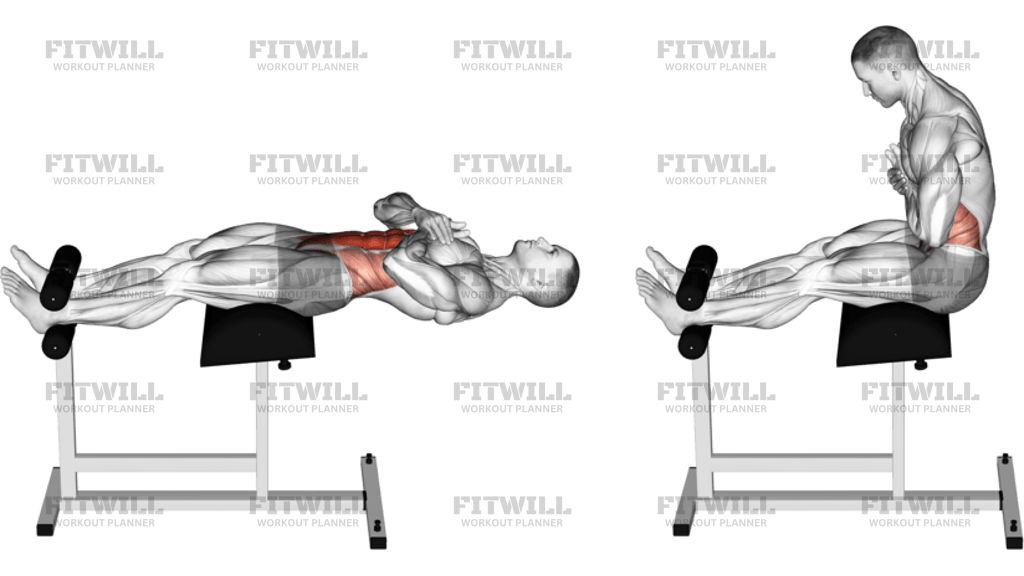
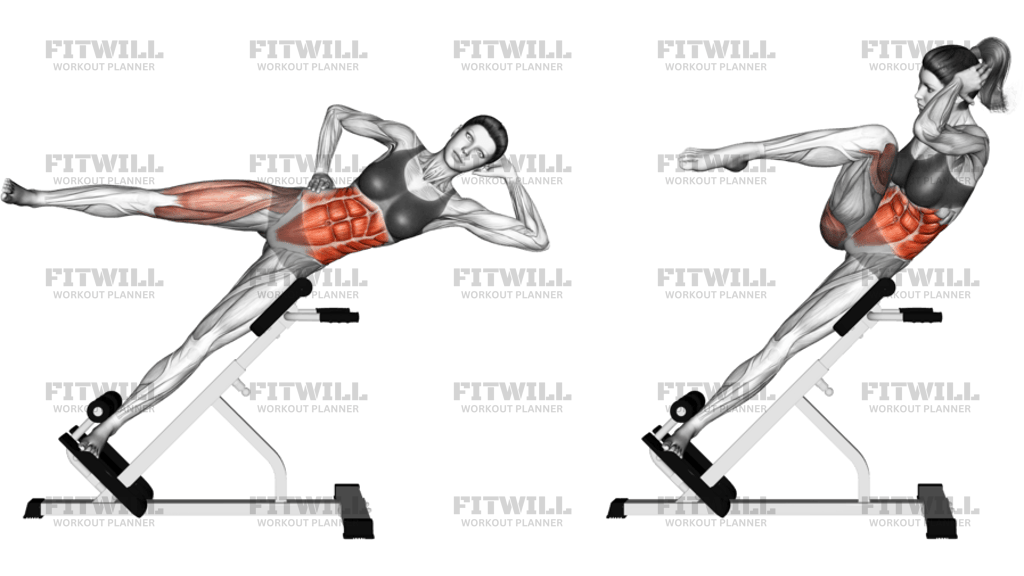
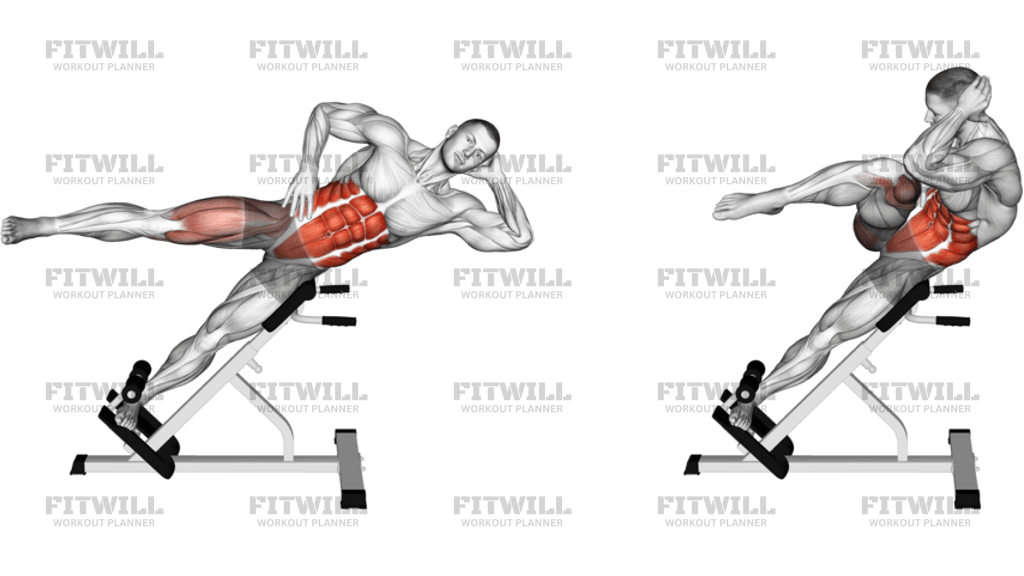
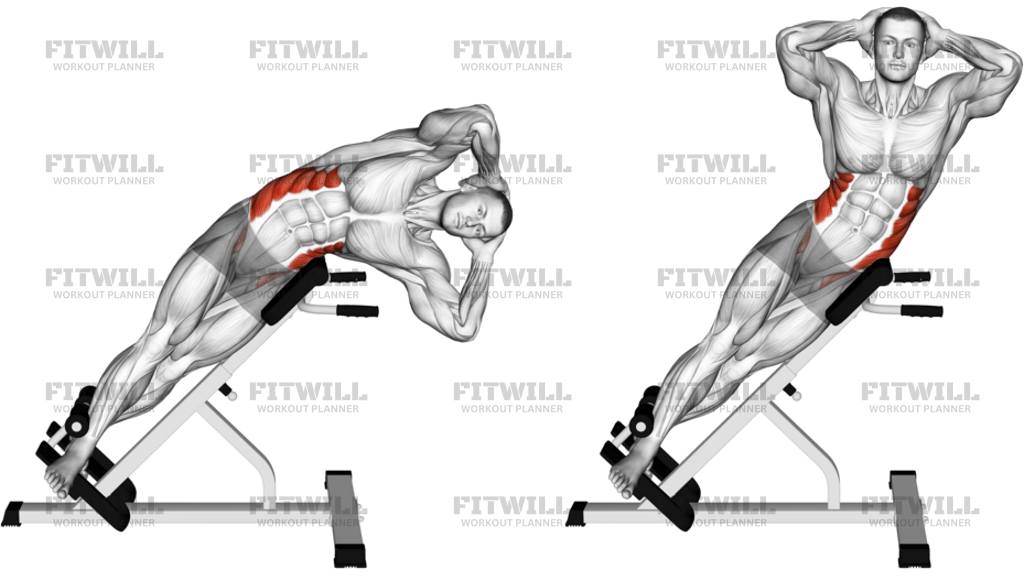
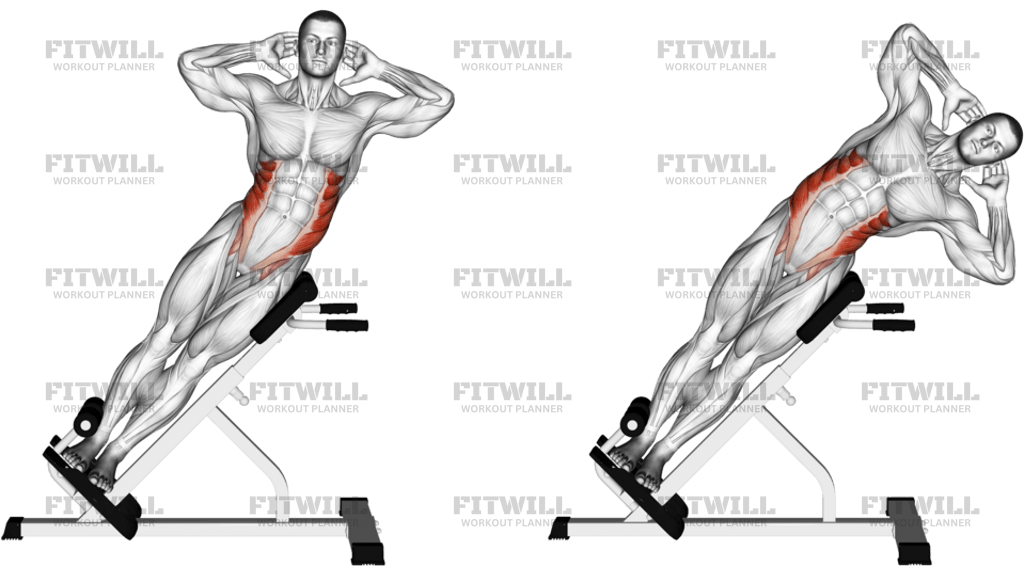
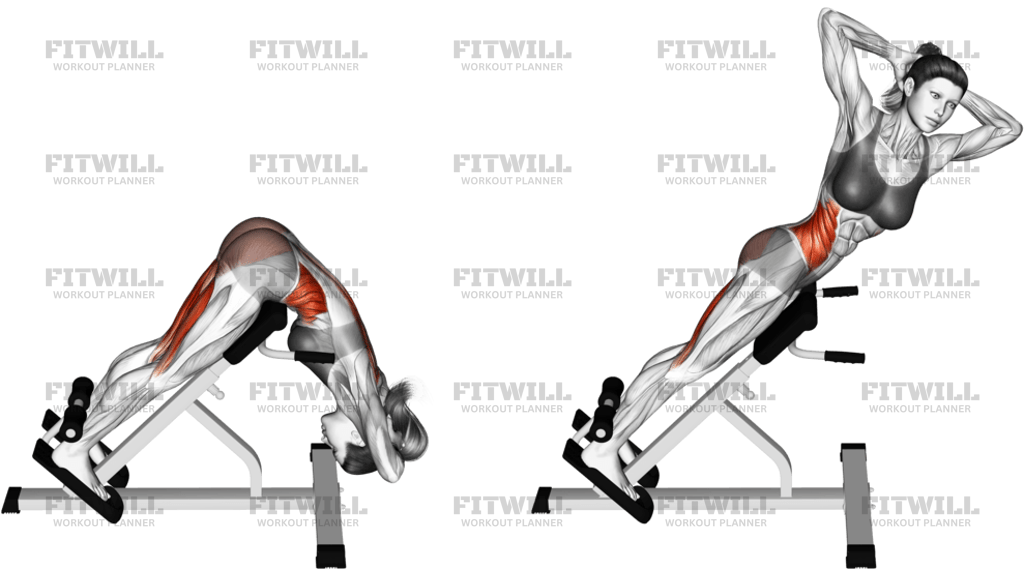
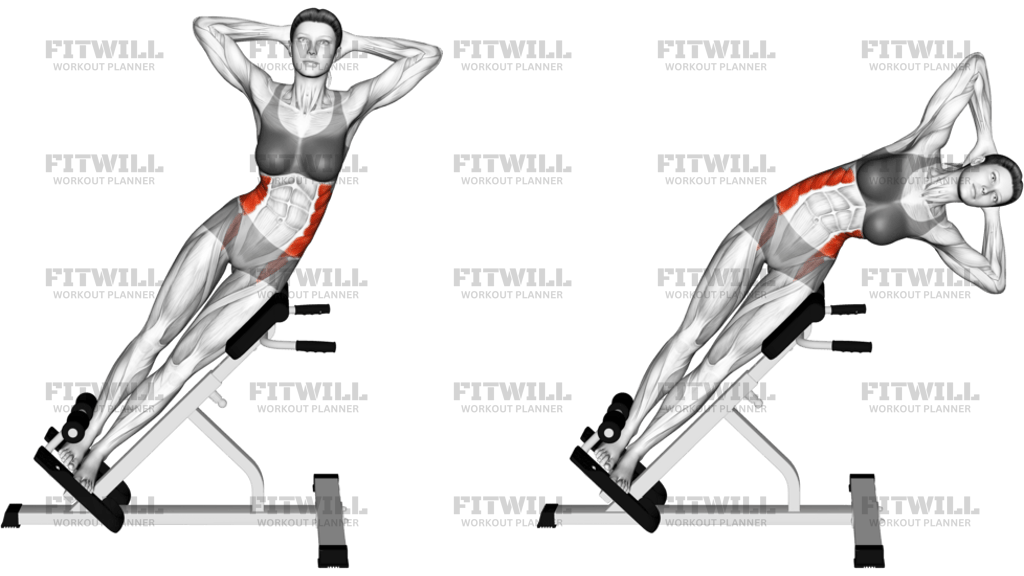
45 Degree Twisting Hyperextension
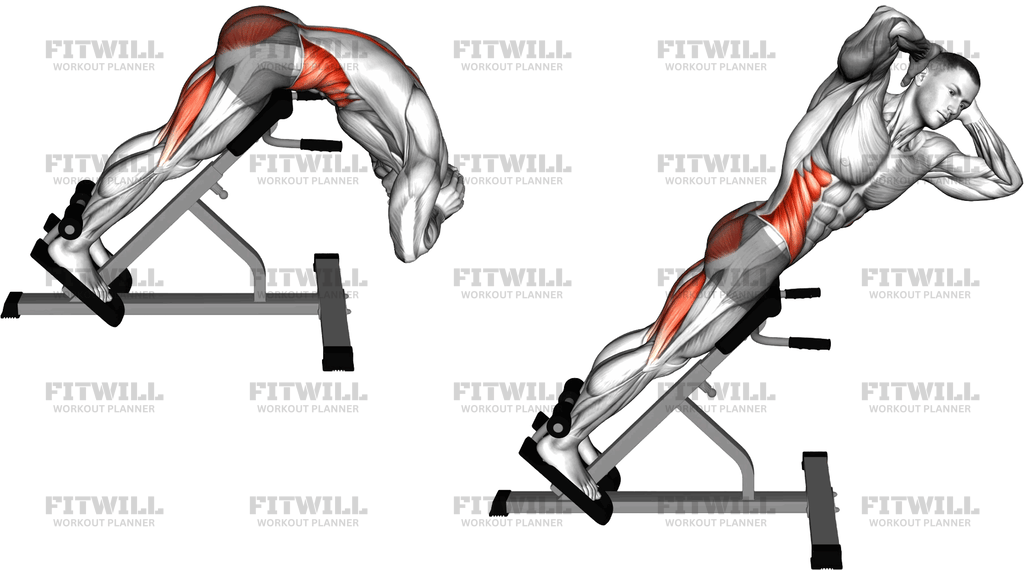
The 45 Degree Twisting Hyperextension is a back extension with a rotational element built into the top of the rep. You set up on a 45-degree hyperextension bench with your feet anchored on the platform and the top of your pelvis resting against the hip pad, then hinge down under control and rise back up to a straight body line. The twist comes at the finish: as you reach the top, you rotate your torso so one shoulder turns toward the ceiling, then alternate sides on later reps. Because you are working against gravity on an angled bench, even body weight alone provides meaningful resistance.
This movement trains the obliques directly through trunk rotation while the erector spinae, glutes, and hamstrings handle the extension itself. A standard back extension builds the posterior chain in a single plane; adding the twist makes the obliques work to both rotate the torso and control that rotation against the pull of gravity. That makes it a practical choice for anyone who wants rotational strength that carries over to swinging, throwing, or changing direction, rather than only flexion-based ab work done on the floor.
The setup matters more here than on most ab exercises. If the hip pad sits too high on your thighs, you lose range; if it sits too low and presses on your stomach, your lower back takes a compressed position at the bottom. Your feet should be flat against the platform with the ankle pads snug across the back of your lower leg, and your body should be able to fold cleanly at the hip joint. Small adjustments to pad height change how the whole movement feels, so take a minute to get it right before adding reps.
To execute it well, cross your arms over your chest or place your hands lightly behind your head without pulling on your neck. Lower your torso by folding at the hips, keeping your spine long rather than rounding deliberately, until you feel a mild stretch through the back of your legs. Drive the movement by squeezing the glutes and extending the hips until your body forms a straight line from head to heel, then rotate the upper torso as one piece so the ribs and shoulders turn together. Pause briefly at the top, breathe out, and lower back down with control before alternating to the other side on the next rep.
Common use cases include posterior chain warm-ups, core blocks after main lifts, and rotational conditioning for field and racket sports. Because the loading is modest and self-regulated, it suits beginners learning to hinge as well as experienced lifters who want higher-rep oblique work. The main safety point is restraint with range and speed: the twist should happen from the trunk with your hips still extended, not from cranking the neck or yanking the torso up with your hands. Stop short of positions where your lower back feels pinched, and progress reps gradually since rotated spinal work under fatigue is easy to rush.
[ Workout Log & Planner ]
Put your next workout in Fitwill
Keep your plan and training log ready when you are.


Instructions
- Adjust the hyperextension bench so the top of the hip pad lines up with your pelvis and your torso can fold forward freely at the hips.
- Place your feet flat on the foot platform with the backs of your lower legs braced against the ankle pads, and keep your knees almost straight.
- Position the top edge of the pad across your upper pelvis, not your stomach, then cross your arms over your chest or rest your hands lightly behind your head.
- Brace your midsection and squeeze your glutes before you start lowering, so your spine stays long instead of sagging.
- Hinge at the hips and fold your torso down toward the floor until you feel a light stretch through the hamstrings.
- Extend your hips by driving them into the pad and raising your torso until your head, hips, and heels form one straight line.
- At the top, rotate your upper torso as a single unit so one shoulder turns upward and back, keeping your hips facing forward and extended.
- Pause for a beat in the twisted position, exhale, then unrotate and lower your torso back down under control.
- Inhale on the way down, and on the next rep rotate to the opposite shoulder so the work stays balanced left to right.
- Complete your set, then carefully unhook one leg from the ankle pad and step off the bench.
Tips & Tricks
- A common mistake is pulling on the back of your head to force the rotation. Keep your fingertips resting rather than gripping, and let the obliques turn your ribs and shoulders instead.
- If you feel the hip pad digging into your stomach at the bottom, raise it slightly; a pad sitting too low turns the movement into a cramped, compressed hinge.
- Rotating before you finish extending steals work from the obliques. Reach the straight body line first, then twist, so the rotation happens on top of an extended hip position.
- Do not let your hips sag or drop sideways during the twist. If your pelvis rotates with your shoulders, the obliques stop doing the work—press both hips evenly into the pad throughout.
- Rushing the descent is the fastest way to lose form on this bench. Lower for two to three counts; the fold-down is where the hamstrings and spinal muscles get their controlled loading.
- Turning your neck independently of your chest strains the neck. Look at a point on the floor a few feet away as you descend, and let your gaze travel with your shoulders on the twist.
- Start with a smaller twist angle for the first few sessions. Full rotation is easy to overshoot when fatigued, and the obliques respond to controlled range, not maximum range.
- If body weight feels too easy, hug a small weight plate to your chest rather than holding it behind your head, where it drags on the neck and shoulders.
- Keep your knees mostly straight but never locked hard; a slight softness in the knee lets you hinge at the hips instead of sinking through the lower back.
Frequently Asked Questions
What muscles does the 45 Degree Twisting Hyperextension work?
The obliques drive the twisting portion, while the erector spinae, glutes, and hamstrings handle the extension. The lower back and glutes remain active throughout because they hold your body in the extended position while the rotation occurs.
How is the 45 Degree Twisting Hyperextension different from a regular back extension?
A regular back extension moves your torso in one plane straight up toward your body line. This version adds a torso rotation at the top of each rep, which turns it into a combined posterior chain and oblique exercise.
Should my hands be behind my head or crossed on my chest?
Either works, but crossed arms are easier to keep honest because you cannot pull on your neck. If you place your hands behind your head, keep the fingers light and let the trunk rotation do the work.
How far down should I lower my torso?
Lower until you feel a gentle stretch through the hamstrings and your torso hangs roughly perpendicular to your legs. Going deeper usually just rounds the lower back under gravity without adding benefit.
Do I twist during the lowering phase or only at the top?
Twist only at the top, once your hips are fully extended and your body forms a straight line. Rotating on the way down encourages spinal rounding and makes the obliques work from a weaker position.
Is this exercise suitable for beginners?
Yes, as long as the bench is set up correctly and the rotation starts small. Beginners often benefit from doing standard 45-degree hyperextensions first to learn the hip hinge, then adding the twist once the hinge feels stable.
Why do my hamstrings fatigue more than my abs on this exercise?
The hamstring involvement is expected because they control the fold-down and help extend the hips back up. If they dominate completely, you may be flexing and extending your knees slightly instead of hinging purely at the hips.
Can I add weight to the 45 Degree Twisting Hyperextension?
You can hold a small plate or dumbbell against your chest once strict body weight reps feel easy. Skip weighted versions if your rotation speed or control drops, since added load magnifies any sloppiness in the twist.
What can I use if I do not have a hyperextension bench?
A stability ball braced against a wall with your feet hooked under something stable can approximate the setup, though the angle is shallower. For the rotational element alone, standing cable or band rotations are a reasonable substitute.
How many reps should I do, and how should I alternate sides?
Rep ranges of 10 to 20 per side work well since the load is relatively light. Alternate the twist on every rep rather than finishing all reps on one side, so both obliques stay equally fresh and evenly loaded.