Dumbbell Decline Shrug
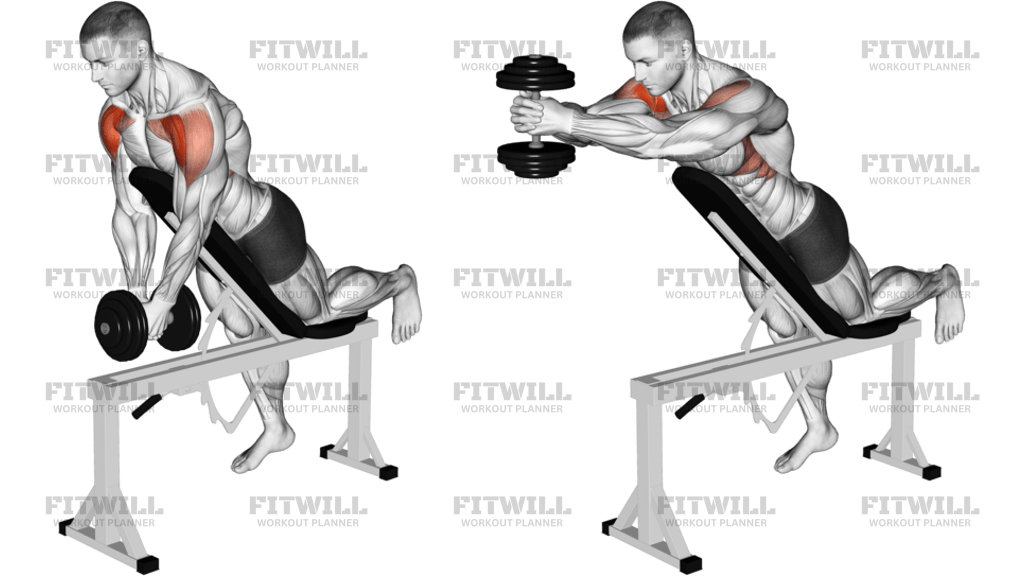
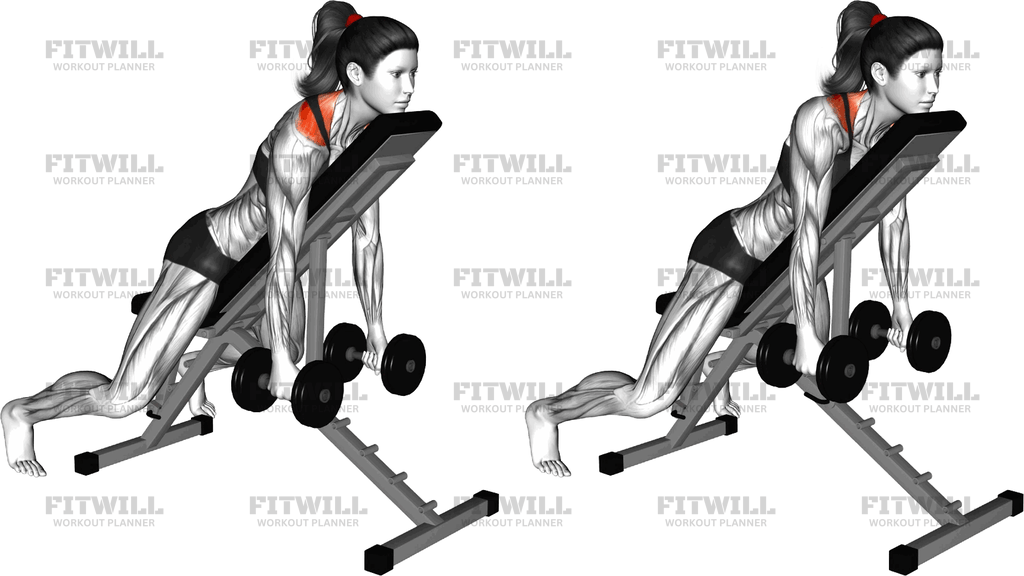
The Dumbbell Decline Shrug is a chest-supported trap exercise performed while lying face-down on an angled bench with a dumbbell in each hand. Because the bench takes your body weight off your feet and locks your torso in place, the only job left for your shoulders is to shrug the dumbbells straight up toward your ears. The highlighted area in the movement is the upper trap, the diamond-shaped muscle that runs from the base of your skull and neck out to your collarbone and down into your upper back.
The main advantage of this setup over a standing dumbbell shrug is stability. In a standing version, gravity pulls the dumbbells straight down and your lower back and legs are quietly working to keep you upright. Here, your torso is supported along the pad, so the traps get consistent tension through a fixed line of pull, and there is far less temptation to bounce or use momentum. It also makes the exercise friendlier for people who find standing shrugs hard on their lower back.
This is a useful exercise for anyone who wants to build the top of the traps, whether for a fuller look across the shoulders and neck or for more strength in pulls, carries, and overhead work. It suits lifters at most experience levels because the movement is short and simple, yet the chest-supported position makes it easy to feel the muscle working without a lot of coaching. It also works well as a finisher after rows or deadlifts when the traps are already warmed up.
Setup matters more here than it looks. Your chest should rest firmly on the pad with the bench angled so your arms hang roughly perpendicular to the floor, and your feet should be planted wide enough to keep you stable on the bench. If your arms drift behind your body or the dumbbells swing, tension leaks away from the traps and your shoulder joint takes the stress instead. Keep the head neutral rather than craning it up as you lift.
Execution is deliberately small: a straight up-and-down shrug with almost no elbow bend. You lift by elevating your shoulder blades toward your ears, pausing briefly at the top, and lowering the dumbbells until your traps feel a full stretch at the bottom. Because the range is short, the temptation is to turn it into a fast, jerky pump movement, and that is where most of the benefit is lost. Slow, controlled reps with a genuine pause at the top will beat heavy, bouncy reps every time.
A few practical points keep this exercise safe and productive. Choose dumbbells you can hold for the whole set, since grip often gives out before the traps do. Keep your chin slightly tucked and your forehead off the pad so your neck stays in a neutral line. And never roll your shoulders backward or forward during the shrug; the path is vertical, plain and simple.
[ Workout Log & Planner ]
Put your next workout in Fitwill
Keep your plan and training log ready when you are.


Instructions
- Set an adjustable bench to a decline or low incline angle and position it so that when you lie chest-down on the pad, your arms will hang straight toward the floor on either side.
- Hold a dumbbell in each hand with a neutral grip (palms facing your body) and lie prone on the bench, chest and upper abdomen supported on the pad.
- Place your feet on the floor on either side of the bench, braced wide enough to stop your hips from shifting during the set.
- Let your arms hang fully extended below your shoulders, elbows straight, and allow the dumbbells to pull your traps into a gentle stretch before you start.
- Keep your chin slightly tucked and your neck in line with your spine; do not lift your head to watch your hands.
- Exhale and shrug the dumbbells straight up toward your ears by elevating your shoulder blades, keeping your arms relaxed and your elbows locked out.
- Pause for a beat at the top of the shrug and squeeze the traps hard before descending.
- Lower the dumbbells under control until your shoulders drop back to the full starting stretch, and breathe in as they settle.
- Reset your grip and brace briefly at the bottom before starting the next rep, keeping the path vertical and free of swinging.
- Finish the set by standing up from the bench carefully or setting the dumbbells on the floor before moving off the pad.
Tips & Tricks
- The most common mistake is bending the elbows and turning the shrug into a partial row; your elbows should stay straight the entire time so the traps, not the arms, do the lifting.
- If your shoulders creep forward and start rolling at the top, you are circling instead of shrugging. Picture your shoulder blades rising straight up toward your ears, not rotating.
- Watch for the chin lifting off toward the pad as the weight gets heavy. A neutral neck keeps tension on the traps and keeps the smaller neck muscles out of trouble.
- Because your chest is supported, you do not need to fight your own body weight, so err on the side of a controlled tempo: about one second up, one-second squeeze, two seconds down.
- Grip fatigue is the usual reason a set of shrugs falls apart. A firm but not crushing grip, or lifting straps for your heavier sets, keeps the focus on the traps rather than your forearms.
- Do not let the dumbbells drift behind your torso as you lift. If they swing toward your hips, your arms are no longer vertical and the shrug line changes; reset with the dumbbells directly under your shoulders.
- A short pause at the bottom, with the traps stretched rather than immediately re-shrugging, makes each rep noticeably harder and more effective than rushing through the range.
- If your chest slides on the pad or your hips rock, widen your foot stance or drop the weight before anything else; instability usually means the load is too heavy, not that your setup is wrong.
Frequently Asked Questions
Which muscles does the Dumbbell Decline Shrug work?
The upper trapezius is the primary mover, with the middle traps and levator scapulae assisting as your shoulder blades elevate. Your forearms and grip work isometrically to hold the dumbbells throughout the set.
How is the Dumbbell Decline Shrug different from a standing dumbbell shrug?
In the decline version your torso is supported on the angled bench, which removes the demand on your legs and lower back to stabilize you. That fixed position keeps the line of pull consistent and makes it easier to isolate the traps without momentum.
Is the Dumbbell Decline Shrug suitable for beginners?
Yes. The movement pattern is simple and the chest-supported position gives beginners feedback, since it is easy to feel when the traps are actually lifting the weight. Start light and prioritize the pause at the top over load.
How heavy should the dumbbells be for the Dumbbell Decline Shrug?
Pick a weight you can lower slowly for every rep without your chest lifting off the pad or the dumbbells swinging. Grip strength often gives out before the traps, so if your hold fails mid-set, reduce the load or use lifting straps.
Should my elbows bend during the Dumbbell Decline Shrug?
No. The elbows should stay straight throughout, because bending them shifts the work toward the arms and back muscles and shortens the trap's stretch. If your elbows keep bending, the weight is too heavy.
Why do I feel the Dumbbell Decline Shrug in my neck?
The levator scapulae and smaller neck muscles sit right alongside the upper traps and assist in elevation, especially when the head juts forward. Keep your chin slightly tucked and your head neutral so the trap, not the neck, drives the lift.
How many sets and reps should I do?
Because the range is short and the muscles respond well to time under tension, two to four sets of 10 to 15 controlled reps with a pause at the top works well. Use it after your main pulls or rows rather than as a first exercise.
What can I use instead of the Dumbbell Decline Shrug if I have no bench?
A standing dumbbell shrug or a cable shrug with the handle set low are the closest substitutes. You lose the chest support, so focus extra attention on keeping your torso still and avoiding momentum.
Is it safe to do the Dumbbell Decline Shrug with a history of neck or lower back discomfort?
The supported torso and neutral neck make this one of the gentler shrug variations, but you should still check with a qualified professional before loading it if you have ongoing discomfort. Start with light dumbbells and a slow tempo to confirm the movement feels comfortable.