Long Plank Against Wall
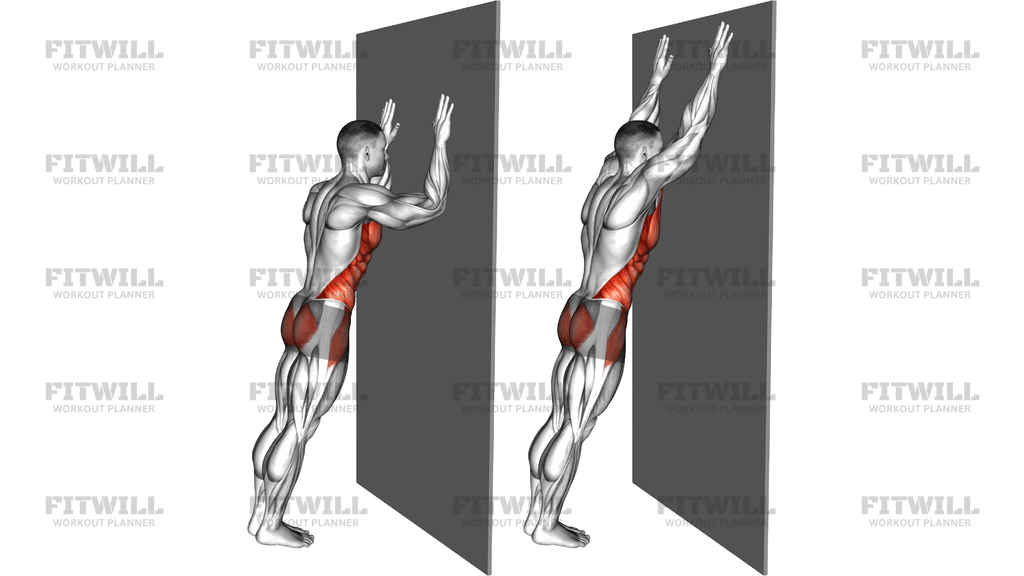
The Long Plank Against Wall is an inclined core exercise where you hold a straight, rigid plank position with your hands braced against a wall and your feet set well back from it. Because the wall takes a large share of your body weight, this is one of the most approachable ways to train the plank pattern while still demanding real tension through the abdominals, obliques, and glutes. The further your feet walk away from the wall, the longer the lever becomes and the harder your core has to work to keep your body in one straight line from head to heels.
What makes this version distinct from a floor plank is the angle. Your body is tilted, your arms press back into the wall, and your shoulders and triceps work isometrically to keep you from folding forward. The glutes and quads stay engaged to hold hip extension, while the deep core braces to stop your lower back from sagging. The wall also gives you instant feedback: if your brace softens, your body position changes against the wall immediately, so faults are easy to feel and correct.
This exercise suits beginners building their first solid plank, intermediate lifters who want a higher-volume core finisher without loading the spine on the floor, and anyone returning from a layoff who needs a joint-friendly anterior core drill. It is also a practical option when no mat is available, since everything happens standing at a wall. Office workers and home trainees appreciate that it needs nothing but a clear stretch of wall and about two square meters of floor.
Setup matters more than most people expect. Hand height determines your incline: hands at chest height creates a steeper, easier angle, while hands lower toward waist height lengthens the lever and increases the load on the abs. Your feet should be far enough back that your body forms one long diagonal, not a pike and not a sag. The elbows stay soft but not locked, the shoulders press down away from the ears, and the ribs stay stacked over the pelvis.
To execute it well, set your hands, walk your feet back until the body is straight, then squeeze the glutes and brace the abdominal wall as if bracing for a light push to the stomach. Hold that position with steady breathing, pushing the wall away the entire time. If you want a dynamic version, you can slowly slide the hands up the wall toward overhead and back down, which shifts more demand onto the shoulders and upper core while the brace never changes.
The main safety points are simple: stop if you feel pressure in the lower back rather than the abs, keep the wrists stacked under firm contact with the wall, and progress by stepping the feet further back or lowering the hand position gradually rather than jumping to a maximal angle. Quality of the brace always beats duration.
[ Workout Log & Planner ]
Put your next workout in Fitwill
Keep your plan and training log ready when you are.


Instructions
- Stand facing a clear, sturdy wall and place both palms flat against it at chest height, slightly wider than shoulder width, with fingers pointing up.
- Walk your feet backward until your body forms one straight diagonal line from head to heels, with your weight pressing into the wall through your palms.
- Set your feet about hip-width apart and shift your weight onto the balls of your feet so your heels are not collapsed.
- Press the wall away with your hands and pull your shoulders down away from your ears so your upper back stays wide, not shrugged.
- Squeeze your glutes and brace your abdominal wall firmly so your ribs and pelvis stay stacked and your lower back does not arch.
- Hold this long plank position, keeping the diagonal line intact; your head stays in line with your spine, eyes on the wall just above your hands.
- Breathe steadily through the hold, inhaling through the nose and exhaling without letting the brace relax.
- For the sliding variation, slowly walk your hands up the wall until the arms are nearly overhead, keeping the hips extended and the body straight, then slide back down to the starting hand height with control.
- When finished, walk your feet forward toward the wall one step at a time and stand up before releasing the brace.
Tips & Tricks
- The most common mistake is letting the hips sag toward the wall, which turns the drill into a lower-back hang. Fix it by squeezing the glutes and tucking the tailbone slightly before you even begin the hold.
- If your wrists ache, your hand position is usually too low for your current angle. Raise the hands on the wall or bring the feet closer in to reduce the load before blaming wrist mobility.
- Do not lock the elbows and sink into the joints. Keep a small bend and actively push the wall away, as if trying to slide it backward.
- Shrugging the shoulders toward the ears is a fatigue sign in this setup. Reset the shoulder blades down and wide before the next set instead of grinding through a collapsed position.
- Progress by distance, not time alone. Moving your feet back two to three inches per week is a more reliable progression than extending a sloppy hold.
- Check your line in a side mirror or record a short video. From the inside, a pike often feels like perfect form because the abs stop working as hard.
- On the overhead slide, move slowly. Rushing the hand path turns the exercise into a shoulder swing and lets the ribs flare forward, losing the abdominal brace.
- If you feel it mainly in the front of the shoulders rather than the core, your hands are likely pressing too low or your feet are too far back for your current strength.
- Keep the neck long by looking at the wall just above your hands rather than craning up to the ceiling or dropping the chin to the chest.
Frequently Asked Questions
What muscles does the Long Plank Against Wall work?
The primary work comes from the abs, especially the deep core that holds the ribs and pelvis stacked. The obliques, glutes, and front shoulders assist isometrically, and the triceps help as you press into the wall.
How is the Long Plank Against Wall different from a regular floor plank?
Your body is inclined and your hands are elevated, so the wall carries part of your weight, making it easier on the shoulders and lower back. The angle also lets you adjust difficulty precisely by moving your feet or changing hand height.
Is the Long Plank Against Wall good for beginners?
Yes, it is one of the best starting points because the incline can be scaled from very easy to quite demanding. Beginners should start with hands at chest height and feet close enough to hold a clean line for 20 to 30 seconds.
How far should my feet be from the wall?
Far enough that your body forms one straight diagonal from head to heels, but no further. If you cannot keep your hips extended and your lower back neutral, walk the feet closer in.
Why do my lower back and not my abs fatigue during the Long Plank Against Wall?
That usually means the brace has relaxed and the hips are sagging toward the wall. Squeeze the glutes, tuck the pelvis slightly, and shorten the distance to the wall until the abdominals do the holding.
Can I do the overhead hand slide in every set?
You can, but keep it slow and controlled, since the extended-arm position shifts more load to the shoulders. If your shoulder position or brace breaks down, finish the set at the fixed hand height instead.
What can I use if I do not have a clear wall?
Any firm, vertical surface works, such as a sturdy door, a squat rack upright, or a stable counter edge. Avoid glass partitions or anything that slides or flexes under pressure.
How long should I hold the Long Plank Against Wall?
Aim for holds of 20 to 45 seconds with a fully intact brace rather than chasing minute-long sets. When form starts to slip, end the set, rest, and repeat.
Is this exercise safe for the wrists?
Generally yes, because the incline reduces the wrist load compared to a floor plank. If you still feel discomfort, place your hands slightly higher on the wall, spread the fingers wide, and keep the weight spread across the whole palm.