Ring Support Hold
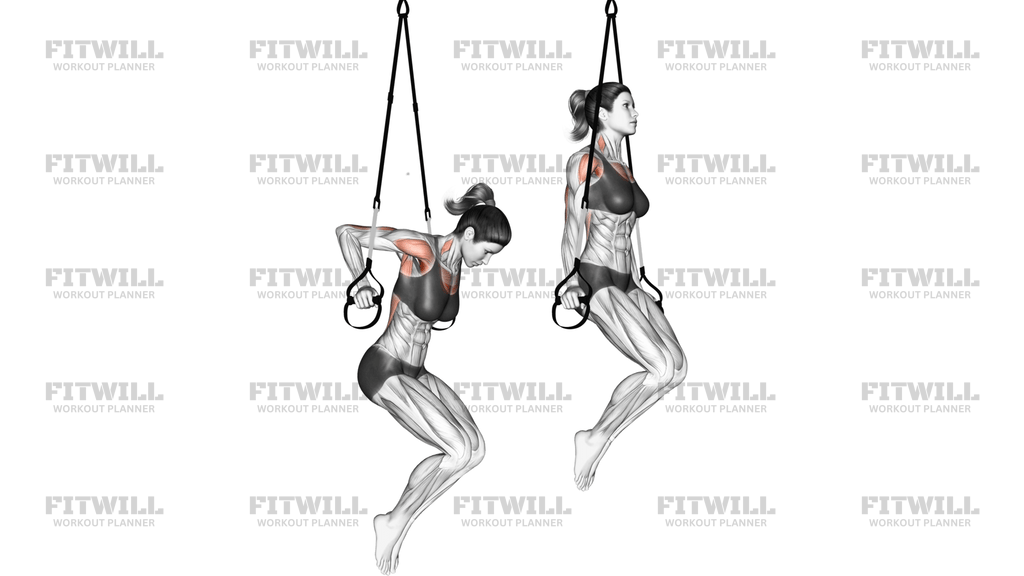
The Ring Support Hold is an isometric gymnastics exercise where you hold yourself locked out on top of gymnastic rings with straight arms, shoulders pressed down, and your body suspended over the floor. It looks deceptively simple, but because the rings are unstable and free to swing in any direction, every muscle from your hands to your hips has to work continuously just to keep you still.
This movement is the foundation for all ring dipping work. Before anyone attempts a Ring Dip, they need to be able to hold a solid support position for a meaningful amount of time, because the top of every dip starts and ends here. It is also a valuable exercise in its own right for building straight-arm strength, shoulder stability, and the kind of chest and triceps tension that is hard to replicate on fixed bars or parallel bars.
The main muscles under load are the chest, triceps, and front delts, which work to keep the rings pulled in toward your sides and your torso from drifting. The abs and hip flexors hold your legs and pelvis in line so you do not pike or arch, while the forearms and grip handle the constant small corrections the rings demand. Because everything is isometric, the tension is steady and joint-friendly when the position is set up correctly.
Setup matters more here than in most holds. The rings should hang at a height that lets your hands lock out at hip level with your feet clear of the floor. Grip the rings with your knuckles facing forward or slightly turned out, then actively turn the rings so your palms drive down and slightly outward. Press the rings together toward your midline, pull your shoulders down away from your ears, and keep your chest tall. That locked, hollow-body line is what keeps the rings from flying apart or rotating under you.
A common beginner mistake is sagging into the shoulders or letting the rings drift wide, which dumps stress into the elbow and shoulder joints. Start with shorter holds, keep your legs together and slightly in front of you if that helps you balance, and only extend hold time as your control improves. If you cannot yet hold a full support position, practicing with your toes lightly touching the floor or using lower rings to reduce the load are both reasonable progressions.
Expect to use the Ring Support Hold as a warm-up skill before dips, a standalone stability finisher, or a benchmark hold to test your readiness for harder ring skills. Most people find that thirty seconds of a clean, quiet hold is far more demanding than a minute of a sloppy one, so prioritize stillness over duration.
[ Workout Log & Planner ]
Put your next workout in Fitwill
Keep your plan and training log ready when you are.


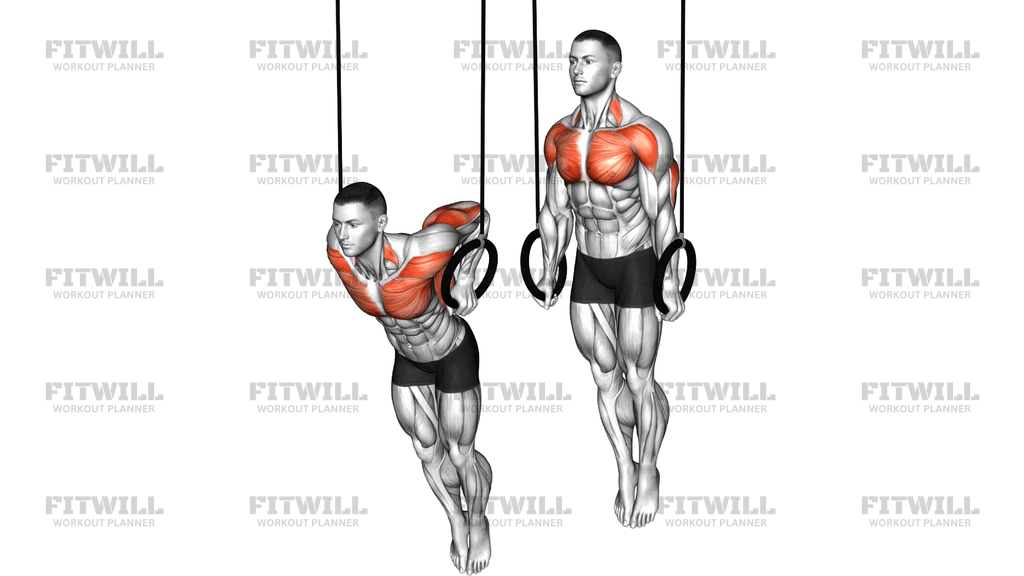
Instructions
- Set the rings so that when you stand underneath them and grip them, your arms lock out straight at roughly hip height with your feet just off the floor.
- Grip each ring firmly with your thumb wrapped around it, and step or jump up so your arms are fully extended and your body hangs in support above the floor.
- Press the rings down and slightly inward so they angle toward each other, with your palms driving down and your elbows locked straight.
- Pull your shoulder blades down away from your ears and lift your chest so you do not sink into your shoulders.
- Brace your abs, squeeze your glutes, and bring your legs together with your toes pointed, holding your body in a slight hollow position with feet a little in front of your hips.
- Keep your wrists stacked over the rings and your forearms quiet; if the rings shake or drift apart, tighten your grip and press them back toward your midline.
- Breathe in a slow, steady rhythm through your nose while holding, rather than holding your breath.
- Hold for your target time while keeping the rings stable and your chest tall, without swinging or piking at the hips.
- When you finish, lower down in a controlled way by bending your elbows slightly and lowering to the floor, or step your toes down before letting go.
- Reset your grip and stance before the next hold, and rest long enough that your shoulders and grip are fresh again.
Tips & Tricks
- If the rings splay outward as you fatigue, it usually means your chest and triceps are losing the press; consciously push them toward each other rather than just hanging on.
- Sinking into your shoulders so your ears get close to them is the most common fault in this hold. Keep tension by actively pressing down and lifting your chest the entire time.
- Keep a slight bend-free lockout at the elbows. Soft elbows turn a support hold into an endurance test for your arms and take the stress off the position you are trying to build.
- Point your toes and squeeze your legs together. Loose legs create swing, and swing on rings is what makes the hold twice as hard and shaky.
- Keep your gaze forward or slightly down, not up. Looking at the ceiling tends to arch your lower back and push your feet behind your hips.
- If your grip fails before your shoulders do, use lower rings so you can step your toes down for brief resets instead of dropping out of the hold entirely.
- Stop the set as soon as the rings start rattling or your body twists. Quality stillness is the training stimulus; grinding through a shaking hold mainly teaches bad habits.
- Chalk your hands if the rings get slick, especially as hold times pass twenty seconds and sweat becomes a factor.
- Progress by time in small jumps, adding only a few seconds per week, since isometric shoulder endurance builds steadily but overreaching shows up quickly as joint soreness.
Frequently Asked Questions
Which muscles does the Ring Support Hold work the most?
The chest, triceps, and front delts do most of the work of pressing the rings down and holding them together, while the abs, hip flexors, and forearms stabilize your body and grip. Everything works isometrically, so the tension is constant rather than moving through a range.
How long should I be able to hold the Ring Support Hold before trying Ring Dips?
A common benchmark is a comfortable, stable hold of thirty seconds or more. If your rings shake or drift apart before that, your dips will be unstable and you will lose energy at the top of every rep.
Should my elbows be fully locked out during the Ring Support Hold?
Yes, straight arms are the standard for a support hold, because it trains true straight-arm strength and keeps the load on your chest, shoulders, and triceps instead of tiring your arms early. Keep them locked without hyperextension discomfort.
Why do the rings want to fly apart when I hold the support position?
The rings rotate freely, so without an active inward press they roll outward under your weight. Push your palms down and slightly toward each other and think about turning the rings so they angle in toward your hips.
Can beginners do the Ring Support Hold?
Yes, with adjustments. Use lower rings and let your toes lightly touch the floor to take some load off, or start with five to ten second holds and build up gradually rather than fighting a long, shaky hold.
Is it normal for my shoulders to shake during the Ring Support Hold?
Some shaking is normal when you are new, since the small stabilizing muscles around your shoulders are learning the job. If the shaking comes with pain or the rings start drifting wide, end the set and rest.
What can I substitute if I do not have rings?
A support hold on parallel bars or dip bars is the closest substitute, though it is easier because the bars are fixed. To keep some of the instability benefit, you can hold the position on two kettlebells or push-up handles placed on the floor.
How do I keep my legs in the right position during the hold?
Squeeze your legs together, point your toes, and keep your feet slightly in front of your hips with a gentle hollow through your torso. This counterbalances the slight backward lean of your shoulders and stops you from swinging.
Is the Ring Support Hold safe for my elbows and shoulders?
When your shoulders stay pressed down, your elbows stay locked, and the rings are pressed inward, the hold is generally well tolerated. Stop if you feel sharp joint pain, and build hold times gradually rather than maxing out early.