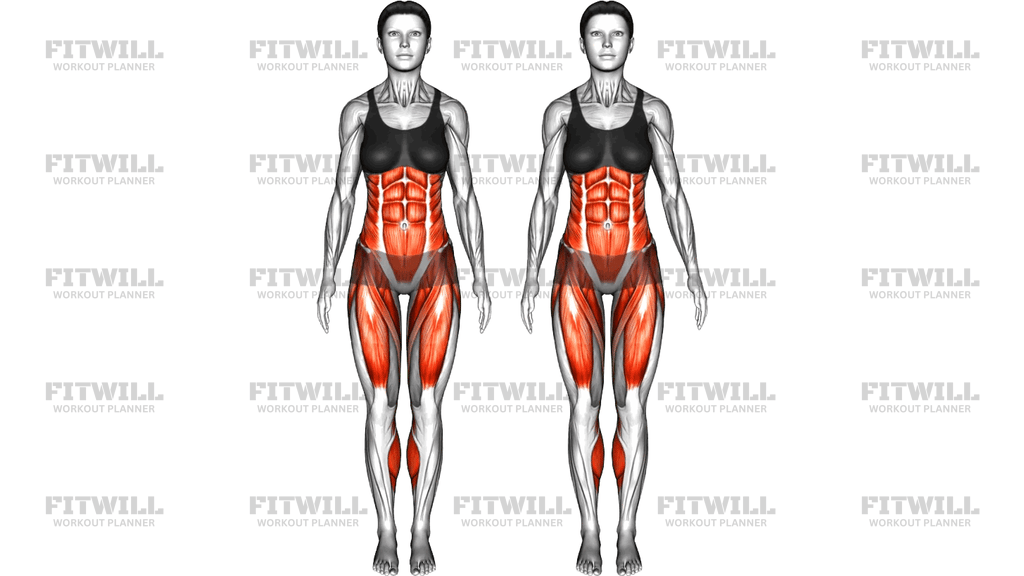
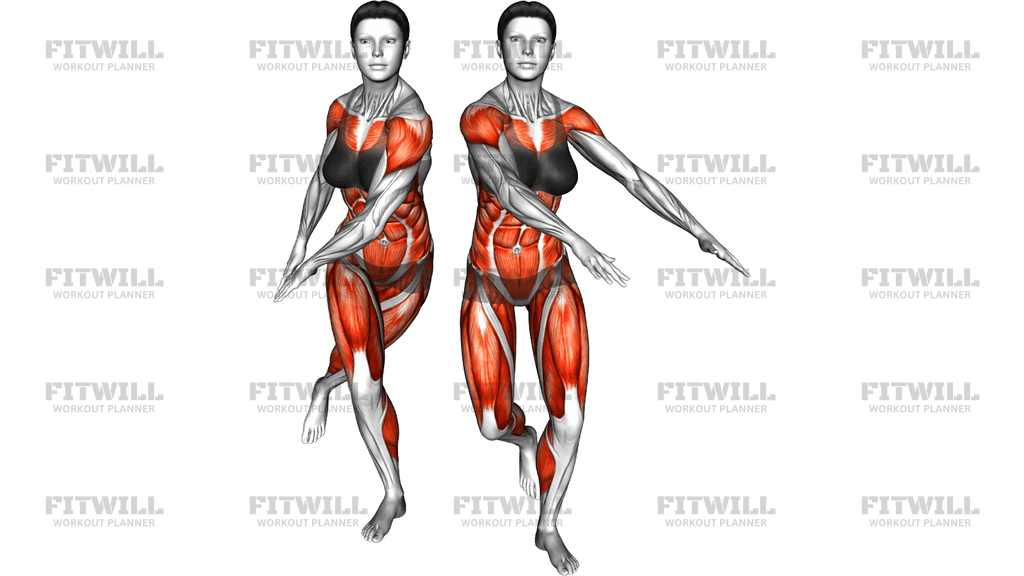
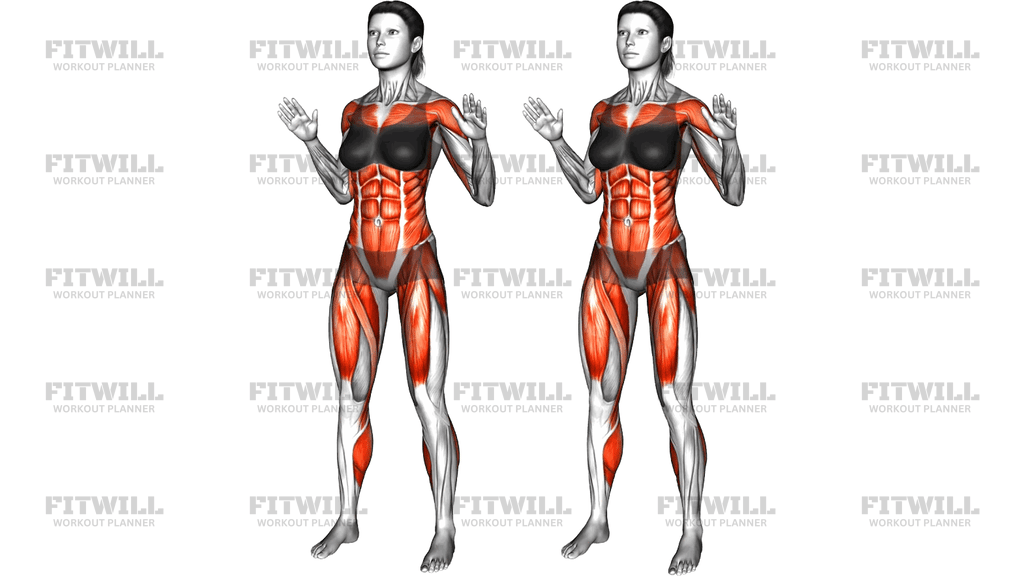
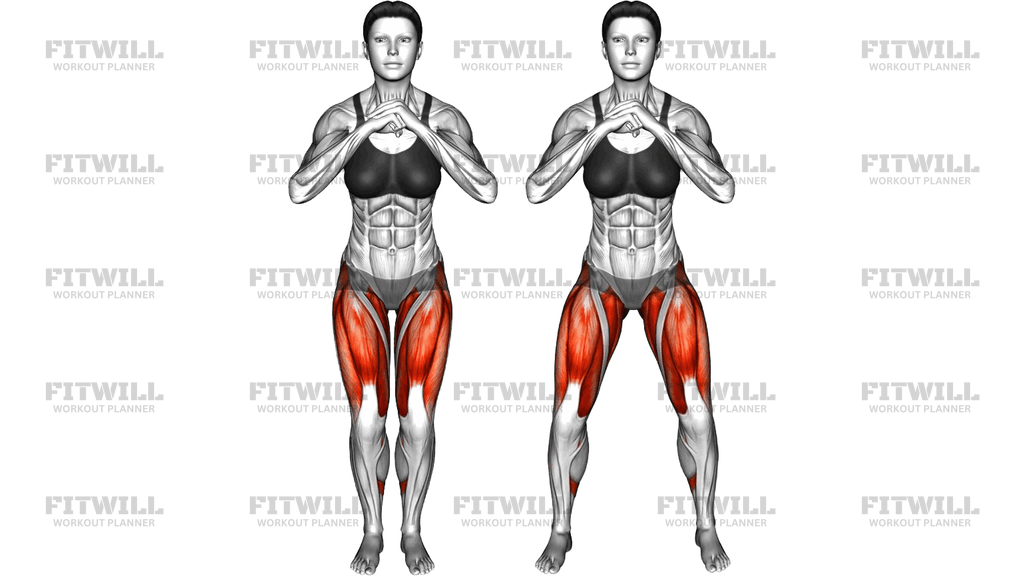
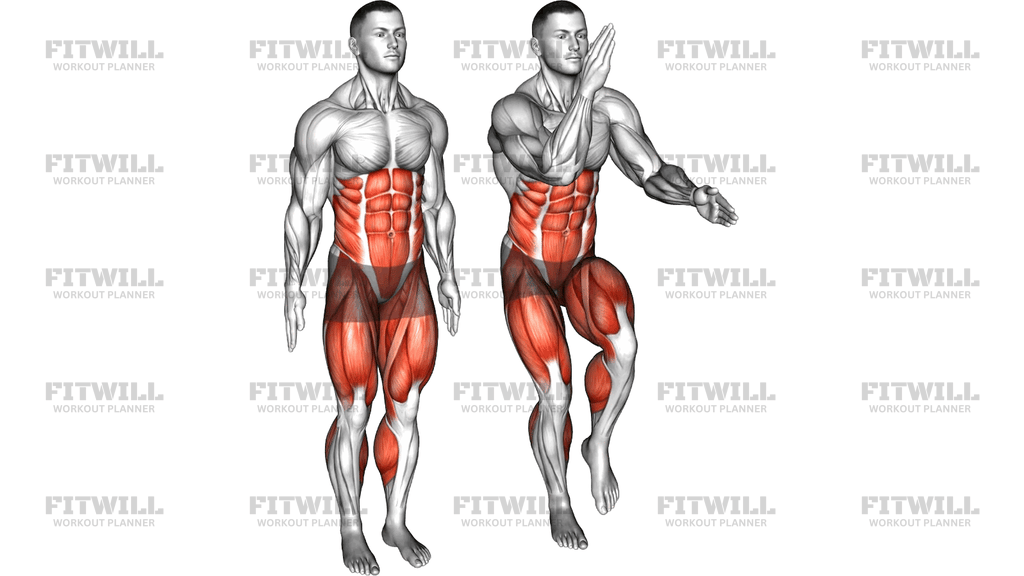
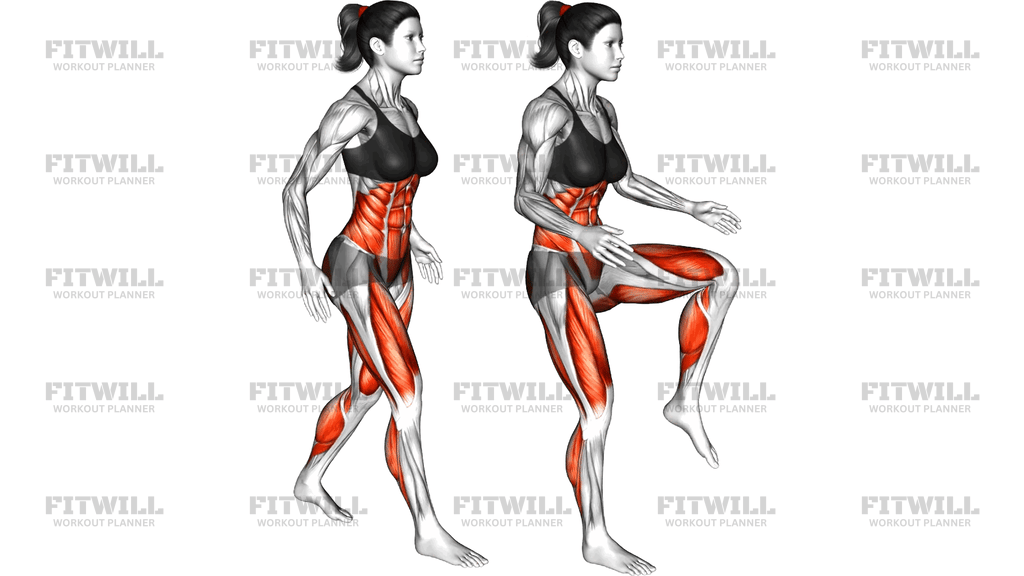
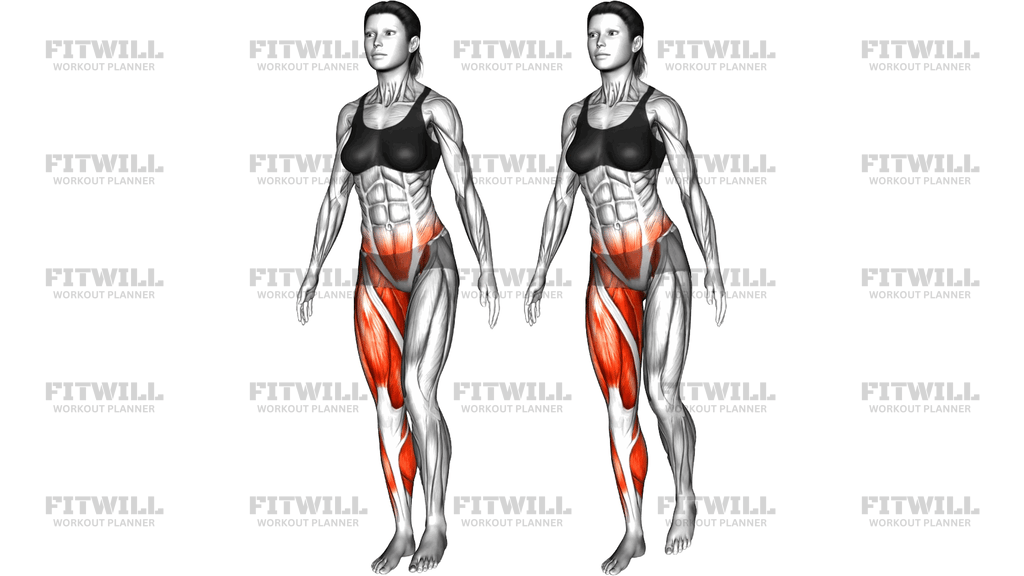
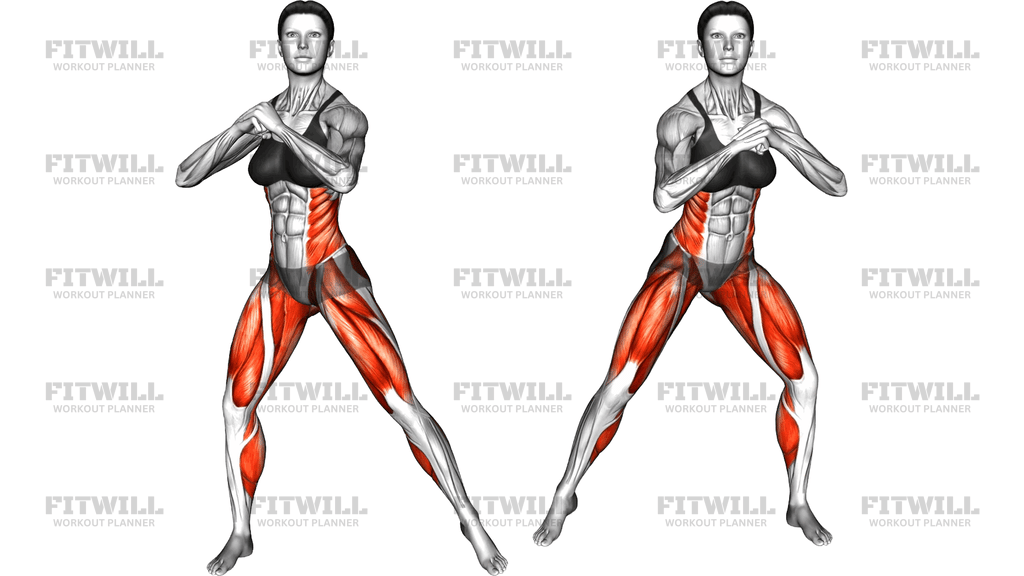
Reverse Lunge Forward Lunge
The Reverse Lunge Forward Lunge is a bodyweight lunge combination where you step one leg back into a reverse lunge, then without resetting your feet, drive that same leg forward into a forward lunge before returning to standing. Your hands stay clasped at chest height throughout, which keeps the load on your legs and forces your torso to do the stabilizing work. Because both lunge directions are linked into one continuous rep, the working leg never gets a real rest between the eccentric and concentric portions.
This movement is useful for anyone who wants to build unilateral leg strength without equipment. It is especially good for targeting the quads, since both the back-step and the forward-step place a strong knee-extension demand on the front leg, while the glutes and hamstrings handle hip extension. The constant switching of direction also challenges balance and the small stabilizing muscles around the hip, knee, and ankle far more than a standard forward lunge does.
Setup matters more than people expect. Because you are transitioning from a backward step to a forward step on the same leg, your foot placement has to stay consistent — if the foot lands wide or drifts off-line on the second lunge, the knee tracks inward and the rep loses quality. Keep your feet hip-width apart at the start, step straight back, and step straight forward along the same line. Your torso should stay tall with the chest up; leaning forward turns the movement into a different hip-dominant pattern.
To execute it well, think of the front knee as the hinge for both halves of the rep. In the reverse lunge, drop until both knees reach roughly 90 degrees, then push through the front heel to bring the back leg forward and immediately lower into a forward lunge on that same leg. The transition should be smooth rather than rushed — control the descent in both directions and let the muscles, not momentum, move you. Exhale as you drive up out of each lunge and inhale as you lower.
This combination works well as a main lower-body exercise in home workouts, as a warm-up activation drill before squats, or as a finisher when you want to accumulate leg volume without weights. Complete all reps on one leg before switching, or alternate legs rep by rep depending on your goal — staying on one side builds more local fatigue and balance skill, while alternating keeps the pace up. If balance is a limiting factor at first, slow the tempo down and keep the ranges slightly shorter until your foot placement becomes consistent.
[ Workout Log & Planner ]
Put your next workout in Fitwill
Keep your plan and training log ready when you are.


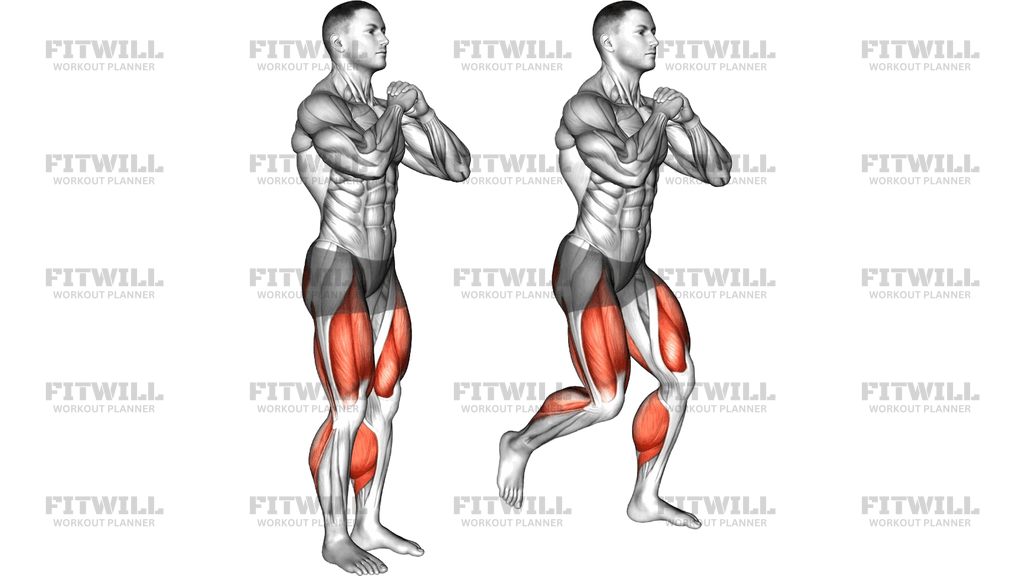
Instructions
- Stand tall with your feet hip-width apart and clasp your hands together in front of your chest, elbows tucked in.
- Brace your core lightly, pull your shoulders back, and pick a point on one leg to work with first — that leg stays the moving leg for the whole rep.
- Shift your weight fully onto the standing leg and step the other leg straight back, landing on the ball of that foot.
- Lower straight down until both knees are bent to about 90 degrees, keeping the front knee stacked over the ankle and your torso upright.
- Press through the heel of the front foot to stand up and, in one continuous motion, bring that same back leg forward past your body.
- Plant the foot flat on the floor in front of you and lower into a forward lunge until both knees reach roughly 90 degrees again.
- Drive through the front heel to return to standing with both feet hip-width apart — that completes one repetition.
- Exhale as you rise out of each lunge and inhale as you lower into it.
- Complete all reps on one leg, then switch sides, or step back with the opposite leg on the next rep to alternate.
- Reset your stance and brace again between reps if your feet drift or your balance wavers.
Tips & Tricks
- Keep the step-back and step-forward on the same straight line — a common fault is landing the forward foot a few inches to the side, which rolls the knee inward.
- Do not rush the transition between the two lunges; the moment between standing up and stepping forward is where most people lose balance.
- Check your front knee in the forward lunge — it should travel over your second toe, not cave toward the midline.
- If your torso tips forward on the reverse lunge, your stance is probably too narrow; widen your base to hip-width before stepping.
- Keep your weight in the heel and mid-foot of the working leg rather than dumping it into the toes, especially on the way up from the forward lunge.
- Your hands at your chest should stay still — swinging the arms forward for momentum is a sign the legs are fatiguing and the rep should slow down.
- Shorten the depth before you shorten the control: a controlled 70-degree knee bend beats a sloppy deep lunge on this combination.
- If your calves cramp when you push off the back foot, spend a moment deliberately driving through the big toe and heel rather than flicking the foot forward.
- Progress by pausing two seconds at the bottom of each lunge before adding reps or holding a weight at your chest.
Frequently Asked Questions
Which muscles does the Reverse Lunge Forward Lunge work the most?
The quads take the largest share because both the reverse and forward positions load the front knee heavily. The glutes and hamstrings assist on the way up, and the calves and core stabilize through the direction changes.
Is the Reverse Lunge Forward Lunge suitable for beginners?
Yes, as long as the depth is adjusted. Beginners can start with shallower lunges and a slower tempo to learn foot placement before dropping to a full 90-degree bend in both knees.
Why step back first and then forward instead of just doing regular lunges?
Linking the two directions keeps the same leg working through two distinct loading patterns in one rep. The forward lunge is more quad-dominant while the reverse lunge is slightly more glute and hip-friendly, so you train both in a single continuous movement.
Should I do all reps on one leg or alternate legs?
Staying on one leg builds more strength and balance on that side, which is ideal for fixing imbalances. Alternating legs each rep keeps the heart rate higher and the set more conditioning-focused.
How do I stop losing my balance when moving from the reverse lunge to the forward lunge?
Slow the transition down and keep your weight centered over the standing leg before the moving foot leaves the floor. Widening your starting stance to hip-width also gives you a more stable base to return to.
Can I add weight to the Reverse Lunge Forward Lunge?
Yes — a dumbbell, kettlebell, or weight plate held at the chest works well and matches the hand position of the bodyweight version. Add load only once your foot placement is consistent for all reps.
My front knee hurts during the forward lunge portion — what should I check?
Look at where your knee travels: it should stack over the ankle and second toe, not drift inward or shoot past the toes. Reducing depth and slowing the descent usually resolves discomfort, but persistent pain should be assessed by a professional.
What can I substitute if the combination is too difficult?
Do reverse lunges and forward lunges as separate exercises, resetting your feet between each rep. Once both feel solid, link them back together into the full Reverse Lunge Forward Lunge.
How many reps and sets should I do?
For strength and muscle, 3 sets of 8-12 reps per leg works well. For a warm-up or conditioning finisher, 2-3 sets of 12-15 reps per leg at a steady pace is a good target.