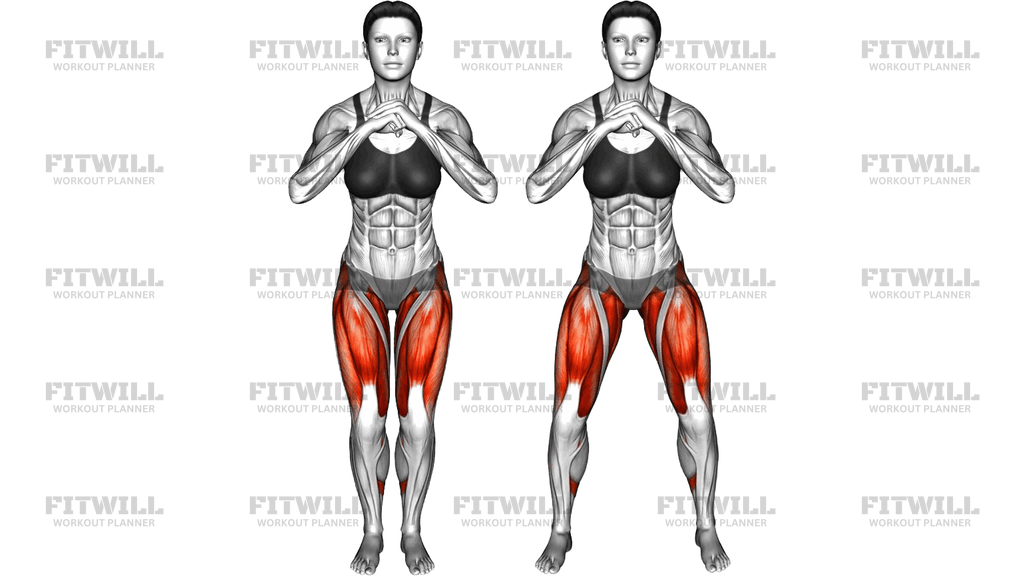
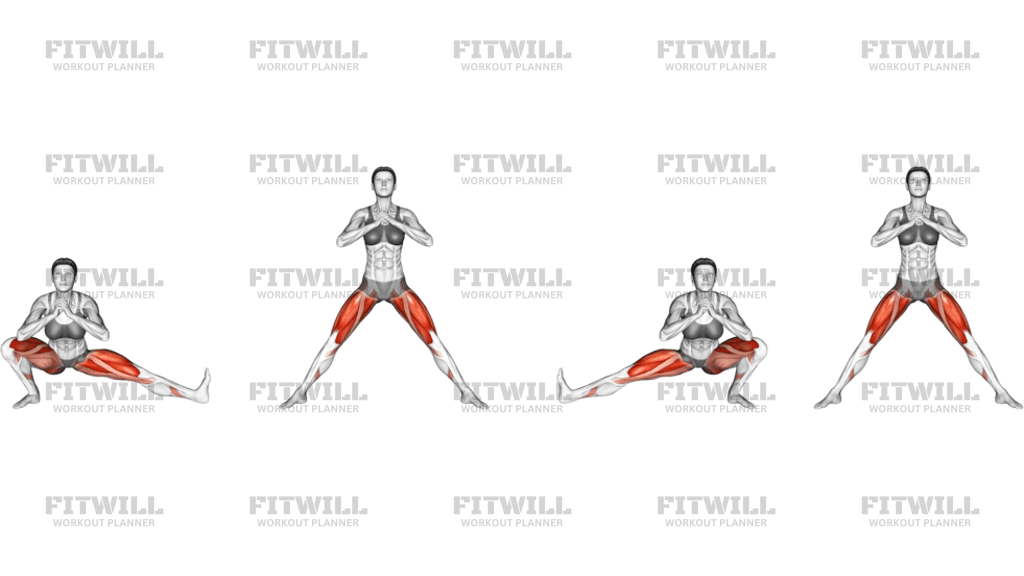
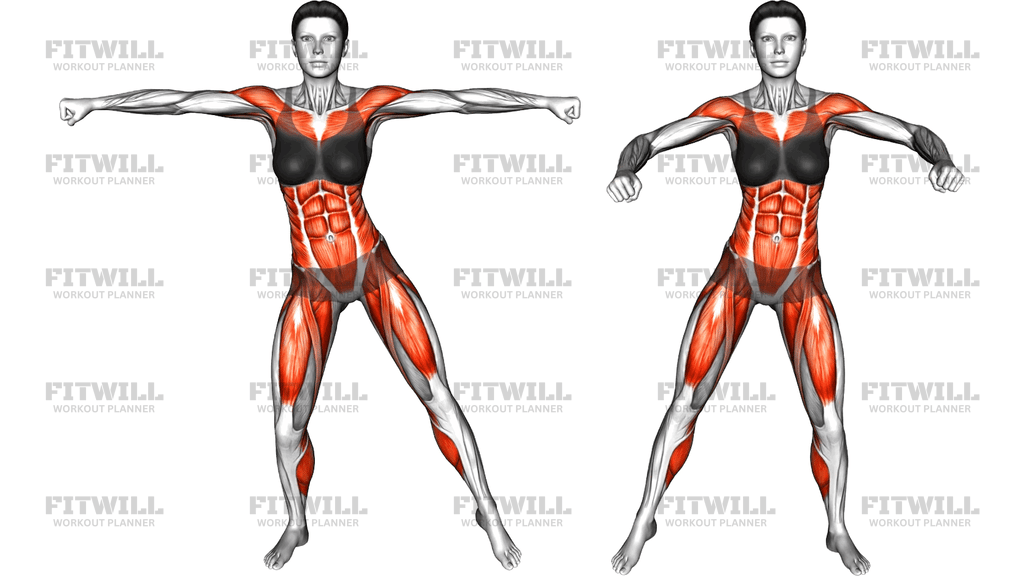
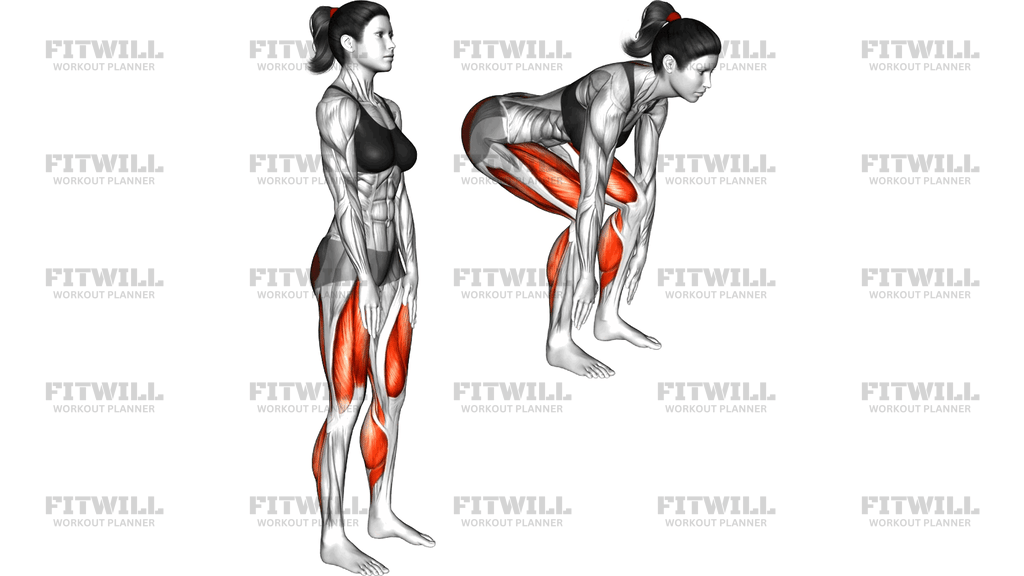
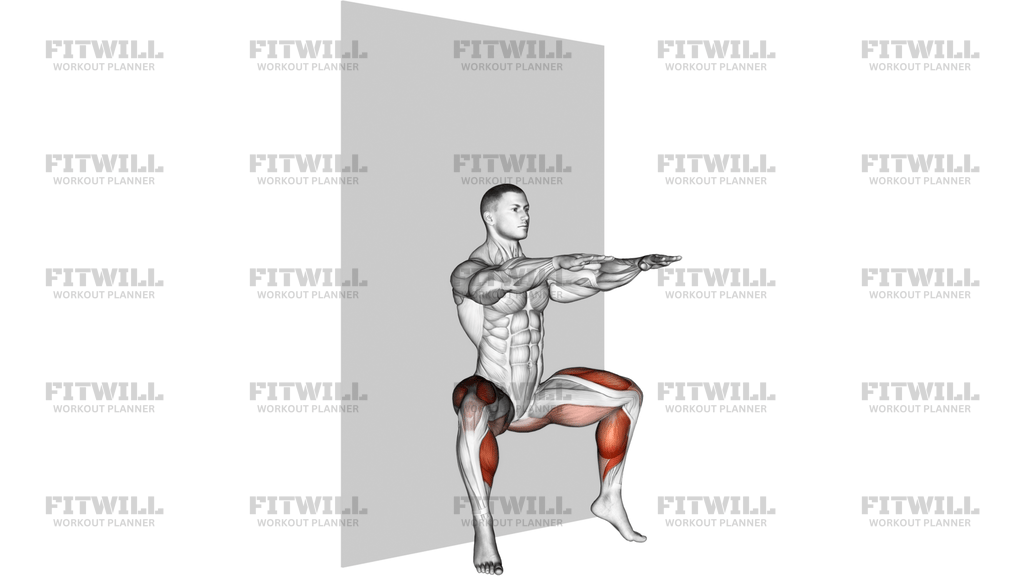
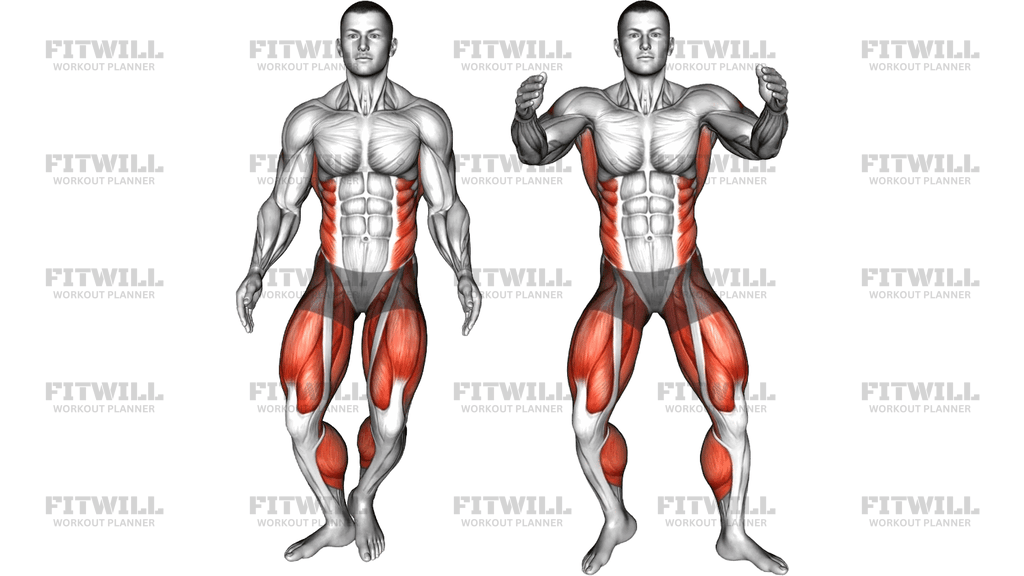
Half Squat Side Lunge
The Half Squat Side Lunge is a lateral lower-body exercise performed from a wide stance, where you shift your hips over one bent leg at a time while the opposite leg stays extended to the side. It blends a partial squat with a side lunge pattern, so you get the knee-dominant work of a squat on the bent leg plus a deep inner-thigh stretch on the straight leg in the same rep. Your hands stay clasped in front of your chest, which helps you balance and keeps your torso upright without needing any equipment.
This movement is especially useful for anyone whose training is mostly forward and backward, like running, cycling, or conventional squats. The side-to-side shift trains the quads and glutes through a frontal-plane path and loads the adductors as they lengthen on the extended leg and contract to pull you back to center. It also challenges hip mobility, particularly in the inner thigh and the ankle of the bending leg, which is why it appears in warm-ups, general strength work, and rehab-style conditioning programs alike.
Setup matters more here than in most squat variations because your stance width determines whether the movement is comfortable or strained. Feet should be significantly wider than shoulder width, toes turned slightly out, and the extended foot should stay flat on the floor. If your stance is too narrow, the moving knee drifts inward and the straight leg cannot settle into the stretch; too wide, and you lose the ability to control the shift.
To execute well, sit your hips back and toward the bending leg, letting that knee travel over or slightly inside the foot while the opposite leg lengthens. Keep your chest up, shoulders relaxed, and hands together at your sternum as a counterweight. Press through the whole foot of the bent leg to return to center, then repeat to the other side. Move at a tempo you can own; the shift itself should feel smooth rather than like you are dropping sideways.
Most people use the Half Squat Side Lunge for two or three sets of eight to twelve shifts per side, either as a warm-up activation drill before heavier leg work or as a main movement in bodyweight sessions. It requires no floor space beyond a stride width in each direction, so it works well at home, in a hotel room, or in a busy gym corner.
A few safety points keep this exercise productive. Only descend to the depth where the extended leg can stay long and the bent foot stays planted; forcing extra range usually collapses the knee or rolls the straight foot inward. If balance is a problem, widen your base slightly and slow the shift down before adding depth.
Fitwill
Log Workouts, Track Progress & Build Strength.
Achieve more with Fitwill: explore over 9600 exercises with images and videos, access built-in and custom workouts, perfect for both gym and home sessions, and see real results.
Start your journey. Download today!




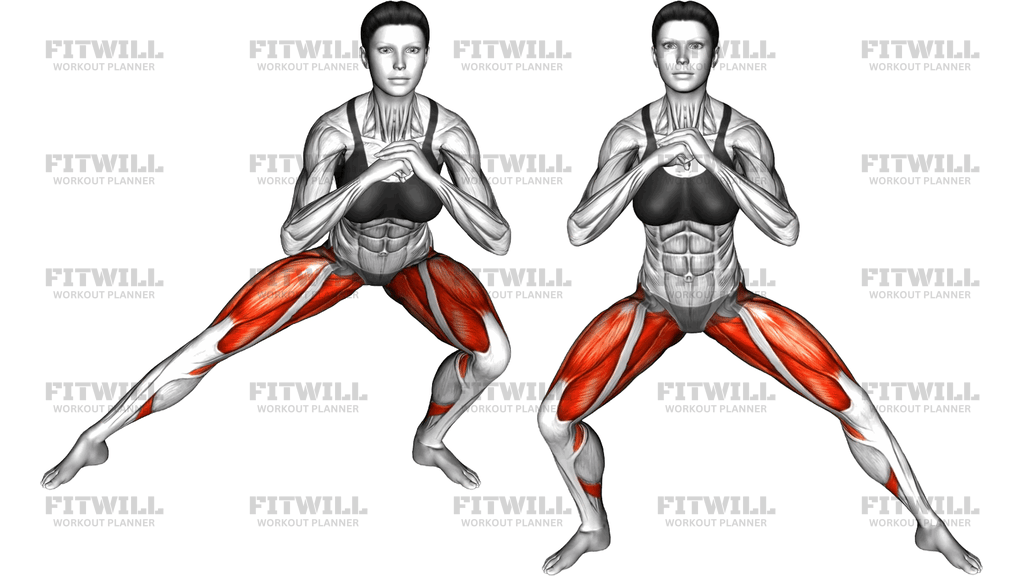
Instructions
- Stand with your feet roughly one and a half to two shoulder widths apart, toes turned out about 15 to 30 degrees, and clasp your hands together in front of your chest.
- Brace your midsection lightly and pull your ribs down so your torso stays tall over your pelvis.
- Shift your weight into your right leg and sit your hips back and to the right, bending the right knee into a half squat.
- Keep your left leg extended, knee straight, with the left foot flat on the floor and toes still angled outward.
- Let your chest stay upright and your hands stay at sternum height; avoid dumping your torso down onto the bending thigh.
- Descend only until you feel a firm stretch along the inner thigh of the straight leg, typically when the bent thigh is near parallel to the floor or slightly above.
- Press through the entire right foot to drive your hips back to center, feeling the inner thigh pull you back up.
- Exhale as you shift into each side and inhale as you return through center.
- Repeat the shift to the left, bending the left knee while the right leg lengthens, and continue alternating for your target reps.
- Between sets, step your feet back in and stand tall for a few breaths before starting the next set.
Tips & Tricks
- If the straight foot rolls onto its inner edge, narrow your stance slightly; a foot that can stay flat is worth more than extra depth.
- Watch that the bending knee tracks over the foot rather than caving inward, a common fault when the adductors are tight and pull the shift off line.
- Keep weight in the heel and midfoot of the bending leg, not the toes; tipping forward onto the toes is the usual reason people lose balance mid-shift.
- Think of pushing the floor away with the bent leg rather than pulling yourself up with the straight one, so the working leg does the returning.
- If your hands drop as you fatigue, reset them at your sternum between reps; the clasped arms act as a counterbalance for the lateral shift.
- Shorten the range before you widen the stance. A controlled half-depth shift beats a deep lunge where the knee collapses.
- Point the toes of the straight leg up toward the ceiling occasionally to confirm the knee is truly extended and the quad is engaged.
- Slow the transition through center down; most of the value of this exercise is lost if you rush through the middle position with no control.
- If inner-thigh tightness limits depth, hold the bottom position on each side for two to three breaths for the first week or two before moving fluidly.
Frequently Asked Questions
Which muscles does the Half Squat Side Lunge work the most?
The quads of the bending leg do the main squatting work, while the inner thighs and glutes handle the lateral shift. The extended leg's hamstrings and adductors work isometrically as it lengthens under stretch.
How is the Half Squat Side Lunge different from a regular side lunge?
A regular side lunge starts with your feet together and steps out to one side. Here you stay in a fixed wide stance and simply shift your hips from one bent leg to the other, which makes it faster to cycle through and easier to control.
Why does my straight leg's foot lift or roll inward?
That usually means your stance is too wide for your current hip mobility or your hips are dropping too far. Narrow the stance a little and reduce the depth until both feet stay planted throughout the shift.
Is the Half Squat Side Lunge good for beginners?
Yes, as long as the depth is kept modest. Beginners often benefit from holding a doorframe or wall lightly for balance on the first few sessions, then working without support as the shift becomes smooth.
How deep should I sink into the bent-knee side?
A half depth, with the bent thigh roughly parallel to the floor or slightly above, is enough for most people. Go deeper only if the straight knee stays fully extended and both feet remain flat without strain.
What can I use instead if lateral shifting bothers my knees?
A standing lateral leg raise or a glute-focused band exercise trains the hips without loading the bent knee. You can also try a shallow version where the bending knee only travels a few inches before returning.
Should my hands stay clasped at my chest the whole time?
Keeping them clasped at sternum height acts as a counterweight and helps you stay upright, so it is worth maintaining. If balance is difficult, extend the arms straight out to the sides instead.
Do I need to alternate sides every rep?
Alternating keeps the workload even and trains the return through center, which is part of the exercise's value. You can also do all reps on one side first if you are focusing on a tighter or weaker hip, just balance it with the other side.
How many sets and reps should I do of the Half Squat Side Lunge?
Two to three sets of eight to twelve shifts per side covers both activation and strength work. If you are using it as a warm-up, one lighter set of six to eight per side is usually plenty.