Double Plank Jack To 4 Mountain Climber
The Double Plank Jack To 4 Mountain Climber is a compound body-weight conditioning drill that chains two high-plank movements into one continuous sequence: two plank jacks, where both feet hop out wide and back in, followed by four mountain climber steps, two with each leg. Because you never leave the plank position between elements, your trunk has to resist rotation and extension the entire time while your legs work through two different footwork patterns. That combination makes it one of the more demanding plank variations you can do without any equipment beyond a floor surface.
This movement is best suited to people who already hold a solid high plank for at least 30 seconds and can perform mountain climbers with a stable torso. It shows up most often in metabolic circuits, HIEM-style interval work, and core finishers, where the goal is to keep the heart rate elevated while still training the abdominal wall isometrically. Runners and field-sport athletes also get carryover, since the drill trains the ability to transfer force between the legs through a braced midsection.
The primary workload lands on the abs and deep core, which must hold a rigid line from shoulders to heels through every hop and knee drive. The hip flexors drive the mountain climber knees forward, the glutes and quads power the plank jack jumps and absorb each landing, and the shoulders, chest, and arms stabilize the upper body on the floor. Expect a noticeable cardiovascular demand as well, since the continuous footwork keeps large muscle groups cycling without rest.
Setup quality determines whether this drill trains your core or just your lower back. Place your hands slightly wider than shoulder width directly under your shoulders with fingers spread, and keep your elbows soft rather than locked. Your body should form one straight line from head to heels before the first jump, with the neck neutral and eyes on the floor a short distance ahead of your hands. If your hips start high in the air or sag toward the floor at any point, shorten the sequence or slow the tempo until you can hold the line.
Execution is a rhythm problem. Two plank jacks means two out-and-in hops with both feet, each landing soft and quiet with the knees nearly straight. Then four mountain climber counts means four alternating knee drives, pulling each knee toward your chest without letting the hips bounce upward. Keeping the jumps and knee drives at a controlled, repeatable pace beats racing through reps with a bouncing lower back. Breathe steadily throughout rather than holding your breath during the hops.
A mat helps on hard floors, both for wrist and knee comfort and for grip under the feet during the jacks. Start with 3 to 5 rounds of 15 to 30 seconds or 4 to 6 total repetitions of the full sequence, resting as needed. If the hops aggravate your wrists, shoulders, or pelvic floor, substitute the plank jack for alternating foot taps out to each side and step the mountain climbers instead of driving them.
[ Workout Log & Planner ]
Put your next workout in Fitwill
Keep your plan and training log ready when you are.


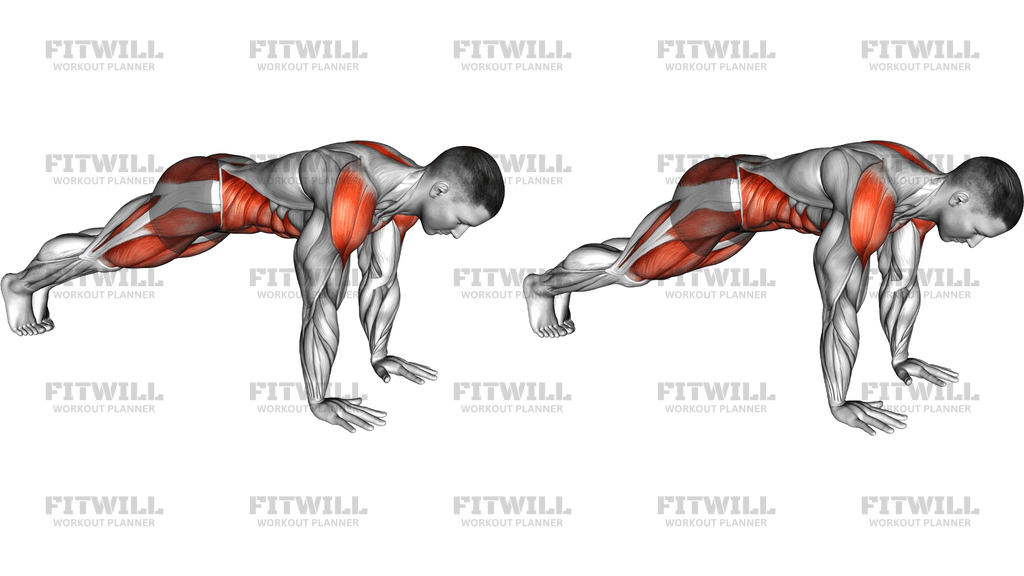
Instructions
- Place an exercise mat on the floor if you are training on a hard surface, then set up in a high plank with your hands slightly wider than shoulder width, wrists stacked under your shoulders, and fingers spread for grip.
- Straighten your legs behind you with the balls of your feet on the floor so your body forms one line from head to heels; pull your belly button in slightly and squeeze your glutes to lock in the brace.
- Keep your elbows soft, your neck neutral, and your gaze on the floor just ahead of your fingertips before you start moving.
- Perform the first plank jack: hop both feet out wide at the same time, landing on the balls of your feet with your knees nearly straight and your hips level.
- Hop both feet back to the narrow plank position, then repeat for the second jack, keeping each landing quiet and controlled.
- From the narrow plank, drive your right knee toward your chest without letting your hips rise, then return it and immediately drive your left knee; complete four knee drives total, two per side.
- That completes one full repetition of the sequence; immediately begin the next rep with the two plank jacks, or pause and reset your plank if your hips have drifted.
- Breathe in a steady rhythm throughout, inhaling through the nose and exhaling as the feet move rather than holding your breath during the hops.
- When you finish the set, step your feet in, sit back to your heels or stand up, and shake out your wrists before the next round.
Tips & Tricks
- The most common fault in the Double Plank Jack To 4 Mountain Climber is the hips popping upward during the mountain climbers; fix it by thinking about driving the knee toward the chest and keeping the back hip bone pressing toward the floor.
- Watch for a lower back sag after the second plank jack, when fatigue usually sets in; reset your brace between reps rather than grinding through with an arched spine.
- Land the jacks on the balls of your feet with bent-knee absorption, not flat-footed; flat, heavy landings shake the plank position apart and hammer the knees.
- If your wrists ache, spread your fingers wider and grip the mat slightly so some load moves into the forearm muscles instead of sitting only on the wrist joint.
- Slow the footwork down before you speed it up; a controlled four-count sequence with a rigid trunk trains the core far better than fast reps with a bouncing lower back.
- Alternate which knee starts the mountain climber on each set so both sides of the hip flexors and obliques get the same leading-side work.
- Keep your head still and eyes down; lifting the head to look forward during the jacks tends to drop the hips and break the shoulder-to-heel line.
- Count out loud or in your head as two jacks, then four knee drives; losing count mid-set usually means the pace is too fast to control.
- On a slick floor, the feet can slide wider than intended during the jacks, so use a mat or a surface with grip to keep the landing width consistent.
Frequently Asked Questions
What muscles does the Double Plank Jack To 4 Mountain Climber work?
The abs and deep core do most of the stabilizing work, while the hip flexors drive the knee lifts and the glutes and quads power the plank jack jumps. The shoulders, chest, and arms support your upper body on the floor throughout the entire sequence.
Why does the sequence use exactly two plank jacks and four mountain climbers?
The 2-to-4 structure gives you a short burst of bilateral footwork followed by alternating knee drives, so you train two different leg patterns without resetting your plank. The even count also makes it easy to keep rhythm when you get tired.
Is the Double Plank Jack To 4 Mountain Climber suitable for beginners?
It is an intermediate progression, because the hops and knee drives demand a stable high plank. Beginners should first master a 30-second high plank and slow step-out plank jacks, then build up to the full hopping sequence.
How do I stop my hips from bouncing during the mountain climber portion?
Reduce the height and speed of each knee drive and focus on pulling the knee toward the chest rather than pushing the floor away. Squeezing the glutes of the extended leg also helps anchor the back half of your body.
Can I do the Double Plank Jack To 4 Mountain Climber without a mat?
Yes, on carpet or a grippy floor it works fine. On hard, slick flooring a mat is worthwhile because it cushions the wrist joints and keeps your feet from sliding wider than intended during the jacks.
What can I substitute if the jumping bothers my wrists or shoulders?
Step each foot out and in alternately instead of hopping both together, and step the mountain climbers rather than driving them. You keep the same core and hip-flexor demand with far less load on the upper body.
How should I program this exercise in a workout?
It works well as a core finisher or a station in a circuit, typically 15 to 30 seconds or 4 to 6 full repetitions per round for 3 to 5 rounds. Because the plank position fatigues quickly, place it early enough in the set that your form holds.
Why does my lower back feel sore instead of my abs?
That usually means your hips are sagging or your back is arching during the hops and knee drives, shifting the load to your lumbar spine. Slow the tempo, reset to a straight head-to-heel line before each rep, and shorten the set if you cannot hold the position.
Should I breathe differently during the hops than the knee drives?
No, keep one steady breathing rhythm across the whole sequence, exhaling as the feet move. Holding your breath through the jacks raises internal pressure and makes the plank position harder to hold.