Assisted Partial Range Inverse Leg Curl Against Wa
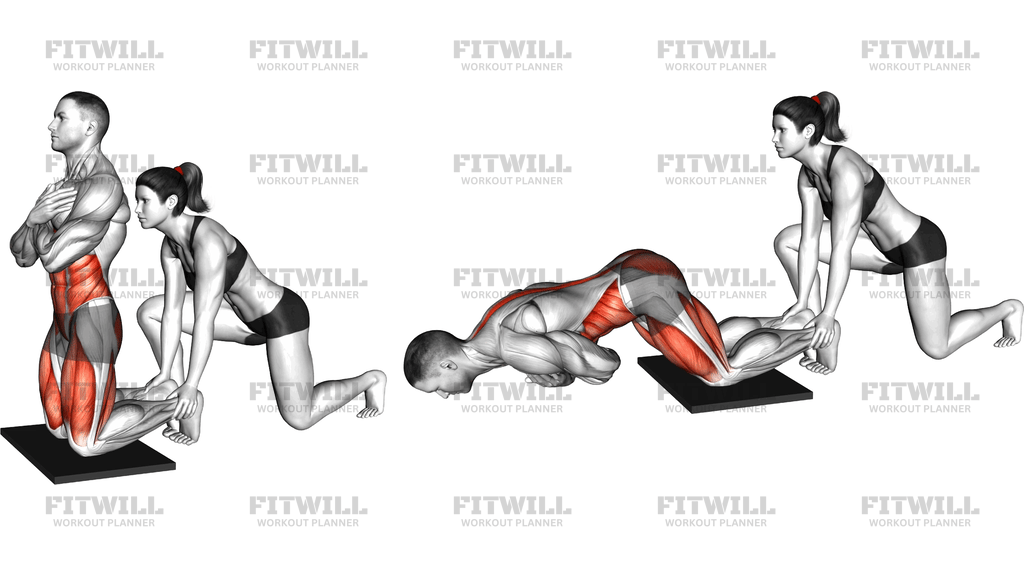
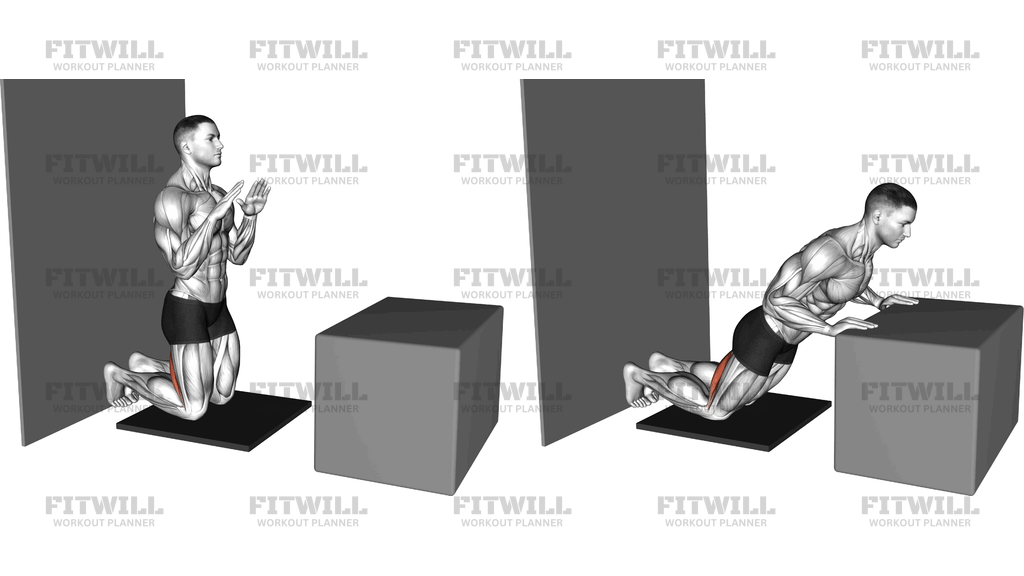
The Assisted Partial Range Inverse Leg Curl Against Wall is a kneeling bodyweight exercise that trains the hamstrings through their most demanding role: controlling your torso as it tips forward over your knees. You start in a tall kneel with your feet anchored against a wall behind you, lower your body forward under control through a shortened, manageable range, and catch yourself with your hands on a sturdy box or platform in front of you. That hand contact is the assistance — it lets you decide exactly how far you descend and gives you a way back up before your hamstrings give out.
This is essentially a friendlier version of the Nordic curl family. A full inverse leg curl or Nordic curl asks the hamstrings to resist your entire falling bodyweight from an upright kneel all the way to near-parallel with the floor, which is beyond what most people can control. By limiting the range and placing your hands on a box for support, you keep tension in the hamstrings without ever reaching the point where you collapse. The wall behind your feet solves the anchoring problem: it stops your feet from sliding backward, which is the usual reason this exercise falls apart without a partner or strap.
The main work happens on the way down. As your torso leans forward, the hamstrings work eccentrically to slow the movement while the glutes and core keep your hips extended and your body in one straight line from knees to head. The calves and the muscles around the ankle help stabilize the anchored feet. Because the emphasis is on controlled lowering, the exercise is demanding relative to its simplicity — you need no weights, just a wall, a mat for your knees, and a stable box at a useful height.
Setup details matter more than they first appear. The distance between your knees and the box determines your range: closer box, shorter and easier lowering; farther box, longer and harder. The box height matters too, since a lower platform forces a deeper descent before your hands arrive. Your kneeling position on the mat should be far enough from the wall that your feet stay braced but close enough that your shins stay roughly vertical as you lean.
This exercise suits lifters who want to build toward full Nordic curls, athletes who need eccentric hamstring strength for sprinting and deceleration, and anyone rehabbing or protecting the back of the thigh with a graded, self-regulated movement. Because you can adjust assistance by pushing more or less with your hands, it scales well from first attempts to harder sessions. Work in sets of five to eight controlled reps, and treat progress as gradually extending the range and lightening the hand support over weeks, not days.
[ Workout Log & Planner ]
Put your next workout in Fitwill
Keep your plan and training log ready when you are.


Instructions
- Kneel on an exercise mat with your back to a solid wall, knees about hip-width apart and shins vertical.
- Place your feet behind you so they are braced against the base of the wall, toes pointed, so your ankles cannot slide backward during the lowering phase.
- Position a sturdy box or platform in front of you at a distance that matches a range you can control — close enough that your hands reach it before your hamstrings are overloaded.
- Sit up tall in the kneel, stack your shoulders over your hips, squeeze your glutes, and brace your abdominal wall so your body forms one straight line from knees to head.
- Begin leaning your whole body forward from the knees, keeping your hips extended and your torso rigid rather than bending at the waist.
- Lower slowly, letting your hands arrive on the box at the end of your controlled range, and absorb your weight through your palms without collapsing onto the box.
- Push lightly off the box to assist the return, then pull your torso back upright by driving your hamstrings and glutes until you are again sitting tall over your knees.
- Exhale as you lean forward and lower; inhale as you push back up to the start.
- Pause briefly in the tall kneel to reset your brace and glute squeeze before starting the next rep.
- Adjust the box distance between sets if the lowering felt too easy or too abrupt.
Tips & Tricks
- The most common error is hinging at the hips — folding forward at the waist turns this into a hip hinge and removes most of the hamstring tension. Keep your hips locked in extension and move your whole body as one rigid lever from the knees up.
- If your feet slip against the wall mid-set, the exercise becomes a struggle for balance instead of a hamstring drill. Press the tops or soles of your feet firmly into the wall base and shift your kneeling spot closer until the anchor feels secure.
- Do not let your chest drop onto the box. Your hands should catch you while your torso is still under tension; if you are crashing down, move the box closer or shorten the range.
- Pushing hard off the box on the way back makes this a push-up with hamstring flavor. Keep the hand push to the minimum needed to get upright — the return should still feel like hamstring work.
- A lower box is a progression and a higher box is a regression, but only after the distance is set correctly. Fix the range first, then adjust the platform height.
- Keep your lower back neutral as you return to the top. Overarching and throwing your chest up with your spinal erectors cheats the hamstrings out of the final part of the rep.
- Use a folded mat or pad under your knees even on soft flooring — the kneecap takes your full bodyweight through every rep and friction against the mat matters over multiple sets.
- A wobbly box is a real hazard here, since your hands will be loaded with part of your bodyweight at the bottom of each rep. Test it before your first descent or use a bench pushed against something immovable.
- Expect your hamstrings to feel sore the next day even at short ranges; eccentric work causes more delayed soreness than the effort suggests, so start with two or three sets and add volume gradually.
Frequently Asked Questions
Which muscles does the Assisted Partial Range Inverse Leg Curl Against Wall work?
The hamstrings are the primary movers, working eccentrically to control your torso as it lowers. Your glutes and core hold the hips extended and body rigid, while the calves help stabilize the feet against the wall.
Is this exercise suitable for beginners?
Yes, and that is largely the point of the setup. The box lets you choose a short, manageable range and push back up with your hands, so a beginner can start with a small lean and progress gradually toward longer ranges.
Why are the feet braced against a wall in the Assisted Partial Range Inverse Leg Curl Against Wall?
The wall anchors your ankles so they cannot slide backward as your torso leans forward. Without that anchor, your feet would slip out and you would lose the lever that loads the hamstrings.
How far from the box should I kneel?
Start close enough that your hands reach the box after only a modest lean, then move it farther away over sessions as your control improves. If you ever feel like you are falling rather than lowering, the box is too far away.
What is the most common mistake in this movement?
Bending at the hips instead of leaning from the knees. The exercise only works when your body stays in a straight line from knees to head, with the movement happening at the knees like a lever tipping forward.
How is this different from a full Nordic curl?
A full Nordic curl takes you from an upright kneel almost to the floor with no hand assistance, which demands far more eccentric hamstring strength. This version cuts the range short and uses the box for both a safety catch and assisted return.
What can I use if I don't have a sturdy box?
A stable bench, a low plyometric platform, or any solid surface at roughly the right height will work, as long as it will not tip or slide when you load your hands on it.
How many reps and sets should I do?
Five to eight controlled reps for two to four sets is a sensible starting point. Because the lowering phase is eccentric, keep the tempo slow and add volume or range gradually rather than chasing high rep counts.
Is it safe for my knees to kneel and lean like this?
The knees stay bent and static throughout, so the joint itself is not moving under load, but the kneecap does bear your bodyweight. Use adequate padding, and if kneeling itself is uncomfortable, a thicker mat or a different hamstring exercise is the better choice.
How do I know when to progress the Assisted Partial Range Inverse Leg Curl Against Wall?
When you can lower smoothly to the box, push back up with very light hand pressure, and complete all sets without your form breaking, move the box slightly farther away or lower the platform to lengthen the range.