Assisted Lying Hamstring Stretch
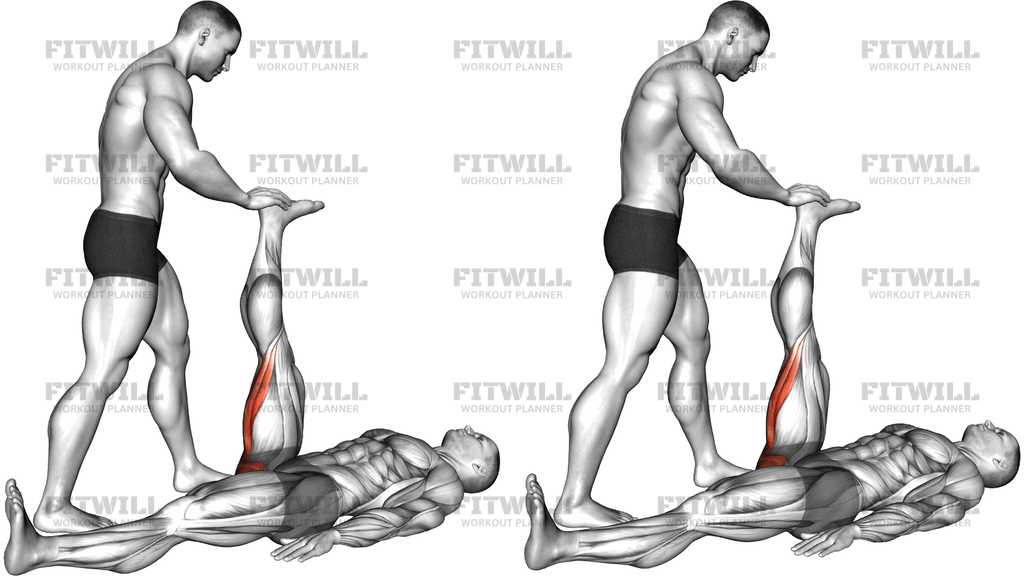
Assisted Lying Hamstring Stretch is a partner-assisted flexibility drill for the back of the thigh. One leg stays straight on the floor while the other leg is lifted and supported at the foot or heel so the hamstrings can lengthen without the lifter having to force the position. The image shows a classic supine setup: the person lies flat, keeps the non-working leg long and quiet, and uses assistance to bring the raised leg into a controlled stretch.
This exercise primarily targets the hamstrings, especially when the knee is kept nearly straight and the ankle stays relaxed or gently dorsiflexed. The glutes, calves, and deep core help stabilize the pelvis so the lower back does not arch as the leg comes up. That pelvic control matters more than chasing a bigger angle, because a tilted pelvis can make the stretch look deeper while actually moving the stress away from the intended tissue.
The best way to perform the stretch is to start with the hips square, the spine long, and the down leg pressing lightly into the mat. From there, the partner or assistant raises the leg until a firm but tolerable stretch is felt in the hamstring, not a sharp pull behind the knee or a pinch in the back. The foot can stay neutral or slightly flexed depending on comfort, but the knee should not be aggressively locked or bent and straightened during the hold.
Use the stretch to restore range after lower-body training, during a mobility block, or as part of a warm-up when the hamstrings feel tight from sitting, running, or hinging work. Because this is a passive assisted stretch, the quality comes from calm breathing, smooth pressure, and a controlled hold rather than from bouncing or pushing to the limit. If the lower back starts to arch, the opposite leg lifts off the floor, or the sensation shifts toward nerve tension, reduce the angle immediately.
Done well, Assisted Lying Hamstring Stretch leaves the hamstrings feeling lengthened without irritating the knee or lumbar spine. Keep the setup precise, use only enough assistance to reach a useful stretch, and finish the hold with the same control you used to get into it.
[ Workout Log & Planner ]
Put your next workout in Fitwill
Keep your plan and training log ready when you are.


Instructions
- Lie on your back on the mat with both legs extended before the stretch begins.
- Keep one leg long on the floor and let the other leg be lifted by a partner at the foot or heel.
- Square your hips and keep your lower back gently settled against the mat.
- Raise the working leg only until you feel a strong but tolerable stretch in the hamstring.
- Keep the knee of the lifted leg nearly straight without forcing it into a hard lockout.
- Keep the ankle relaxed or lightly flexed while the assistant maintains steady pressure.
- Breathe out slowly and let the hamstring soften as the stretch is held.
- Lower the leg with control, then repeat on the other side if both legs need work.
Tips & Tricks
- Keep the opposite leg heavy on the floor so the pelvis does not roll toward the stretched side.
- If the lower back arches, lower the raised leg a little before trying to hold it again.
- Ask for steady pressure instead of pulsing or bouncing the heel upward.
- A slight bend in the knee can reduce tension if the stretch feels more like a nerve pull than a muscle stretch.
- Flexing the ankle can sharpen the hamstring sensation, but it should never create pain behind the knee.
- Use a slow exhale to ease the leg a little farther only after the stretch sensation settles.
- Keep the neck and shoulders relaxed so you do not turn this into a full-body strain.
- Stop short of any sharp, burning, or tingling sensation and reset the position.
Frequently Asked Questions
What does the Assisted Lying Hamstring Stretch target most?
It primarily targets the hamstrings on the raised leg.
Why is the other leg kept flat on the mat?
Keeping the other leg down helps stabilize the pelvis and makes the hamstring stretch more honest.
How high should the lifted leg go?
Only high enough to feel a firm hamstring stretch without the lower back arching or the knee forcing straight.
Should the knee stay locked during the stretch?
It should stay close to straight, but not jammed into a painful lockout.
Is this more of a stretch or a strength exercise?
It is a stretch-focused mobility drill, not a loading exercise.
What if I feel the stretch behind the knee instead of in the thigh?
Back off the range and slightly bend the knee until the sensation moves back into the hamstring.
Can beginners use this stretch?
Yes, if the partner uses gentle pressure and the range stays comfortable and controlled.
When is the best time to use it?
It works well after lower-body training, after running, or during a mobility session when the hamstrings feel tight.