Ring Straddle L Sit
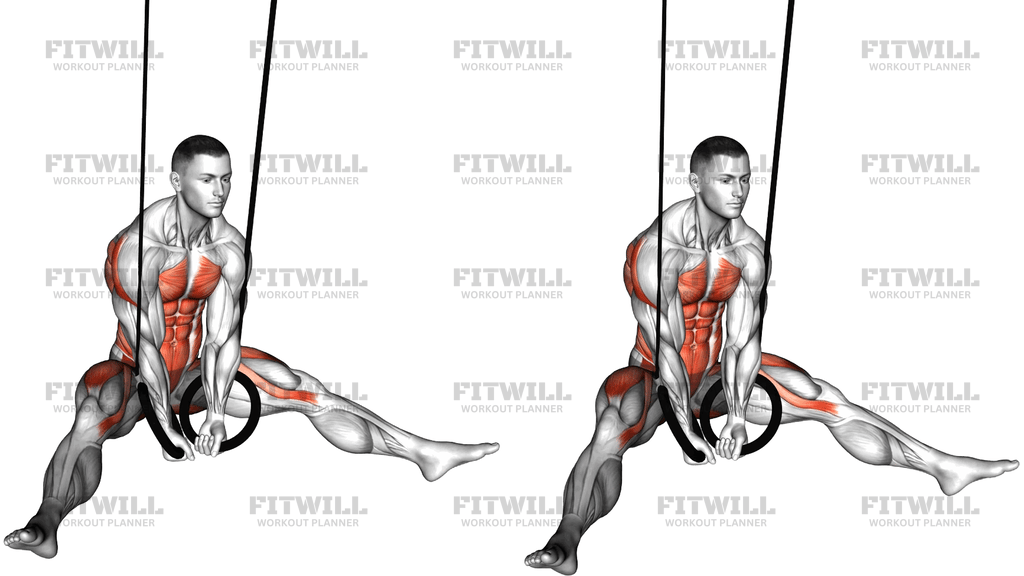
The Ring Straddle L Sit is an isometric gymnastic strength hold performed on suspended rings. Instead of holding the legs together in front of the body as in a standard L-sit, you spread the legs into a wide straddle and hold them elevated on either side of the rings. This wider leg position shortens the leverage slightly compared to a closed L-sit, but the rings add a serious stability demand because the straps can sway and shift in every direction.
This hold is aimed at intermediate to advanced trainees who already own a solid support position on rings and can hold a tuck or bent-knee L-sit for at least 15-20 seconds. It is a staple in gymnastic strength work, calisthenics programming, and ring-specific training because it builds the exact midline control needed for harder skills like the ring L-sit, manna progressions, and advanced support holds.
The primary work comes from the hip flexors lifting and holding the legs, the abdominals and deep core keeping the pelvis tucked and the torso rigid, and the adductors actively holding the straddle open. Meanwhile the triceps, shoulders, and chest press the rings down and together to keep the body lifted, and the forearms and grip manage the unstable ring handles for the entire duration.
Setup quality decides whether this hold feels controlled or chaotic. The rings should hang at a height that lets you press into a straight-arm support with your feet clear of the floor, and the straps need even length on both sides. Press the rings slightly outward and down before the legs lift; this creates tension through the shoulders and stops the rings from drifting inward as you raise the legs.
To execute the hold, lift into support, spread the legs into a wide straddle, and raise them until they sit roughly parallel to the floor with the heels wide of the rings. Keep the knees straight, toes pointed, and hips slightly tucked under so the lower back stays flat rather than arching. Breathe in short, shallow breaths through the nose while holding, then lower the legs under control and rest before the next set.
Because the rings move, this exercise exposes asymmetries and weaknesses that a parallette L-sit hides. Expect shorter hold times than on solid bars at first. Spot the hold near the straps or set the rings low enough that a loss of control simply sets your feet on the floor, and stop the set as soon as the legs begin to sink or the shoulders start riding up toward the ears.
[ Workout Log & Planner ]
Put your next workout in Fitwill
Keep your plan and training log ready when you are.


Instructions
- Set both rings to even strap lengths at roughly hip to chest height, and check that they are anchored securely before loading them.
- Grip each ring with a neutral, knuckles-forward grip and press down into a straight-arm support so your shoulders sit directly over your hands and your feet hover off the floor.
- Push the rings slightly outward and turn the rings a few degrees in so the straps are vertical and stable before the legs come up.
- Brace the abdominals, tuck the pelvis slightly, and pull the shoulder blades down away from your ears to lock in the support position.
- With straight knees and pointed toes, spread the legs into a wide straddle and raise them on either side of the rings until they are roughly parallel to the floor.
- Hold the top position with the heels wide of the rings, hips tucked, and chest tall, pressing the rings down and slightly outward the whole time.
- Keep breathing in shallow, controlled breaths; do not hold your breath during the isometric hold.
- When the legs start to sink or the shoulders creep up, lower the legs slowly and with control rather than dropping them.
- Re-set the support position, shake out the arms and shoulders briefly, and begin the next hold only once your grip and support position feel fresh.
Tips & Tricks
- If the rings wobble or drift inward as the legs rise, you are lifting the legs before the support is set; press the rings outward and still the straps first, then raise the legs.
- Bent knees are the most common compensation. If the knees bend as the legs come up, hold a lower angle, around 30-45 degrees, with straight legs instead of forcing parallel.
- Avoid shrugging into your ears. Push the rings away from the floor and keep the neck long; the shoulders should stay depressed throughout the hold.
- An arched lower back means the pelvis has tipped forward. Tuck the tailbone under slightly and squeeze the glutes lightly to flatten the back before the legs lift.
- If the legs sink after a second or two, the straddle is probably too narrow. Widen the split to shorten the leverage, then narrow it gradually over weeks.
- Chalk the hands and grip the rings with the whole palm, not just the fingers, since sweaty or shallow gripping accelerates both forearm fatigue and ring sway.
- Film from the side for a set: if the torso leans back as the legs lift, the hip flexors are losing the fight; shorten the hold or reduce the leg height.
- Keep sets in the 5-15 second range while learning. Quality short holds with a still torso build the position faster than grinding out a long hold with sagging legs.
- Train this earlier in a session while fresh. A fatigued grip from pull-ups or dips first makes the rings sway long before the core actually fails.
Frequently Asked Questions
Which muscles does the Ring Straddle L Sit work most?
The hip flexors and abdominals do the main work of lifting and holding the legs, with the adductors holding the straddle open. The triceps, shoulders, and chest support the body weight on the rings, and the forearms handle grip and ring control.
Is the Ring Straddle L Sit suitable for beginners?
Not as a starting point. Beginners should first build a solid ring support hold and a tuck or bent-knee L-sit on parallettes or the floor, then progress to the straddle position on rings once those hold for 15-20 seconds.
Why is the Ring Straddle L Sit harder to balance than a parallette L Sit?
Rings are suspended from straps and can shift in any direction, so every small correction in the legs or torso moves the hands as well. The straddle also demands active adductor tension that a closed-leg L-sit never trains.
How high should the rings be set for this hold?
Set them so you can press into a straight-arm support with your feet just clearing the floor. This way, if you lose control, your feet can simply touch down instead of dropping you out of the straps.
Should the legs be fully straight in the Ring Straddle L Sit?
Yes, straight knees and pointed toes are the standard, since bent knees turn it into an easier tuck variation. If straight legs cannot reach parallel, hold them at a lower angle rather than bending the knees.
How long should I hold the Ring Straddle L Sit each set?
Aim for 5-15 seconds per set while learning, accumulating 30-45 seconds of quality hold time in a session. Long, sagging holds reinforce poor positions and stress the shoulders and lower back.
What can I substitute if I do not have rings?
A straddle L-sit on parallettes, on the floor, or on a pair of sturdy chairs trains the same leg position with less stability demand. Once that is strong, moving to rings mainly adds the balance and grip challenge back.
My rings spin or sway when I lift my legs. How do I fix it?
Still the straps before the legs move by pressing the rings down and slightly outward and holding the support for a moment. Also check that the straps are hanging vertically and free of twists before you start.
Is the Ring Straddle L Sit safe for the shoulders?
It is generally safe when the shoulders stay depressed and the elbows stay locked, since hanging into the shoulders under load is the main risk. Stop the set when you feel yourself shrugging or sinking between the rings.