Ring Handstand To L Sit
The Ring Handstand To L Sit is an advanced gymnastic-strength movement performed on still rings. You begin in (or press up to) a stable handstand on the rings, then lower with complete control down through a straight-arm support and finish holding an L-sit with your legs extended straight ahead at hip height or above. Because the rings are free-moving, every centimeter of the descent demands that you actively stabilize the apparatus instead of relying on a fixed bar for balance.
This drill sits at the intersection of two skills: the ring handstand and the ring L-sit. It is aimed at gymnasts, calisthenics practitioners, and strength athletes who already own both positions separately and want to connect them under tension. If you can hold a ring support for 30 to 60 seconds and a solid ring handstand, this transition teaches you to move between them without losing shoulder position.
The primary work falls on the shoulders, which must press hard down into the rings and resist wobbling throughout the entire range. The triceps keep the elbows locked straight, the upper back and traps elevate and depress the shoulder blades as you descend, and the lower abs and hip flexors hold the legs rigid in the L position at the bottom. The forearms and grip work continuously to keep the rings from turning outward.
Setup matters more here than in almost any bar-based movement. Ring height, strap spacing, and how you grip the rings determine whether your wrists, elbows, and shoulders track cleanly or fight the straps the whole way down. Turning the rings slightly outward and keeping them turned through the descent is the hallmark of a controlled ring transition.
To execute it well, think of it as one long eccentric press rather than a drop into a support. Descend slowly by bending only at the shoulders, keeping the elbows locked, until your hands reach your hips, then raise the legs into the L-sit and hold. Rushing the transition is the most common reason people lose the rings or collapse into the shoulders.
Use this movement as a strength finisher on upper-body or gymnastic-skill days, typically for low repetitions of 2 to 5 controlled descents per set. Because it loads the shoulder girdle at end-range under body weight, progress gradually, keep the straps clear of your arms, and bail by releasing and landing on your feet if control slips.
[ Workout Log & Planner ]
Put your next workout in Fitwill
Keep your plan and training log ready when you are.


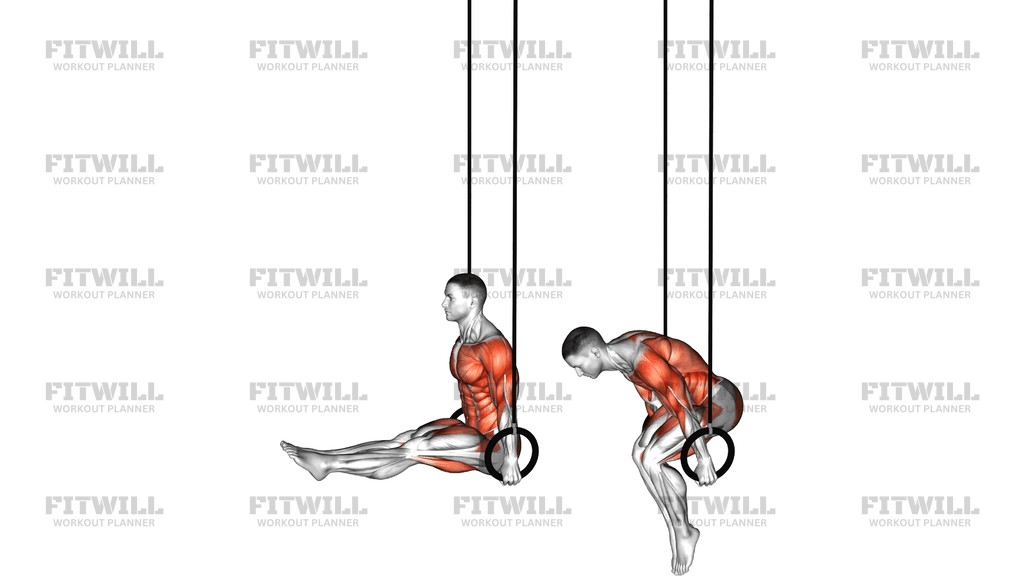
Instructions
- Set the rings so the handles hang at roughly hip to waist height when you stand beside them, and check that the straps are even and not twisted.
- Grip the rings with a full wrap, knuckles facing forward, and turn each ring slightly outward so the straps hang clear of your forearms and shoulders.
- Press up into a support position with locked elbows, then kick or press to a controlled handstand on the rings, stacking wrists over shoulders with the shoulder blades actively elevated.
- Brace the trunk, squeeze the glutes, and point the toes so the handstand line is rigid before you begin the descent.
- Begin lowering by allowing the shoulders to flex forward slowly while keeping the elbows completely locked, letting the rings turn slightly outward as you descend.
- Continue the eccentric until your hands arrive beside your hips in a straight-arm support, shoulders pressing down hard to keep the rings stable.
- As you reach the support, raise your straightened legs forward until they are parallel to the floor, forming the L-sit with toes pointed and knees locked.
- Hold the L-sit position for a deliberate one to three seconds, keeping the chest lifted and the shoulders depressed away from the ears.
- Exhale slowly on the way down, breathe shallowly but steadily during the hold, and avoid holding your breath through the transition.
- To reset, either lower the legs and step down from the support, or lower one leg at a time to the floor and stand up before the next repetition.
Tips & Tricks
- Most people lose the rings halfway down because the elbows bend. If your elbows crack even slightly, the descent turns into a dip and the shoulder stabilization work disappears, so cut the set and drill slow support lowers first.
- Letting the rings rotate inward or backward is the classic failure on this apparatus. Turn the rings outward at the start and keep them turned through the whole descent, which gives your shoulders a stable platform to press against.
- If your legs drop out of the L-sit at the bottom, the issue is usually hip flexor and lower ab endurance rather than shoulder strength. Train the ring L-sit on its own with longer holds until you can own it for 15 to 20 seconds.
- Straps brushing your forearms or shoulders mid-descent will disrupt balance and can throw you off the rings. Adjust your hand placement on the rings and verify strap clearance before every set.
- Do not rush from handstand straight into a swing. A brief pause at the top to establish a still line makes the eccentric far more controlled and protects the shoulders.
- If you cannot yet handstand on rings, build this movement from a ring support instead: press the shoulders down, raise the legs to L-sit, and only add the handstand start once the support transition is smooth.
- Shrugging to the ears in the handstand and then dumping the shoulders at the bottom are opposite errors. Keep the shoulder blades elevated in the handstand and transition smoothly to a strong depression as you reach the support.
- Keep the head neutral rather than craning the chin up during the descent; looking forward too early arches the back and shifts your center of mass behind the rings.
- Because the load lands on the shoulders at long muscle lengths, leave 48 hours between heavy sessions of this drill and treat any pinching in the front of the shoulder as a signal to shorten the range.
Frequently Asked Questions
Which muscles does the Ring Handstand To L Sit work the most?
The shoulders carry most of the load through the descent, supported heavily by the triceps and upper back. The lower abs and hip flexors take over at the bottom to hold the legs in the L-sit, and the forearms and grip stabilize the rings throughout.
Can beginners do the Ring Handstand To L Sit?
Not in its full form. Beginners should first build a 30 to 60 second ring support hold, a straight ring L-sit, and a comfortable handstand before attempting the connected descent. A useful early regression is lowering from a support with a tuck rather than from a handstand.
Why do the rings need to be turned outward during the Ring Handstand To L Sit?
Outward ring turn keeps the straps from pressing into your forearms and shoulders and gives the shoulder muscles something rigid to press against. It is the same technique used in ring dips and ring muscle-ups, and losing the turn is a common cause of wobbling or falling.
How low should I descend before lifting into the L-sit?
Lower until your hands are beside your hips in a straight-arm support, with your torso upright and shoulders pressed down away from the ears. From there, raise the extended legs to parallel with the floor.
What is the most common mistake in the Ring Handstand To L Sit?
Bending the elbows during the descent, which turns the movement into an uncontrolled drop and strips the shoulders of the stabilization work. Keep the elbows locked from the handstand all the way to the support, even if that means descending more slowly or shortening the range.
What can I substitute if I do not have rings?
Parallettes or a stable dip bar allow a straight-arm lower into an L-sit, though the balance demand is much lower. A suspension trainer can approximate ring instability but usually cannot safely support a handstand, so treat it as a support-level regression only.
How many repetitions of the Ring Handstand To L Sit should I do?
Keep it in the 2 to 5 repetitions per set range with full control and a brief hold in the L-sit each rep. Quality of the eccentric matters far more than volume, and form typically breaks down quickly once fatigue sets in.
Is it safe on the shoulders to lower from a ring handstand?
It is safe for healthy, well-prepared shoulders when the elbows stay locked, the descent is slow, and the range is built up gradually. Stop and regress the drill if you feel pinching at the front of the shoulder or if your control slips.
Should the legs stay straight the entire time in the Ring Handstand To L Sit?
In the full movement, yes: the legs are straight and toes pointed in the handstand and remain straight as they swing forward into the L-sit. Bent knees make the bottom hold easier but reduce the hip flexor and lower ab demand.
How do I bail out safely if I lose the rings mid-descent?
Release your grip and land on your feet, which is why the rings should be set at a height where you can stand with your feet reaching the floor. Never try to fight a lost ring position by swinging or kipping to recover it.