Predator Jack
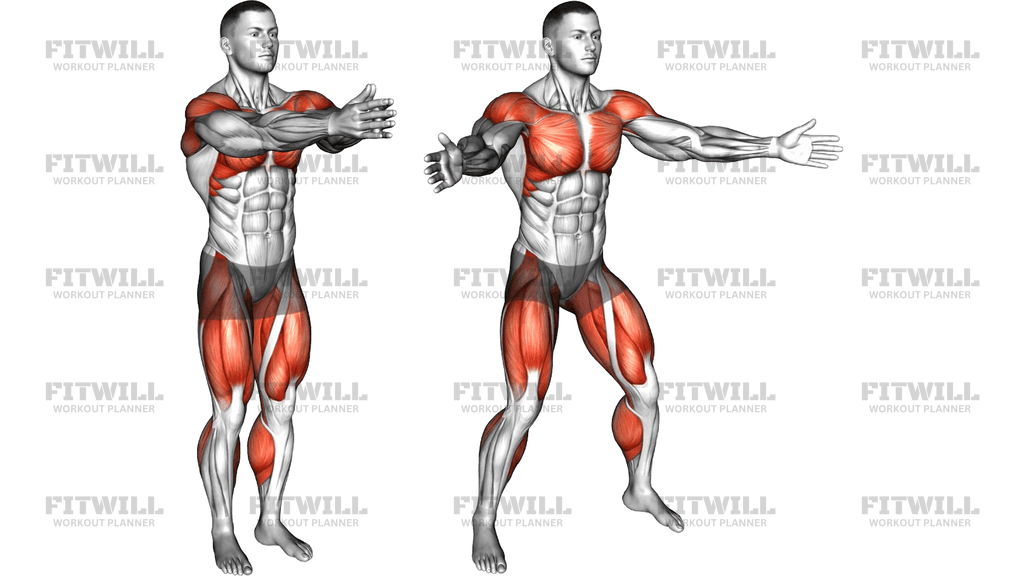
The Predator Jack is a dynamic bodyweight conditioning move that blends the rhythm of a jumping jack with a sweeping arm pattern. Instead of the simple overhead arm swing of a standard jack, you drive your arms from a crossed position in front of your chest out to a wide open position at shoulder height, while your legs jump between a narrow stance and a wide, softly bent-knee stance. The result is a movement that raises your heart rate quickly while challenging coordination, timing, and control through the shoulders, chest, and hips.
This exercise fits well into warm-ups, circuit training, and cardio intervals because it works the whole body without any equipment. The repeated opening and closing of the arms and legs recruits the chest and shoulders as the arms sweep wide, the quads and inner thighs as you land into the wide stance, the calves with each hop, and the core as it holds your torso upright through every change of direction. Because the arms stay active at chest height rather than swinging overhead, many people find it easier to keep good posture than with a traditional jumping jack.
The setup matters more than it looks. Standing tall with the ribs stacked over the hips and the arms held at chest height sets the path for the entire movement. If your arms drift or your knees collapse inward on the wide landing, the pattern loses its crispness and the workload shifts away from the intended muscles. A slight bend in the knees at the wide position keeps the landing quiet and protects the joints.
To execute it well, think of the arms and legs as one coordinated unit: the feet go wide exactly as the arms open wide, and everything returns to center together. Move at a pace you can sustain with clean form — the Predator Jack rewards rhythm, not rushing. Land on the whole foot with weight spread across the mid-foot, and keep the chest open as the arms come back across the front.
You will see this movement in martial arts–inspired cardio workouts, bootcamp classes, and home routines where floor space is limited and no equipment is available. It scales easily: beginners can step one foot out at a time instead of hopping, while advanced trainees can increase speed or add longer intervals. Keep the volume sensible — because it is repetitive and impact-based, it is better done in timed sets with good form than pushed to the point where your landings become heavy and sloppy.
Fitwill
Log Workouts, Track Progress & Build Strength.
Achieve more with Fitwill: explore over 9600 exercises with images and videos, access built-in and custom workouts, perfect for both gym and home sessions, and see real results.
Start your journey. Download today!




Instructions
- Stand tall with your feet together or a few inches apart, weight spread evenly across both feet, and your posture upright with the ribs stacked over the hips.
- Extend both arms straight out in front of your chest at shoulder height, hands open with palms facing each other or lightly overlapping, elbows soft but not bent.
- Brace your core lightly and soften your knees so you are ready to move — do not lock out the legs or let the lower back arch.
- In one motion, hop both feet out to a wide stance while sweeping both arms out to the sides until they are fully open at shoulder height.
- Land softly in the wide position with a slight bend in both knees, letting the knees track over the toes rather than collapsing inward.
- Immediately hop the feet back to the narrow starting stance while sweeping the arms around and across the front of your chest, returning to the crossed-arm position.
- Keep the arm sweep at chest height throughout — the arms travel horizontally, not overhead and not dropping toward the hips.
- Breathe in a steady rhythm, inhaling on the opening phase and exhaling as the arms cross back in, and keep breathing continuously rather than holding your breath.
- Maintain the same tempo for your chosen interval or rep count, then finish the set by stepping the feet together, lowering the arms, and shaking out the shoulders before the next exercise.
Tips & Tricks
- The most common mistake is letting the arms drop below shoulder height on the wide phase — the movement becomes a lazy swing. Keep the open arms level with your chest so the shoulders and chest actually do the work.
- Watch your knees on the wide landing. If they cave inward, deliberately spread the floor with your feet as you land so the knees track over the middle of the foot.
- Heavy, slapping landings usually mean your legs are tired or the tempo is too fast. Slow down until every landing is quiet through the whole set.
- Keep the torso upright as the arms cross in front. Leaning the chest back to make room for the arms turns the move into a lower-back stress instead of a core-controlled pattern.
- If your shoulders creep up toward your ears as the arms sweep wide, reset between intervals: shrug up, then pull the shoulder blades down and back before starting again.
- No space or joint comfort for hopping? Step one foot out to the wide stance as the arms open, step it back as the arms cross, then alternate — the pattern and conditioning effect stay largely intact.
- Crossing the arms fully at the front is part of what makes this a Predator Jack rather than a standard jack. Cutting the cross short shortens the chest and shoulder range on every rep.
- Because the pattern repeats quickly, form drifts fast. Check yourself halfway through each set: feet quiet, knees soft, arms at chest height, torso tall.
- Place this exercise early in a workout as a primer or in the middle of a cardio circuit, not as the last thing you do when your legs are already fatigued — the landings need fresh, responsive legs.
Frequently Asked Questions
What muscles does the Predator Jack work?
It is primarily a conditioning move, but the sweeping arm action loads the chest and shoulders, while the wide landings engage the quads, inner thighs, glutes, and calves. The core stays active the entire time to keep the torso upright through the rapid changes of direction.
How is the Predator Jack different from a regular jumping jack?
In a regular jack the arms swing overhead; in the Predator Jack the arms stay at chest height and travel from a crossed position in front of the body out to a fully open position. The leg action is similar, but the arm path changes the emphasis and the coordination demand.
Is the Predator Jack suitable for beginners?
Yes, as long as you start with a step-through version: step one foot out to the wide stance as the arms open, step back in as they cross, and build rhythm before adding the hop. Once the pattern feels natural and your landings are quiet, progress to the jumping version.
How wide should my stance be at the open position of the Predator Jack?
Wide enough that you land with a soft knee bend and your feet comfortably outside shoulder width, but not so wide that your knees collapse inward or your heels lift. If you feel strain at the inner thighs or hips, narrow the stance slightly.
Why do my shoulders burn more than my legs during Predator Jacks?
The arms travel through a long horizontal sweep at chest height every rep, which places a steady demand on the chest and shoulder muscles. If it becomes uncomfortable, slow the arm speed slightly and make sure you are not shrugging the shoulders up toward the ears.
Can I do the Predator Jack if jumping bothers my knees?
Use the low-impact step version and focus on the arm sweep and controlled weight shift. Keep the knee bend modest and make sure the knees track over the toes in the wide stance. If discomfort persists, choose a different cardio movement and consult a qualified professional.
How long should I perform Predator Jacks in a workout?
Timed intervals of 20 to 40 seconds work well for most people, or roughly 15 to 25 reps per set. Stop the set when your form slips — especially when landings get heavy or the arms start dropping below chest height.
Should my arms cross fully in front of my chest on every rep?
Yes, the full cross in front is what defines the movement and gives the chest and shoulders a complete sweep each rep. Aim for the hands to pass each other or lightly overlap, keeping the arms at chest height rather than drooping downward.
What is the most common form mistake with this exercise?
Rushing. People speed up until the arms stop crossing fully, the knees cave inward on the wide landing, and the landings become loud. Cut the tempo in half, restore the full arm sweep and clean landings, then build speed back up from there.
Where does the Predator Jack fit best in a training session?
It works well as a warm-up primer to raise the heart rate and wake up the shoulders and hips, or as a cardio station inside a circuit. Because it relies on responsive landings, avoid placing it at the very end of a session when your legs are already fatigued.