Seated Quadriceps Stretch
The Seated Quadriceps Stretch is a floor-based flexibility exercise that lengthens the quadriceps, the large muscle group across the front of the thigh. You sit with one knee bent so the foot rests alongside your hip, place your hands on the floor behind you for support, and gradually lean your torso back to intensify the stretch along the front of the thigh. The opposite leg is folded in front of you with the foot tucked toward the inner thigh, which gives your hips a stable, symmetrical base to lean from.
This stretch is especially useful for anyone whose quads spend a lot of time in a shortened position: runners, cyclists, desk workers, and lifters who squat or lunge heavily. The quadriceps, particularly the rectus femoris, which crosses both the hip and the knee, commonly get tight from these activities, and tight quads can contribute to that stiff, heavy feeling in the thighs and the front of the hips after training days.
Setup matters here more than in most stretches. How far your bent knee travels out to the side and how close your foot sits to your hip both determine where you feel the stretch. Keep the foot in line with the knee rather than flaring it wide, and let your torso position, not your hands, control the intensity. Leaning back onto your palms, then onto your forearms or elbows if your flexibility allows, is the progression path shown in this movement.
To execute it well, ease into the lean over several breaths instead of dropping back at once. You should feel a broad, even stretch down the front of the thigh and possibly into the hip flexors, never a sharp pull at the knee. If your knee lifts off the floor or the sensation concentrates in the kneecap, back off slightly and let the thigh settle before going deeper.
A common use case is as a cooldown after leg training, running, or cycling, holding each side for 20 to 40 seconds. It also works well in a dedicated mobility session alongside hamstring and hip flexor stretches, since the seated position lets you relax into the stretch rather than fight for balance as you would in a standing quad stretch.
The main safety point is to respect the knee joint. The stretch should live in the thigh muscles, not in the knee ligaments or the kneecap. If you have a history of knee discomfort, keep the torso more upright and reduce the foot-to-hip distance until your range improves gradually over weeks of consistent practice.
[ Workout Log & Planner ]
Put your next workout in Fitwill
Keep your plan and training log ready when you are.


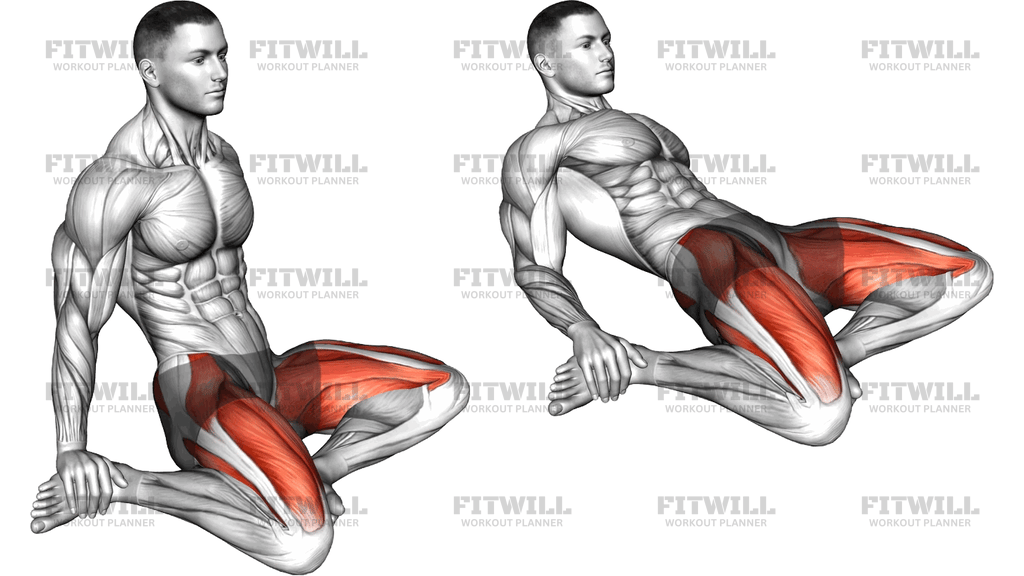
Instructions
- Sit on the floor with your legs extended in front of you, then bend your right knee and draw the foot in so the heel rests near your left inner thigh.
- Bend your left knee and place the left foot alongside your left hip, with the top of the foot flat on the floor and the shin running back from the knee.
- Settle your weight evenly over both hips and sit tall, resting one hand on the floor on each side of your body behind you.
- Brace your core lightly and keep your chest lifted as you begin to shift your weight backward into your hands.
- Lean your torso back gradually, letting the front of the left thigh lengthen; stop when you feel a firm but comfortable stretch in the quadriceps.
- For a deeper stretch, lower onto your forearms or elbows, keeping the bend in the left knee honest and the foot flat against the floor beside the hip.
- Breathe slowly and steadily, exhaling as you settle into each small increase in depth, and hold the end position for 20 to 40 seconds.
- Press through your hands to lift your torso back upright in a slow, controlled motion before releasing the leg.
- Straighten the left leg, shake it out briefly, then switch sides so the right knee is bent with the foot beside the right hip and repeat for the same hold.
Tips & Tricks
- If the stretch concentrates right at the kneecap instead of spreading across the thigh, move the bent-leg foot a few inches farther from the hip to reduce knee compression.
- A knee that floats up off the floor usually means the hip is fighting the position; don't force it down, just reduce the lean and let gravity work over multiple sessions.
- Squeeze the glutes of the stretched leg gently while leaning back, as this naturally lengthens the rectus femoris across the hip and makes the stretch more effective.
- Keep both sitting bones as level as you can; collapsing onto one hip twists the pelvis and shifts the stretch into the lower back instead of the thigh.
- Point the toes of the bent leg straight back rather than letting the foot roll outward, which keeps even tension across the quadriceps.
- If your lower back complains during the lean, narrow the backward angle and support more weight on your hands instead of dropping to the elbows.
- Warm thighs stretch far better, so save this for after leg training or a short walk rather than as your first movement of the day.
- Progress depth through time, not force, holding 20 seconds the first week and adding a few seconds per side each week as the thigh tolerates it.
Frequently Asked Questions
Which muscles does the Seated Quadriceps Stretch target?
The primary target is the quadriceps on the front of the thigh, with strong emphasis on the rectus femoris because the bent knee puts it on stretch across both the hip and the knee. The hip flexors at the front of the hip often feel a secondary stretch as you lean back.
Why is the foot placed beside the hip instead of behind the body?
Sitting the foot alongside the hip with the shin flat on the floor keeps the knee bend within a comfortable range while still lengthening the quad. It also gives you a stable base to lean back from, so you control the intensity with your torso rather than by pulling on the leg.
Is the Seated Quadriceps Stretch suitable for beginners?
Yes, as long as you stay upright at first. A beginner can hold the position with the torso vertical and hands on the floor behind the hips, then lean back only a few degrees as flexibility improves.
How long should I hold each side?
Aim for 20 to 40 seconds per side, repeated two to three times if you are working on mobility. Longer, relaxed holds are more productive for flexibility than short, forceful pulls.
My knee lifts off the floor during the lean back. What should I do?
That usually means the quad or hip is not ready for that depth yet. Reduce the backward lean, keep the torso more upright, and let the knee descend gradually over weeks of practice rather than pressing it down with your hand.
Can I do this stretch if I feel pinching at the front of the knee?
Sharp or pinching knee sensation is a signal to stop and adjust, not push through. Move the foot farther from the hip, keep the shin in line with the knee, and stay more upright; if the sensation persists, choose a gentler standing or side-lying quad variation.
How is the Seated Quadriceps Stretch different from a standing quad stretch?
The seated version removes the balance demand, so you can fully relax the thigh and use the floor to control depth, which makes it better for longer holds. The standing version is convenient mid-workout but tends to be shallower because you are also stabilizing yourself.
Should I stretch both sides even if only one thigh feels tight?
Yes, work both sides for the same hold. Matching the sides keeps your hips and knees symmetrical, and the tighter leg often catches up faster when both are trained consistently.
When is the best time to use this stretch?
It fits best as a cooldown after running, cycling, or leg training, or within a dedicated flexibility session when the muscles are already warm. Doing it cold usually produces a stiffer, less productive stretch.