Dumbbell Single Stiff Leg Deadlift
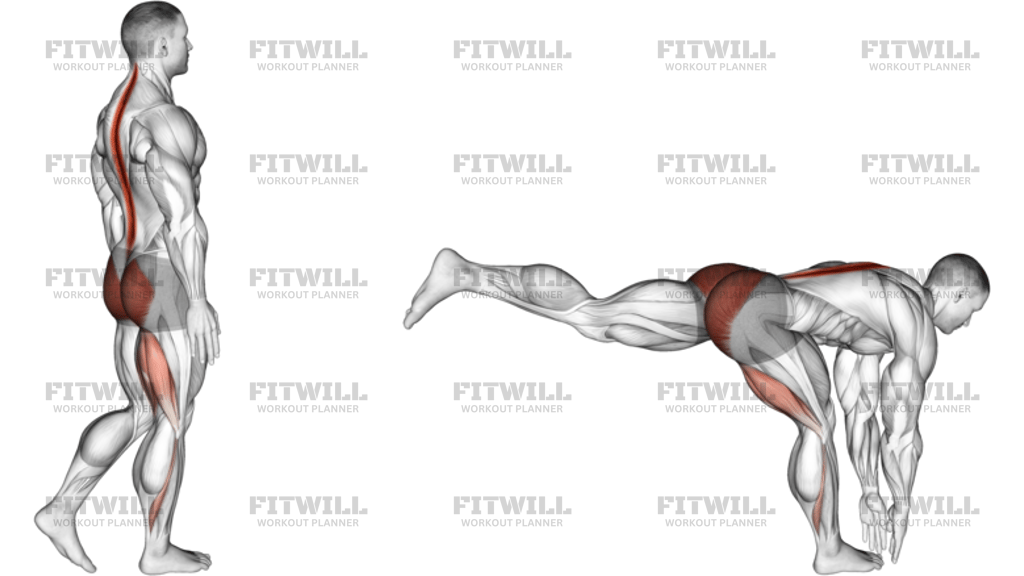
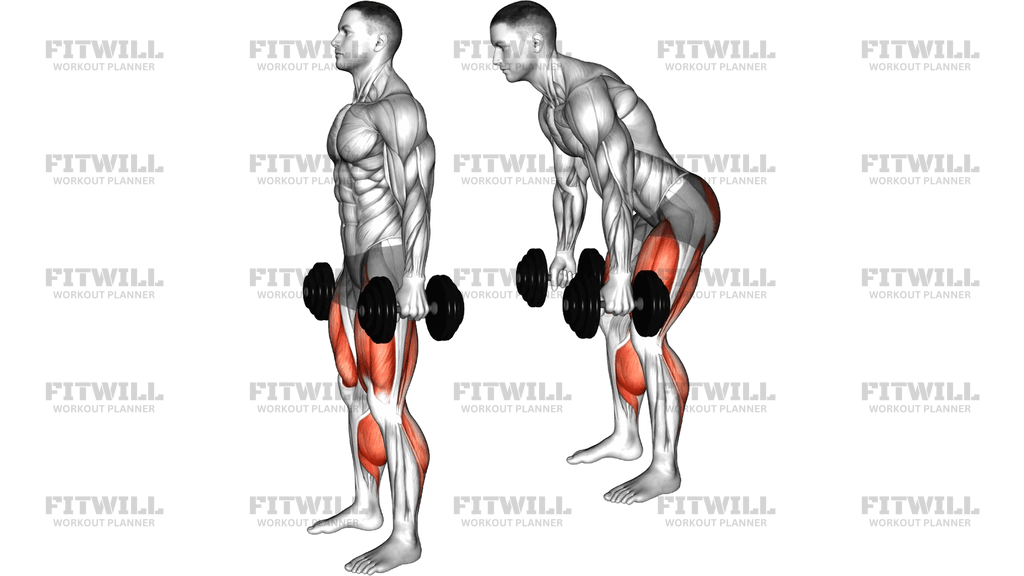
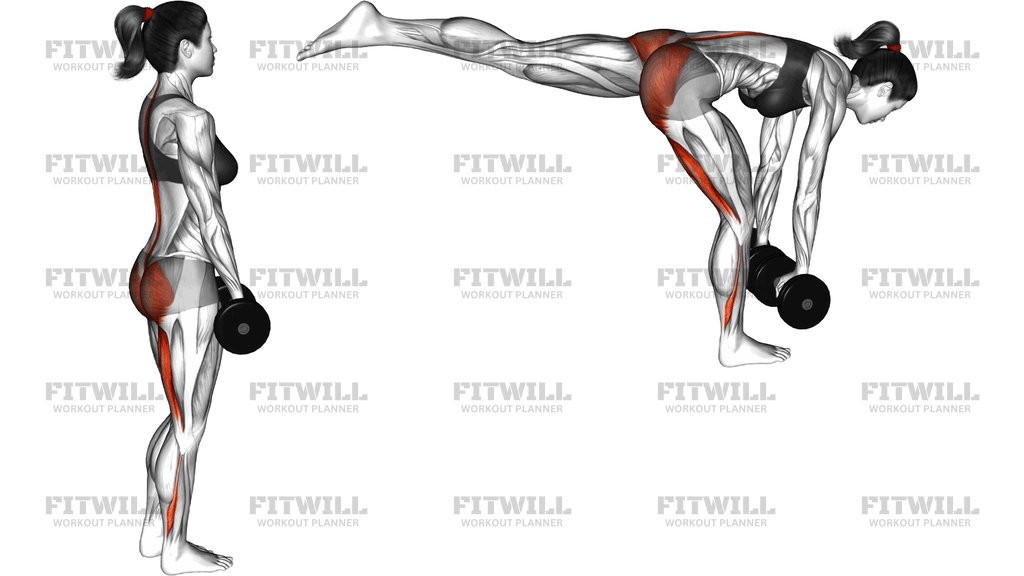
The Dumbbell Single Stiff Leg Deadlift is a one-legged hinge performed while holding a dumbbell in one hand. You balance on a single straight leg, keep the knee soft but essentially fixed, and drive the hips back as the free leg swings behind you like a counterweight. The torso travels forward until you feel a strong stretch along the hamstring of the standing leg, then you push the floor away to return upright. It is one of the simplest tools for teaching the hip hinge because it forces the movement to come from the hips rather than the lower back.
This exercise earns its place in most programs because it trains three things at once: hamstring strength through a deep stretch, glute drive to bring you back up, and balance under a light-to-moderate load. Because you are on one leg, each side has to do its own work, which is useful for clearing up left-right differences in strength, control, or hip mobility. Runners, field sport athletes, and anyone rehabbing toward heavier barbell deadlifts tend to benefit from it, since single-leg work also conditions the foot, ankle, and hip stabilizers in a way bilateral lifts do not.
Setup matters more here than in most hinge variations. Your weight should sit over the midfoot of the standing leg, your spine stays long and neutral, and the dumbbell hangs close to the body rather than drifting forward. If the dumbbell wanders away from your shin line, the load leverages your lower back instead of loading the hamstrings. The hinge comes from pushing the hips backward, not from simply bowing the chest down, so cueing yourself with "hips back, chest tall" at the start of each rep keeps the pattern honest.
To execute well, think of the free leg and your torso as two ends of a seesaw: as the chest lowers, the rear leg rises, and both stay in one straight line from head to heel. Stop when you feel the hamstring reach its comfortable end range — usually somewhere between torso-parallel and just above it. Reverse by squeezing the standing-leg glute and driving the hip forward until you are standing tall again. Keep the movement smooth and slightly slower than a two-legged deadlift; speed hides balance errors.
In practice, this movement works well as a main single-leg strength lift with a moderate dumbbell for sets of 6-10 per side, or as a lighter accessory done for higher reps after squats or deadlifts. Newer lifters can hold the dumbbell in both hands or even just a light weight to learn the balance first. The main safety points are keeping the back neutral, avoiding a locked-and-bouncing knee, and leaving your ego at the door — the balance demand means most people start far lighter than they expect.
[ Workout Log & Planner ]
Put your next workout in Fitwill
Keep your plan and training log ready when you are.


Instructions
- Stand tall with a dumbbell in one hand at your side, feet together, and shift your weight onto one leg so the toes of the other foot just rest on the floor for balance.
- Set your standing knee slightly bent and keep it in that position for the whole set; place your free hand on your hip or extend it out to the side to help with balance.
- Brace your core as if bracing for a light punch, pull your shoulder blades back so your spine is long, and look at a fixed point on the floor a few feet ahead of you.
- Push your hips straight back behind you, letting the dumbbell slide down the front of your thigh toward your shin as your torso leans forward.
- Lift your free leg behind you at the same time so it stays in line with your torso — head, hips, and rear heel forming one long line at the bottom.
- Lower until you feel a clear stretch in the hamstring of the standing leg, keeping the dumbbell close to your leg and your back flat.
- Drive your hips forward by squeezing the glute of the standing leg, pulling the dumbbell back up along the same path until you are fully upright.
- Exhale as you stand up, inhale at the top, and pause briefly to reset your balance before starting the next rep.
- Complete all reps on one side, then switch the dumbbell to the other hand and repeat on the opposite leg.
Tips & Tricks
- If you wobble side to side, the usual culprit is the dumbbell drifting forward of your shin — think of dragging it along your leg like a rail.
- Do not straighten the standing knee completely; a locked knee plus a heavy dumbbell turns this into a lower-back stress test instead of a hamstring exercise.
- Keep your hips square to the front. The hip of the rear leg loves to rotate open as you hinge, which twists the lower back and steals tension from the hamstring.
- Grip the dumbbell slightly firmer than feels necessary. A firmer grip improves shoulder stability, which tightens the whole line from hand to heel.
- Film yourself from the side once: if your lower back rounds at the bottom instead of your torso simply stopping, you have gone past your current hamstring range — shorten the depth.
- Practicing the movement barefoot or in flat shoes sharpens the feedback from your foot; three points of contact with the floor make balance much easier.
- Start with the dumbbell in the hand on the same side as your standing leg. If it still feels unstable, holding a light dumbbell in each hand balances the load while you learn the pattern.
- Never bounce out of the bottom stretch. Pause for a beat and pull up under control — the stretch position is where the hamstring work actually happens.
- Place a bench or wall within arm's reach when first learning; touching it with a fingertip on a wobbly rep is better than sacrificing your spine position.
Frequently Asked Questions
Which muscles does the Dumbbell Single Stiff Leg Deadlift work?
The hamstrings of the standing leg are the main movers, supported strongly by the glutes on the way up. Your lower back works to hold the spine neutral, and the foot, ankle, and hip stabilizers work continuously to keep you balanced.
Should the dumbbell be in the same hand or the opposite hand as my standing leg?
Holding it on the same side as the standing leg is the standard setup shown for this exercise. Moving it to the opposite hand shifts your center of mass over the working leg and can actually make balance easier, so both are worth trying.
How far down should I lower the dumbbell?
Lower only until you feel a solid stretch in the hamstring of the standing leg with your back still flat. For most people that is around torso-parallel, but going deeper by rounding the lower back cancels the benefit and adds risk.
Is the Dumbbell Single Stiff Leg Deadlift good for beginners?
Yes, as long as the load starts low. Beginners should first rehearse the hinge pattern with bodyweight or a very light dumbbell, since the single-leg balance is usually the limiting factor, not strength.
Why do I keep losing my balance halfway through the rep?
Common causes are the dumbbell drifting away from your leg, moving too fast, or letting the hips rotate open. Slow the tempo, keep the weight sliding along your shin line, and fix your eyes on one spot on the floor ahead of you.
What can I use instead of a dumbbell?
A kettlebell works well because the handle sits above the weight and keeps the load close to your body. With no equipment at all, a bodyweight single-leg hinge with hands reaching forward is a valid substitute for learning the pattern.
How is this different from a regular dumbbell stiff leg deadlift on two legs?
The single-leg version loads one hamstring at a time, demands far more balance and hip stability, and uses lighter weights. The two-legged version lets you handle more total load but hides side-to-side differences.
How many sets and reps should I do?
For strength and control, 3 sets of 6-10 reps per side with a moderate dumbbell works well. For balance and endurance, 2-3 sets of 10-15 reps per side with a lighter weight is a better fit.
My lower back gets sore after this exercise — what am I doing wrong?
Soreness usually means your lower back is rounding at the bottom or your hips are twisting during the hinge. Reduce the depth, lighten the dumbbell, and focus on keeping the chest proud and the hips square until the movement feels clean.