Dumbell Glute Dominant Bulgarian Split Squat
The Dumbbell Glute Dominant Bulgarian Split Squat is a rear-foot-elevated split squat performed with a deliberate forward torso lean, a setup that shifts the workload away from the front quad and onto the glutes and hamstrings of the working leg. You place the top of one foot on a flat bench behind you, hold a dumbbell in each hand at your sides, and squat down on the front leg until your rear knee drops close to the floor. Because the torso is hinged over the front foot from the very first rep, the hip sits in a position where the glute has to extend a deep flexion angle under load, which is exactly what makes this version so effective for glute development.
This movement is useful for almost anyone chasing stronger, better-shaped glutes without loading the spine with a barbell. Because the weight hangs at your sides, the lower back is far less stressed than in a barbell squat, and the split stance lets you train one side at a time, which helps expose and fix left-right strength differences. It is a common choice in lower-body hypertrophy programs, in rehabilitation-style progression after someone has mastered static lunges, and among lifters who find back squats uncomfortable but still want a heavy, demanding hip-dominant exercise.
Setup matters more here than in most single-leg work. The distance between your front foot and the bench controls how the movement feels: too close and the front knee travels far past the toes with a quad-dominant pattern, too far and you lose stability and depth. A forward shin angle of roughly vertical to slightly past vertical, combined with a torso hinge of about 30 to 45 degrees, creates the glute-biased path. The dumbbells should hang relaxed at arm's length so they do not pull your torso out of the hinge.
Execution is about controlled depth and a strong hip drive. Descend until your rear knee nearly touches the floor and you feel a real stretch across the front of the rear hip and the glute of the working leg, then push the floor away through the whole front foot, driving the hip up and back to standing without letting the torso pop upright early. Keep the front knee tracking over or slightly outside the toes the whole way.
A few practical points keep this safe and productive. Balance is the first limiting factor for most people, so expect to learn the pattern with light dumbbells or body weight before adding real load. Grip the dumbbells firmly, keep your ribs stacked over your pelvis, and stop the set when your front foot starts twisting or your rear hip starts drifting sideways, since those are the usual signs of fatigue rather than a reason to grind out more reps.
Fitwill
Log Workouts, Track Progress & Build Strength.
Achieve more with Fitwill: explore over 9600 exercises with images and videos, access built-in and custom workouts, perfect for both gym and home sessions, and see real results.
Start your journey. Download today!




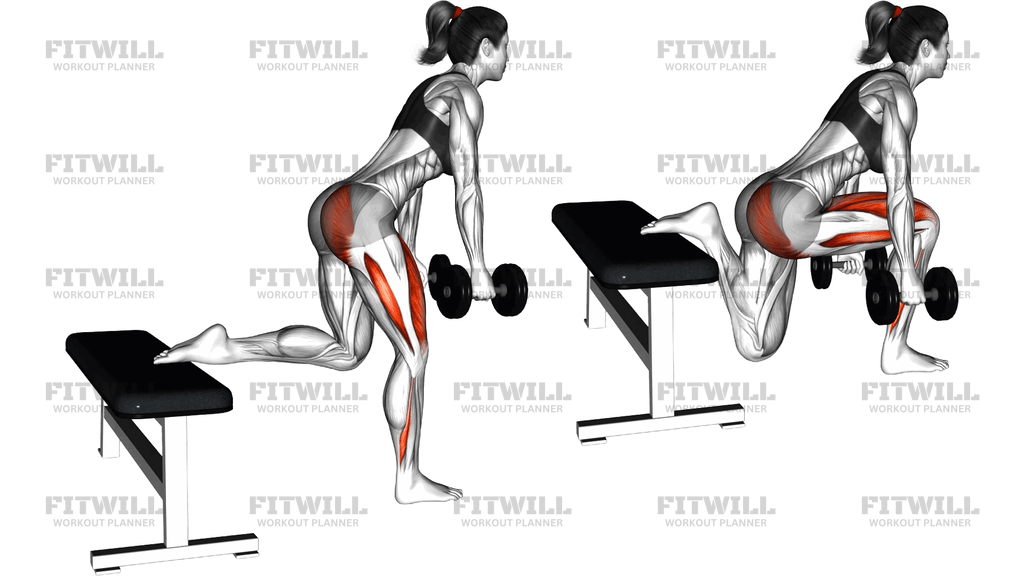
Instructions
- Stand facing away from a flat bench and place the top of your rear foot, laces down, on the bench pad so the heel stays off the edge.
- Hop or step your front foot forward until, at the bottom of the squat, your shin sits close to vertical with your weight spread across the whole front foot.
- Hold a dumbbell in each hand with a firm grip and let your arms hang straight down at your sides, shoulders pulled back and down.
- Hinge forward from the hips about 30 to 45 degrees so your chest sits over or just behind your front knee, and hold that torso angle for the entire set.
- Brace your core as if preparing for a light punch, and look at a spot on the floor a meter or so ahead of your front foot.
- Bend the front knee and hip together, lowering straight down until your rear knee is just above the floor and you feel a stretch in the glute of the working leg.
- Check that the front knee tracks over the toes or slightly outside them, never caving inward.
- Drive through the whole front foot, pushing the floor away to stand back up while keeping the torso lean until you are nearly upright.
- Exhale on the way up and inhale on the way down, keeping the breath steady rather than holding it through heavy reps.
- Complete all reps on one leg, then re-set your stance on the bench and perform the same number on the other side.
Tips & Tricks
- If you feel this mostly in the front of your thigh, your torso is probably too upright — push your hips back and let your chest come lower over the front foot before descending.
- Front foot placement is the most common setup error: aim for roughly two to two and a half of your own foot-lengths from the bench, then adjust based on whether the knee or the hip feels loaded.
- Let the dumbbells hang fully at arm's length; curling them toward you or shrugging to stabilize rotates the torso and steals work from the glute.
- The rear foot should rest on the bench, not push off it — if you catch yourself driving through the back toes, shorten the range slightly and re-focus on the front leg.
- Pause for a full second in the bottom position if balance is the limiting factor; the pause forces you to own the stretched glute position instead of bouncing.
- A slightly wider front foot, turned out 5 to 10 degrees, gives the hip more room to descend and often lets you sit deeper into the glute.
- Do not chase depth by rounding your lower back — once your pelvis tucks and your spine curls, the set is over even if the knee has not reached the floor.
- Start with lighter dumbbells than you would use for a regular split squat; the forward hinge adds leverage against the glute and hamstrings, making the same load feel heavier.
- If your standing foot slides on a smooth gym floor, place a mat under it or use flat-soled shoes rather than widening into an unstable split.
Frequently Asked Questions
Which muscles does the Dumbbell Glute Dominant Bulgarian Split Squat work?
It primarily targets the gluteus maximus of the front leg, with strong involvement from the hamstrings and adductors. The quads still work to extend the knee, but the forward torso lean reduces how much they dominate compared with an upright version.
How is the glute dominant version different from a regular Bulgarian Split Squat?
In the glute dominant version you hinge your torso forward over the front foot and drive up through the whole foot with an emphasis on the hip, which lengthens and loads the glute more. A regular version keeps the torso more upright, which shifts emphasis toward the quads.
Can beginners do the Dumbbell Glute Dominant Bulgarian Split Squat?
Yes, but most beginners should start with body weight and a lower surface like a step before using dumbbells. The balance demands are significant, and learning the hinge pattern unloaded makes the loaded version far more effective.
Why do I feel it more in my quads than my glutes?
The most likely causes are a torso that stays too upright, a front foot placed too close to the bench, or pushing up onto the toes. Hinge the chest forward, check that your front shin is close to vertical at the bottom, and keep the whole foot planted.
How far should my front foot be from the bench?
Roughly two to two and a half of your own foot-lengths is a good starting point. At the bottom, your front shin should be near vertical; if the knee travels far past the toes, step the foot further forward, and if you feel unstable or cannot reach depth, bring it slightly closer.
Should the rear foot be flat on the bench or on the toes?
Rest the top of the foot and toes on the bench with the laces down, which is the standard setup. This keeps the rear leg as a passive support rather than an active pusher, so the front leg does the work.
What can I use instead of dumbbells for this exercise?
You can perform it with body weight, with a single dumbbell or kettlebell held in the goblet position, or with a barbell across the upper back if your mobility allows. The dumbbell setup is often preferred because the hanging load spares the lower back and makes balancing easier.
Is it normal for my back knee to touch the floor?
Lightly touching or hovering just above the floor is fine on most surfaces, as long as you are not slamming into it. Lower under control and reverse the movement as soon as you feel the glute stretch.
Is it safe for the front knee?
When the front foot is placed correctly, the knee tracks over the toes, and the load is controlled, this is generally a knee-friendly way to train the lower body. Keep the load moderate at first and stop if you feel pinching or pain in the joint rather than muscular effort.
How many reps and sets should I do?
For muscle building, 3 to 4 sets of 8 to 12 reps per leg with a controlled tempo works well for most lifters. Because balance fatigues before the glutes do on this exercise, stop the set when your foot starts wobbling or twisting rather than grinding out unstable reps.