Dumbbell Lunge Squat
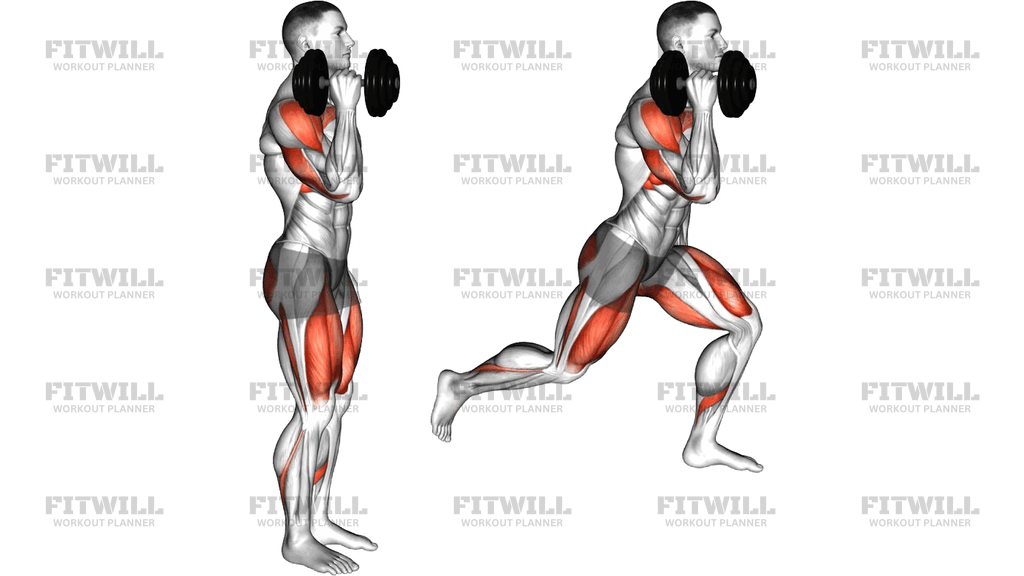
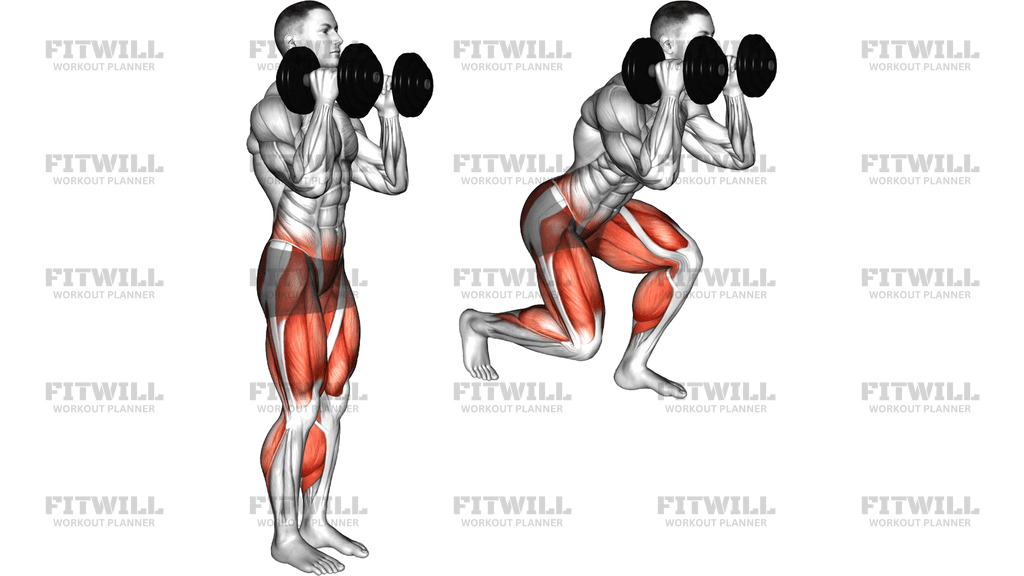
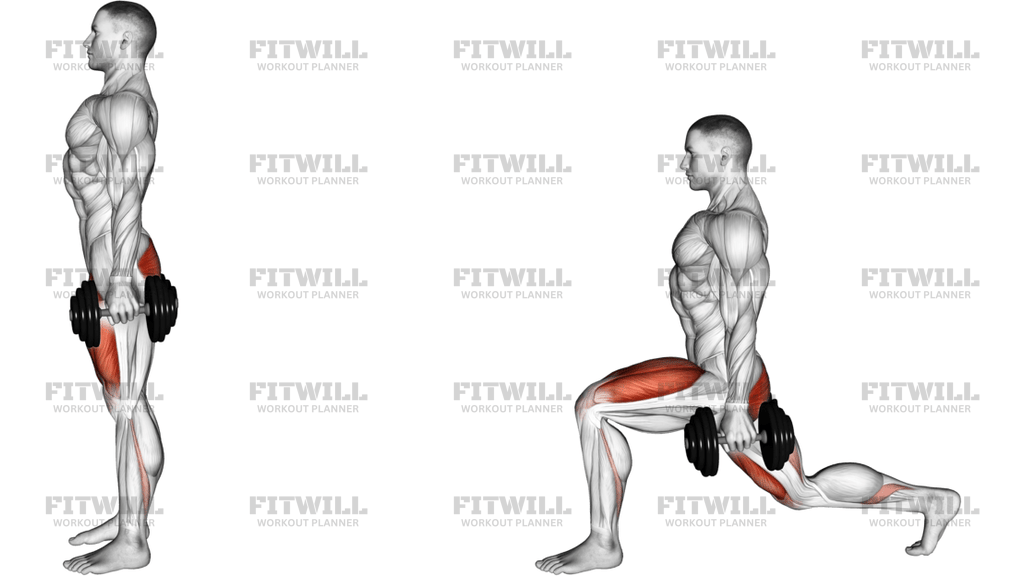
The Dumbbell Lunge Squat is a single-leg strength exercise performed with a pair of dumbbells held at shoulder height in a racked position. From a tall standing stance, you step one leg back into a deep lunge, lower until both knees reach roughly 90 degrees, then drive through the front foot to return to standing. The shoulder-height dumbbell position is what separates this from a standard farmer-hold lunge: it raises the center of mass, forces your torso to stay upright, and adds a real demand on your core and upper back that a low-hold variation doesn't provide.
The main work is done by the quadriceps of the front leg, with the glutes and hamstrings contributing heavily on the drive back up. The elevated front knee and dropped back knee position loads the lead leg almost entirely, which makes this a useful tool for finding and fixing side-to-side strength differences. Because each rep is supported by one leg, your ankle and hip stabilizers work overtime in a way they never do during a barbell back squat.
This variation suits intermediate lifters who want leg development without heavy spinal loading, and it's a common choice in hypertrophy programs where squats and lunges are trained on the same day. The racked dumbbell position also lets you train legs hard when a barbell isn't available or when lower back fatigue is a concern, since the load sits against your shoulders rather than pulling down your spine.
Setup matters more than people expect. Dumbbells rested properly on the front of the shoulders let your arms act as shelves; if you try to hold them purely with arm strength, your grip and biceps will fail long before your legs do. Your stance width, torso angle, and step length all determine whether the work lands on your quads and glutes or leaks into your lower back.
To execute well, keep your ribs stacked over your hips, step back rather than forward, and let the back knee travel down toward the floor. Push the floor away through the whole front foot, not just the toes, and finish each rep with your hips fully open before stepping back with the other leg. Controlled tempo beats depth-chasing here: a smooth three-second descent with a strong drive up does more for your legs than rushing through sloppy reps.
Common use cases include leg day finishers, unilateral strength blocks, and home training where dumbbells are the only load available. For safety, start lighter than you think you need, since balance under load is often the limiting factor early on, and step back from the exercise if you feel twisting stress in the front knee rather than muscular effort.
[ Workout Log & Planner ]
Put your next workout in Fitwill
Keep your plan and training log ready when you are.


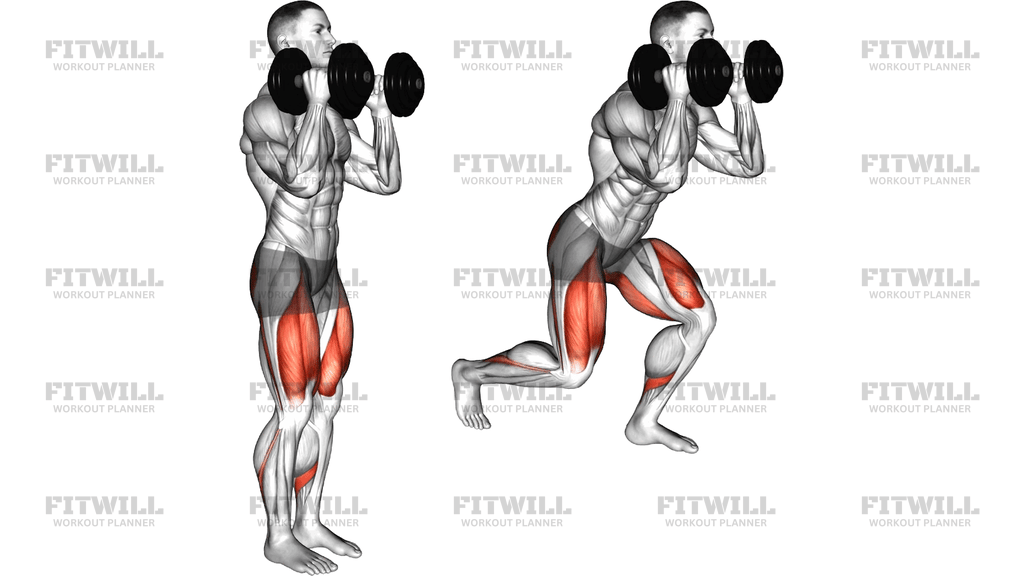
Instructions
- Stand tall with a dumbbell in each hand, then clean them up so they rest on the front of your shoulders with your elbows pointing down and slightly forward.
- Set your feet hip-width apart, toes pointing straight ahead, and lift your chest so your ears, shoulders, and hips line up.
- Brace your core as if preparing for a light punch to the stomach and pull your shoulder blades gently back to keep the dumbbells stable.
- Shift your weight onto one foot, then step the opposite leg straight back about two to three feet, landing on the ball of that foot.
- Bend both knees to lower your body straight down until your back knee hovers just above the floor and your front thigh is close to parallel.
- Keep your torso upright throughout the descent; let the dumbbells press into your shoulders rather than letting your elbows drop.
- Drive through the heel and midfoot of your front leg to push back up to standing, bringing the rear foot forward to hip width.
- Exhale as you push up and inhale on the way down, keeping your breathing steady and never holding your breath through a full rep.
- Complete all reps on one side or alternate legs each rep, resetting your stance and brace between reps if you wobble.
Tips & Tricks
- If the dumbbells roll off your shoulders, your elbows are drifting too high; drop them so your upper arms point down and the handles sit against your fingers and front delts, not your collarbones.
- A common mistake is stepping too short, which pushes the front knee far past the toes and grinds stress into the kneecap. Lengthen the step until your shin is close to vertical at the bottom.
- Watch for the front knee caving inward as you fatigue. Cue yourself to spread the floor with your front foot so the knee tracks over your second toe.
- Don't let your torso lean forward as you descend. If your chest drops, the weight is usually too heavy or your core is unbraced, so reduce the load and re-tighten before continuing.
- Keep your back heel lifted and your back toe firmly planted. Letting the rear foot roll outward shifts the rep sideways and costs you balance.
- Alternate legs rep for rep if your balance is shaky; save same-side sets for when you can complete every rep without a stability check between steps.
- Control the return step. Snapping the back foot forward and slamming it down wastes the eccentric strength benefit and often pulls your torso out of position.
- Start with dumbbells you could comfortably hold at your shoulders for 30 seconds. If your grip and shoulders fail before your legs, the load defeats the purpose of the racked position.
Frequently Asked Questions
What muscles does the Dumbbell Lunge Squat work?
The quadriceps of the front leg do most of the work, with strong contributions from the glutes and hamstrings on the way up. Holding the dumbbells at shoulder height also keeps your core and upper back engaged to keep your torso upright.
Why hold the dumbbells at my shoulders instead of at my sides?
The racked position raises the load, demands more from your core and upper back, and keeps your torso vertical, which biases the quads and glutes. Holding dumbbells at your sides is easier on balance but reduces that trunk demand.
Is the Dumbbell Lunge Squat good for beginners?
Beginners can do it, but most should start with bodyweight reverse lunges or light dumbbells at their sides first. Once you can complete ten balanced reps per leg, moving the dumbbells to your shoulders is a natural progression.
Should I step backward or forward during the lunge?
Stepping backward is the safer default because it places less shear on the front knee and makes it easier to keep your shin vertical. Forward stepping works the same muscles but requires more control and ankle mobility.
How deep should I lower each rep?
Lower until your back knee is just above the floor and your front thigh is at or near parallel. If you can't reach that depth without your heel lifting or torso folding, shorten the range until your mobility improves.
My front knee hurts when I do the Dumbbell Lunge Squat. What should I change?
Take a longer step, make sure the knee tracks over your second toe, and slow down the descent. If discomfort persists at a comfortable depth and controlled tempo, stop and have a professional assess the movement.
What can I substitute if I don't have dumbbells?
A barbell in front-rack or back-rack position, a single kettlebell in the goblet position, or simple bodyweight reverse lunges all train the same pattern. The bodyweight version is the easiest way to learn the footwork first.
How many sets and reps should I do?
For strength and muscle, three to four sets of eight to twelve reps per leg with a controlled tempo works well. Because balance is often the limiter early on, treat the first set as a calibration set and add weight only when every rep stays clean.
Why do I lose balance halfway through my set?
Fatigue in the small stabilizers of the hip and ankle usually shows up before the big muscles quit, especially with the weight held high. Alternate legs rep for rep, slow your tempo, or slightly reduce the load until your single-leg control catches up.