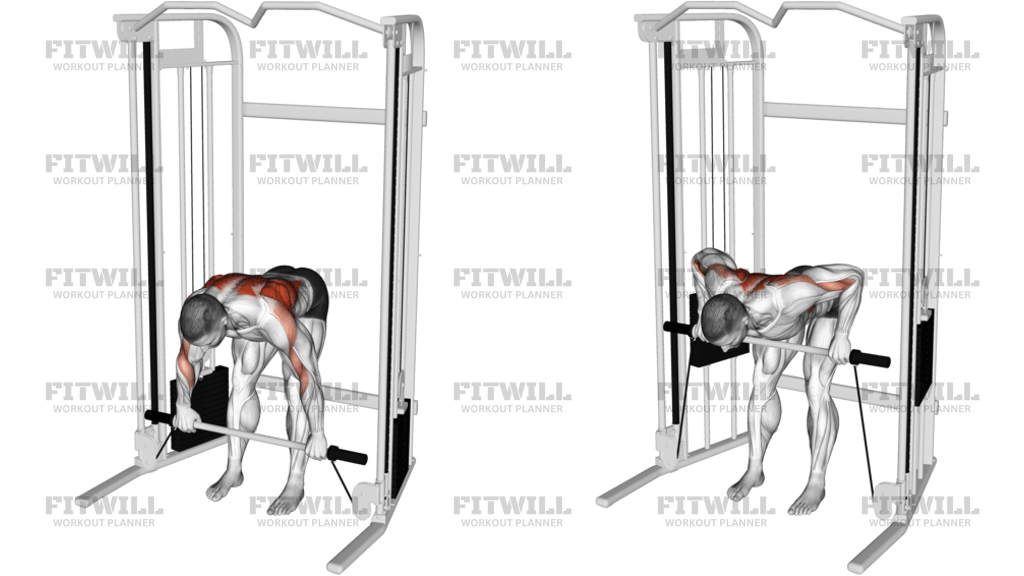
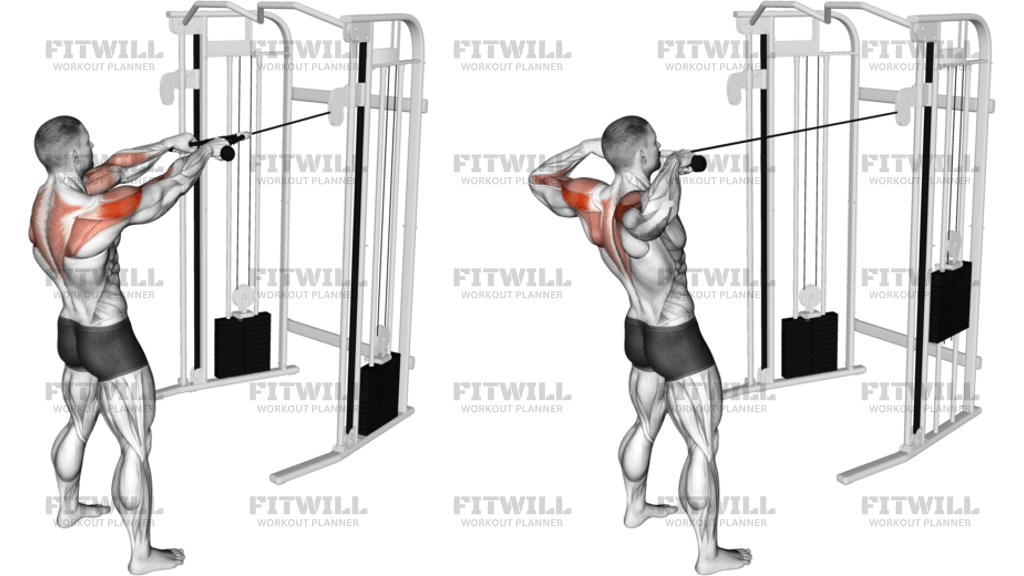
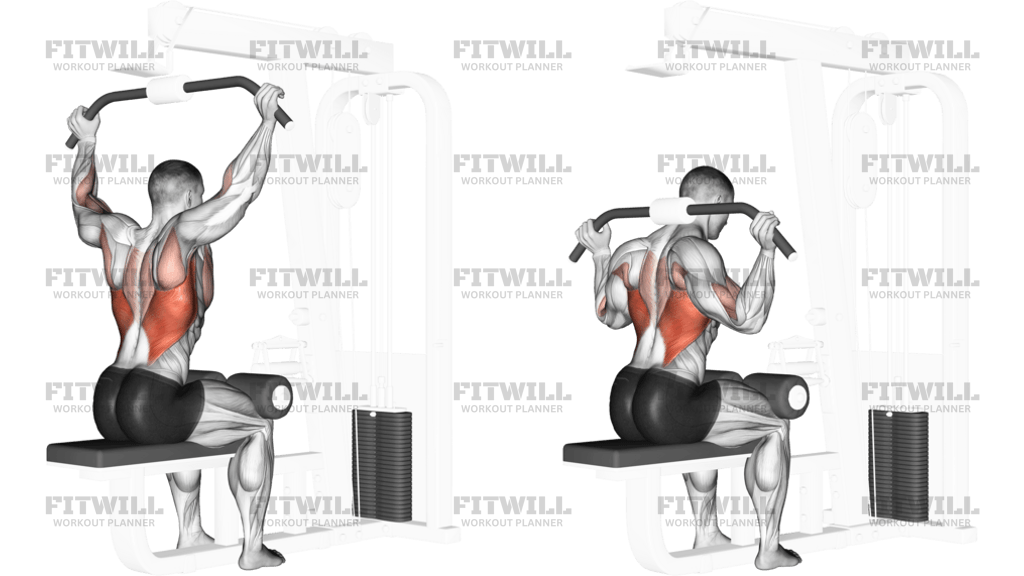
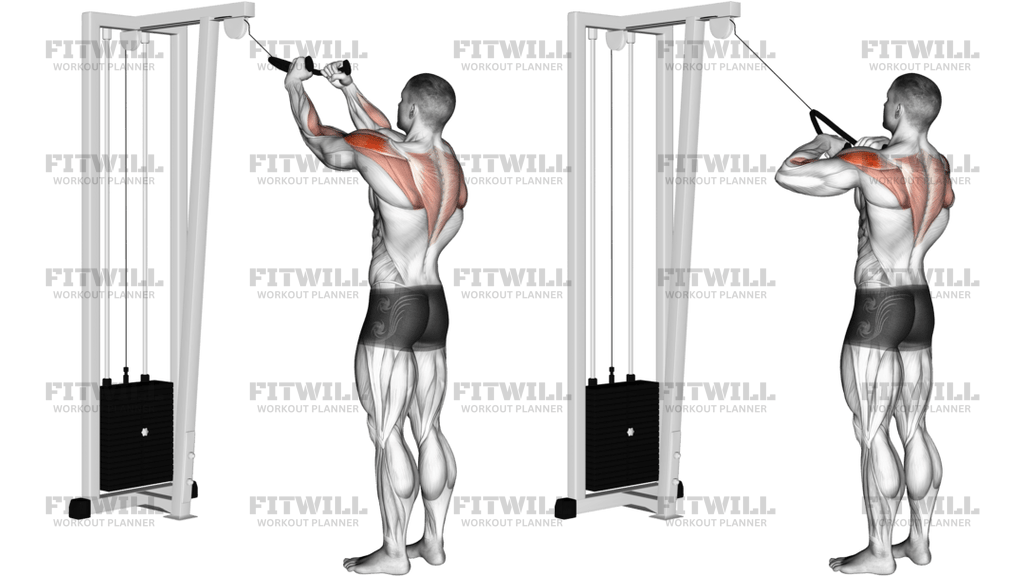
Cable Lying Face Pull
The Cable Lying Face Pull is a face pull performed from a supine position on a flat bench, with your head pointed toward a high cable pulley. Instead of standing or kneeling as in a traditional face pull, you lie on your back and pull the attachment from overhead down toward your face, letting gravity and the cable's angle load the rear shoulders and upper back through a slightly different path. Because the bench supports your torso and removes the need to resist your own body position, it can be easier to stay strict with the movement than in the standing version.
The main work is done by the rear delts, with strong assistance from the mid and lower traps, the rhomboids, and the external rotators of the shoulder. The biceps and forearms contribute as the elbows bend, and the triceps help control the arm as it extends back to the start. For anyone whose training is heavy on pressing — bench press, overhead press, push-ups — this pull balances out all that pressing volume and supports healthy shoulder mechanics.
Setup matters more here than in most cable pulls. The bench must be positioned so the cable runs roughly over your forehead when your arms are extended, because a cable that enters too high or too low changes the resistance angle mid-rep and can pull your shoulders out of position. Keep your head and upper back in contact with the bench and your feet planted so the torso stays quiet while the arms do the moving.
Execution is straightforward but easy to rush. Start with arms extended toward the pulley, pull the attachment down toward your face or forehead by driving the elbows out wide and back, then pause briefly at the closest point before letting the arms travel back overhead under control. The elbows should stay high and flare outward rather than dropping toward your sides, which is what separates a face pull from a triceps extension or a pullover.
This variation suits lifters who want focused rear delt and upper back work without standing, people who feel standing face pulls more in the lower back or legs, and anyone using a cable stack with limited floor space. It also works well as a finishing movement at the end of a shoulder or upper body day, where light weight and higher reps get the most out of the small muscles around the shoulder blade.
Keep the load modest. The rear delts and rotator cuff are small muscles, and the lying position gives you no bodyEnglish to borrow strength from. If the weight forces your head forward off the bench or your elbows to drop, the set is done.
[ Workout Log & Planner ]
Put your next workout in Fitwill
Keep your plan and training log ready when you are.


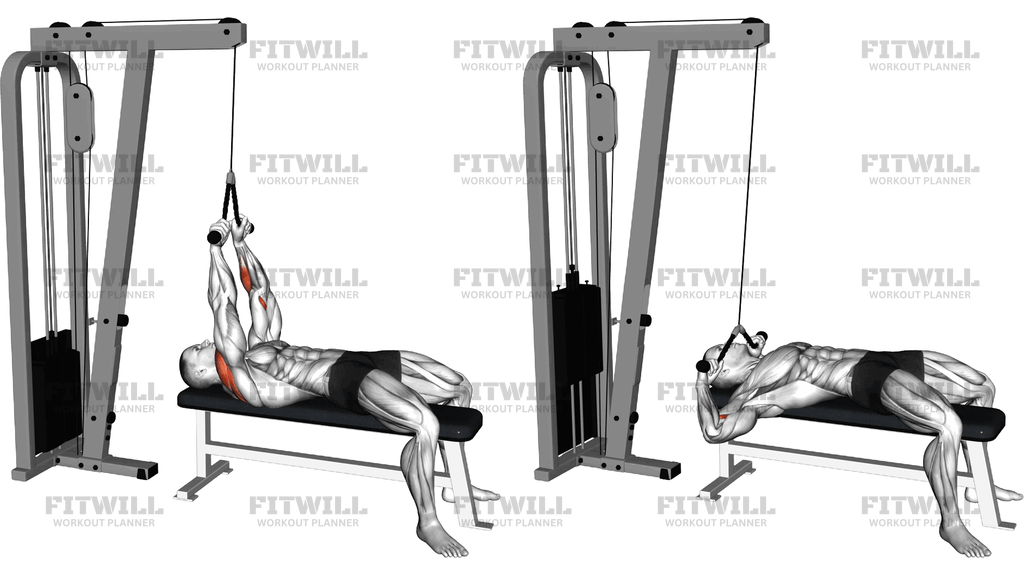
Instructions
- Set the pulley of the cable machine to the highest position and attach a rope attachment or short straight bar.
- Place a flat bench so its long axis points away from the machine, with the head end directly under the pulley, then lie face up with your head close to the cable's line.
- Grip the attachment with both hands and press your arms straight up toward the pulley so the cable runs over your forehead; plant your feet on the floor on either side of the bench.
- Brace your trunk lightly and keep your head, shoulders, and hips in contact with the bench before starting the pull.
- Initiate the rep by pulling the attachment down toward your face or forehead, leading with the elbows and letting them flare out wide to the sides.
- Finish the pull with the handle near your face, elbows bent and pointed outward, and squeeze the shoulder blades together for a beat.
- Reverse the movement slowly, letting the arms travel back overhead until they are nearly extended and you feel a light stretch across the rear shoulders.
- Exhale as you pull toward your face and inhale as the arms return overhead.
- Complete the set, then release one hand at a time and sit up carefully to avoid the recoiling cable.
Tips & Tricks
- Position the bench by trial before adding weight: when your arms are extended, the cable should pass over your forehead, not your chest or behind your head.
- If your elbows drop toward your ears or your sides, the set becomes a triceps extension or pulldown — cue yourself to pull the attachment toward your face, not your chest.
- Use a thumb-pointing-back or neutral grip on the rope and pull the handles toward your ears; this naturally biases external rotation and the rear delts.
- A common fault is lifting the head off the bench to shorten the pull. Keep the back of your head down and accept a slightly shorter range instead.
- Do not fully lock out the elbows at the top of each rep; keeping a soft elbow protects the joint and keeps tension on the target muscles.
- Because you are lying down, you cannot see the attachment travel — film a set occasionally or have someone watch that the path stays over your face rather than drifting toward your chest.
- Start lighter than you think you need. The first rep of a lying face pull often feels easier than the last because the stretch position is where form breaks down.
- Pause for one to two seconds at the face with the blades squeezed; the pause does more for the rear delts and mid traps than adding another plate.
- If the bench slides, anchor it against the cable machine frame or add weight plates around its base so it cannot creep toward the stack.
Frequently Asked Questions
What muscles does the Cable Lying Face Pull work?
The rear shoulders are the prime movers, supported by the mid and lower traps, the rhomboids, and the external rotators of the shoulder. The biceps and forearms assist as the elbows bend.
Why do the Cable Lying Face Pull lying down instead of standing?
The bench removes the need to brace against the pull with your legs and lower back, so it is easier to isolate the rear shoulders and upper back. It also changes the cable angle slightly, which some lifters find more comfortable on the shoulders.
Should my elbows flare out or stay tucked during the Cable Lying Face Pull?
They should flare out wide and stay high, roughly in line with or above your shoulders. Tucked elbows turn the movement into a triceps extension and take the work off the rear delts.
Where exactly should I pull the attachment to?
Pull it toward your face or forehead so the handles end up beside your head or just above it. If the attachment finishes near your chest, you have turned the rep into a pulldown.
Is the Cable Lying Face Pull suitable for beginners?
Yes, as long as the weight is light. The bench gives beginners more stability than a standing face pull, so they can learn the elbow-out pull pattern without fighting balance.
What weight should I use for the Cable Lying Face Pull?
Choose a load you can control for 10 to 15 reps while keeping your head and upper back on the bench. If the weight drags your head forward or your elbows drop, reduce it.
My lower back arches off the bench during the Cable Lying Face Pull — is that a problem?
A small natural arch is fine, but if your ribs flare and your back lifts, plant your feet firmly, brace your trunk lightly, and slightly bend your knees with feet flat on the floor.
Can I substitute the Cable Lying Face Pull with another exercise?
Standing or kneeling cable face pulls, band face pulls, and bent-over rear delt rope pulls all train the same pattern. The lying version is simply the most supported of the group.
Is it safe to do the Cable Lying Face Pull with a shoulder issue?
The movement is generally shoulder-friendly because it trains external rotation and scapular retraction with light load, but if you have a current or recent shoulder problem, get clearance from a qualified professional first and start with a very light weight.
How many sets and reps of the Cable Lying Face Pull should I do?
Two to four sets of 12 to 20 reps works well, usually at the end of an upper body or shoulder session. The muscles involved respond better to higher reps and controlled tempo than to heavy loads.