Landmine Overhead Rear Lunge
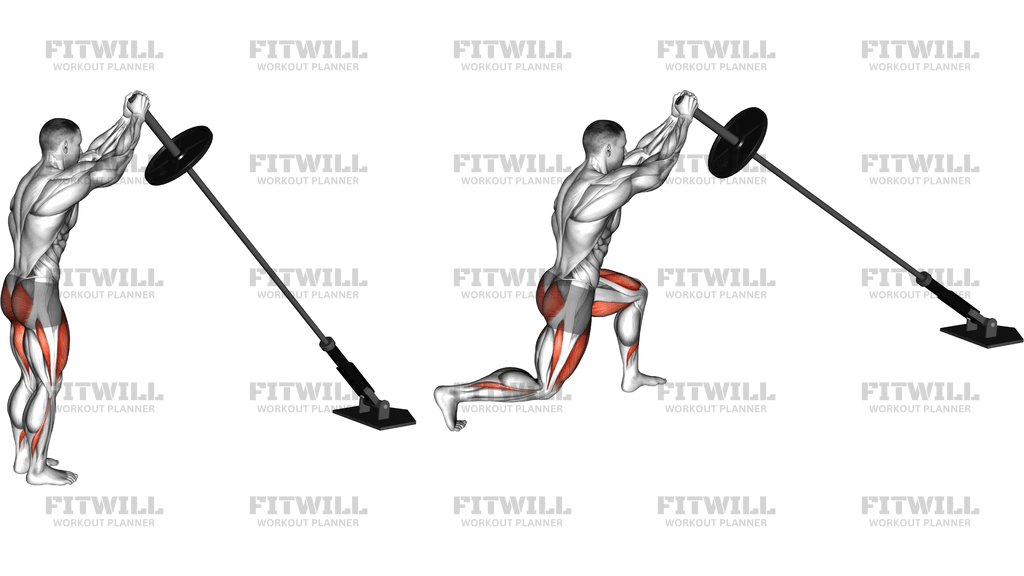
The Landmine Overhead Rear Lunge combines two demanding elements into one movement: an overhead landmine hold and a reverse lunge. One end of the barbell sits anchored in a landmine attachment or wedge into a corner, with a plate loaded on the lifted end. You press or hold that end straight overhead with both hands while stepping one leg back into a lunge, then return to standing. Because the landmine sits on an angled path rather than directly over your spine, the overhead position is far friendlier to the shoulders than a barbell held strictly vertical.
This exercise earns its place in a program because it forces the lower body and upper body to solve the same problem at once. The front leg's quads and glutes drive the lunge, the rear leg's hip flexors and calves handle the trailing position, and the shoulders, upper back, and core work continuously to keep the plate stacked over the midline as your base of support shifts underneath it. Every inch of knee and hip travel changes the angle of the bar, so your stabilizers cannot coast.
The setup matters more here than in most lunge variations. The landmine angle gives you a fixed arc, which means the bar will tell you immediately if your torso leans, your overhead position drifts, or your lunge depth shortens. Set the plate at a height you can press to with straight arms and a tall ribcage before you ever step back. A bar that starts crooked stays crooked, and it gets heavier to control the deeper you descend.
Execution comes down to patience and stacking. Stand far enough from the anchor that the bar can travel vertically without drifting forward, press the plate overhead until your biceps finish beside your ears, and keep it there for the entire set. Step one foot back, drop the back knee toward the floor while the front knee tracks over the midfoot, then push the floor away to return. The plate should travel in a small, controlled vertical path — if it swings forward, the lunge is stealing position from the press.
You will see this movement used in athletic strength work, general lower body training, and as a shoulder-friendly overhead option for lifters who struggle with strict pressing. It pairs well with heavier bilateral leg work earlier in a session, or it can serve as a full-body finisher with a moderate load for higher reps. Use a weight you can hold overhead for all reps without the elbow bending or the lower back arching into the movement.
[ Workout Log & Planner ]
Put your next workout in Fitwill
Keep your plan and training log ready when you are.


Instructions
- Wedge one end of a barbell into a landmine attachment or a corner, and slide a plate onto the free end.
- Stand facing the anchor, far enough away that the bar can rise vertically, with feet about hip-width apart.
- Grip the sleeve with both hands stacked or side by side, and clean the plate up to shoulder height.
- Press the plate straight overhead until both elbows are locked and the plate sits over your midline, biceps finishing near your ears.
- Brace your core, squeeze your glutes, and keep your ribs stacked over your pelvis before any leg movement begins.
- Step one foot straight back and lower until the back knee hovers just above the floor and the front thigh is roughly parallel, keeping the plate stationary overhead.
- Drive through the front heel to stand and bring the rear foot back to the starting stance.
- Exhale as you lunge down and inhale at the top, or breathe steadily at the top between reps if the hold feels demanding.
- Complete all reps on one leg or alternate legs, then lower the plate back to the shoulder before setting the bar down with control.
Tips & Tricks
- If the plate drifts forward as you descend, the bar angle is winning — step slightly closer to the anchor so the sleeve can stay vertical over your shoulders.
- A common fault is bending the elbows mid-set to rest the weight. If your press position breaks, the load is too heavy for the overhead hold, not necessarily for the lunge.
- Keep the front shin close to vertical and the heel glued to the floor. Reaching too far back turns the rep into a balance drill and robs the front leg of tension.
- Watch for the lower back arching under the plate, especially when fatigue sets in. Ribs down and glutes tight keeps the overhead position honest.
- Alternate legs rep for rep if you notice the plate tilting toward one side — a strong lunge on one leg with a sloppy hold on the other usually points to a mobility gap, not weakness.
- Wear flat, stable footwear or go barefoot on a non-slick surface. Cushioned running shoes make the narrow rear-foot balance noticeably harder.
- Start with a small plate and treat the first sessions as positioning practice. The landmine arc punishes a rushed setup more than it punishes low weight.
- If your shoulders feel pinched at the top, narrow or widen your grip slightly on the sleeve until the plate can sit directly over the joint line without forcing rotation.
- Reset the brace at the top of every rep, not just the first one. The overhead hold tends to loosen quietly between the third and eighth lunge.
Frequently Asked Questions
Which muscles does the Landmine Overhead Rear Lunge work the most?
The front leg's quads and glutes do the primary work of the lunge, while the hamstrings and calves of the rear leg assist. Holding the landmine overhead keeps the shoulders, upper back, and core under continuous tension throughout the set.
Is the Landmine Overhead Rear Lunge suitable for beginners?
Yes, with a light plate and a focus on the overhead hold before adding lunge depth. The landmine's fixed arc actually helps beginners learn a vertical overhead path, but the combined demand means it helps to already be comfortable with basic reverse lunges.
Why use a landmine instead of holding a dumbbell overhead during a lunge?
The angled landmine path lets the plate sit slightly forward of a perfectly vertical line, which is easier on the shoulder joints and lets you stabilize with two hands. It also creates a consistent arc, so any torso lean or position drift becomes obvious right away.
How far should I stand from the landmine anchor?
Far enough that the sleeve rises vertically when you press, usually an arm's length or slightly more from the anchor. If the plate pulls you forward as you lunge, you are too close; if the bar drags backward, you are too far away.
Should I step the same leg back every rep or alternate?
Both work. Doing all reps on one leg before switching makes it easier to keep the plate stable, while alternating legs balances out the loading and highlights side-to-side differences in the overhead hold.
What is the most common mistake in this exercise?
Letting the elbows bend or the plate drift forward mid-set to make the hold easier, which shifts work away from the shoulders and core and strains the lower back. If your press position breaks down, reduce the load rather than shortening the arms.
Can I do the Landmine Overhead Rear Lunge if I have shoulder discomfort with overhead pressing?
The landmine angle is often tolerated better than a vertical barbell or dumbbell press because the plate sits slightly ahead of the shoulder line, but this varies by individual. Start with a very light load and a pain-free range, and skip the movement if discomfort persists.
How deep should the rear lunge go?
Lower until the back knee is just above the floor and the front thigh is around parallel, as long as you can keep the plate stacked overhead without leaning. Depth that forces the torso forward or the plate off-line is too deep for the current load.
What can I substitute if I don't have a landmine attachment?
Wedge the barbell sleeve into a sturdy corner with a towel protecting the wall, or hold a single dumbbell or kettlebell overhead with both hands. The corner setup replicates the angle closely; the single-dumbbell version changes the balance demand but trains the same pattern.
How should I set the bar down safely at the end of a set?
Finish your last rep standing tall, lower the plate under control back to shoulder height, then guide the sleeve down the landmine arc until the end rests on the floor. Never drop it from overhead, as the plate can bounce or roll off the sleeve.