Hollow Body Hover
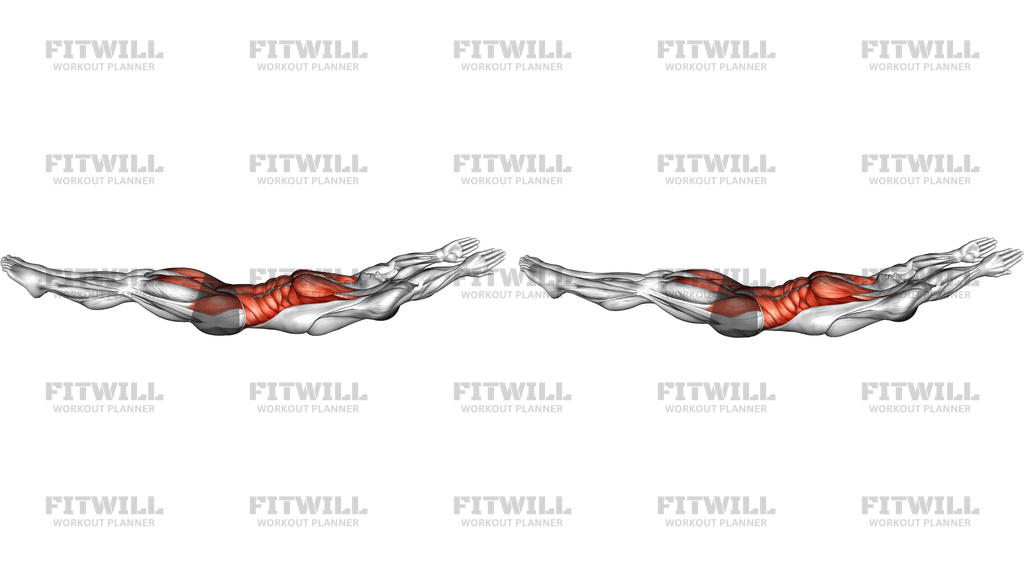
The Hollow Body Hover is a supine isometric core exercise performed on the floor, usually on a mat. You lie flat on your back with arms extended straight overhead and legs fully straight, then lift both ends of your body a few inches off the ground while pressing your lower back firmly into the floor. The result is a shallow, slightly curved shape - the classic hollow position used in gymnastics - held against gravity for time rather than reps.
This movement is one of the best ways to build the deep brace that supports almost every other athletic skill. It challenges the rectus abdominis, transverse abdominis, and obliques to hold your trunk rigid, while the hip flexors work hard to keep straight legs hovering just above the floor. Because your arms reach past your head, the position also loads the abs through a longer lever than a typical crunch, making it noticeably harder than it looks.
Setup matters more here than in most floor exercises. The single most important detail is maintaining contact between your lower back and the mat for the entire hold. If your lumbar spine lifts off the ground, the load shifts away from your abs and into your lower back, which is both ineffective and uncomfortable. Tucking the pelvis slightly and squeezing the glutes helps lock that posterior tilt in place before the arms and legs rise.
Execution is deceptively simple: press the low back down, then lift the shoulders, arms, and legs to a low hover with everything straight and held together. The body should feel like one solid piece from fingertips to toes, with the ribs pulled down rather than flared toward the ceiling. Breathe shallowly but continuously through the hold - holding your breath causes pressure spikes and premature fatigue.
The Hollow Body Hover shows up in gymnastics conditioning, calisthenics progressions, and general core training because it teaches a stiff, braced trunk that transfers directly to pull-ups, handstands, sprinting, and heavy lifting. Beginners can bend the knees or keep the arms by the sides, while advanced trainees can add gentle rocking, which turns the static hold into the hollow rock. Stop the set the moment your lower back begins to peel away from the floor - quality of position, not time on the clock, is what makes this exercise work.
Fitwill
Log Workouts, Track Progress & Build Strength.
Achieve more with Fitwill: explore over 9600 exercises with images and videos, access built-in and custom workouts, perfect for both gym and home sessions, and see real results.
Start your journey. Download today!




Instructions
- Lie flat on your back on an exercise mat with your legs fully straight and together and your arms extended straight overhead, biceps beside your ears.
- Press your lower back into the mat by tilting your pelvis slightly toward you and squeezing your glutes; keep this contact for the entire set.
- Point your toes and squeeze your legs together, then take a breath in through your nose.
- As you exhale, lift your straight legs a few inches off the floor while keeping your knees locked out.
- Raise your shoulders and arms off the mat at the same time so your head, arms, and legs hover at a similar low height, forming a shallow curve.
- Keep your chin tucked slightly toward your chest and your ribs pulled down so your low back stays pressed flat against the mat.
- Hold this hover position with your whole body rigid, breathing in short, shallow breaths without letting your chest collapse.
- To finish, lower your legs and upper body back to the mat under control, one smooth motion rather than a drop.
- Rest briefly, reset your pelvic tilt and back contact, then repeat for the desired hold time or interval.
Tips & Tricks
- If your lower back arches off the mat, widen the position: bend your knees, keep your heels closer to the floor at a higher angle, or bring your arms down to your sides until your abs are strong enough to hold the flat-back position.
- The most common mistake is turning the hover into a neck exercise - lift with your trunk and keep your gaze at your knees or shins rather than tucking your chin hard to your chest or craning forward.
- Reach actively through your fingertips and point your toes; passively dangling limbs shorten the lever and quietly reduce the abdominal demand.
- Shake or trembling in the legs usually means the hip flexors are doing the work alone - slightly raise the legs a few degrees and re-squeeze the glutes to shift tension back into the abs.
- Do not hold your breath; a slow, shallow breathing rhythm keeps the brace sustainable and prevents dizziness during longer holds.
- Start with 10-15 second holds and add time gradually; the position degrades quickly past your current ability, and a sloppy 40-second hold trains less than a crisp 20-second one.
- Keep your arms squeezing inward toward your ears and your legs squeezing together - these internal tensions are what make the body behave as one rigid piece.
- Place a hand or a flat object such as a towel under your lower back as feedback: if it can slide out mid-hold, your pelvis has tilted and you should reset.
Frequently Asked Questions
What muscles does the Hollow Body Hover work?
The primary muscles are the abs, especially the rectus abdominis and deep core stabilizers, with strong support from the hip flexors holding straight legs up. The obliques and glutes contribute by keeping the trunk square and the pelvis tucked.
Why is it so important to keep my lower back pressed into the mat?
The back contact is what keeps the tension on your abdominal muscles instead of your lumbar spine. Once the low back lifts and arches, the hover stops being a safe or effective core exercise.
Can beginners do the Hollow Body Hover?
Yes, with modifications. Bend your knees at roughly 90 degrees, keep your arms at your sides or on the floor, and hold a shorter hover while maintaining flat-back contact, then progress as your control improves.
How long should I hold the Hollow Body Hover?
Aim for quality holds of 10-30 seconds and build toward 45-60 seconds over time. Multiple crisp short sets beat one long set where your lower back arches off the floor.
My legs shake and my hips feel it more than my abs - what am I doing wrong?
Your hip flexors are dominating because your pelvis has tipped forward. Raise your legs slightly, re-tuck your pelvis, squeeze your glutes, and think about pulling your ribs toward your hips to reload the abs.
How is the Hollow Body Hover different from a hollow rock?
The hover is a static hold in the hollow position, while the hollow rock adds a gentle back-and-forth rocking motion with the body held in the same rigid shape. The rock is typically more demanding, so master the hover first.
What can I substitute if I do not have a mat?
Any firm, comfortable surface works - carpet or grass are fine. The mat is only there for comfort; the exercise itself requires no equipment.
Is it normal to feel this in my neck?
Some upper-body fatigue is expected since the shoulders hover off the floor, but sharp neck strain is not. Keep your gaze toward your knees, support your head position with your trunk rather than your chin, and lower your arms if the discomfort persists.
How does the Hollow Body Hover help with pull-ups and gymnastics skills?
A stiff hollow position is the foundation for hanging movements, handstands, and levers because it teaches you to keep your trunk rigid while your limbs move. Practicing this hover makes that brace automatic when you are under load.
Should I stop a set before the timer runs out?
Yes - stop immediately if your lower back lifts off the floor, your legs drop, or your position visibly collapses. Holding a broken position trains the wrong pattern and strains the lower back.