Adductors Stretch Transverse Plane
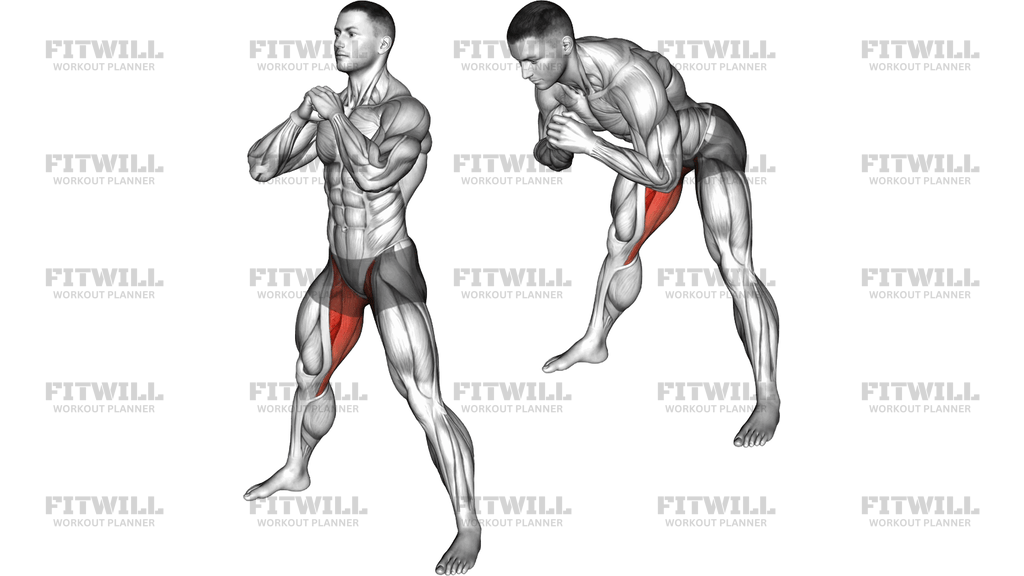
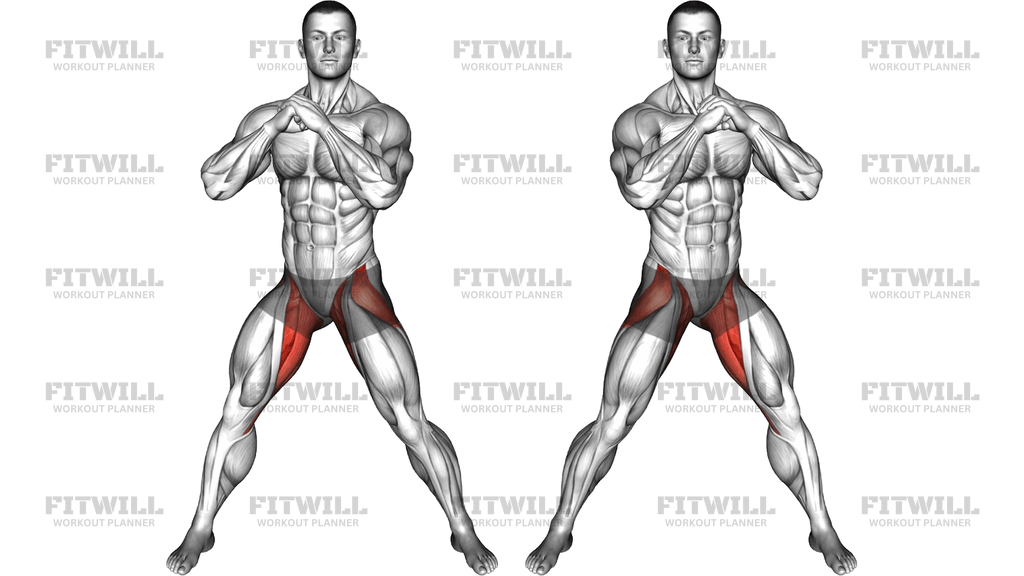
The Adductors Stretch Transverse Plane is a standing, body-weight stretch that targets the inner thigh muscles through a rotational, side-to-side pattern rather than a straight forward split. You set up in a very wide stance, clasp your hands in front of your chest for balance, and then shift your hips laterally over one leg while rotating your torso and pelvis, which places the adductors of the straight leg and the loaded leg on stretch from a different angle than a classic side lunge or straddle stretch.
This movement is especially useful for anyone who feels chronically tight through the groin: lifters who squat wide, martial artists and field-sport athletes who cut and rotate, and desk workers whose hips rarely move out of a narrow, forward-facing range. Because the stretch happens in the transverse plane, it reaches the adductor fibers that assist with rotation, which a purely frontal-plane stretch often misses.
The wide stance is what makes the exercise work. Your feet should be far enough apart that shifting your weight over one leg puts you near the end of your comfortable range, and your hands clasped at chest height give you a counterweight and a stable point to rotate around. Keep the stretching leg straight with the foot flat, and let the loaded knee travel over or slightly inside the loaded foot as you rotate.
Execute the stretch by shifting your hips sideways, softening the loaded knee, and turning your chest and pelvis toward the loaded side. You should feel a deliberate pull along the inner thigh of the straight leg and into the groin of the bent leg. Hold the end position for several calm breaths, then shift to the other side and repeat, keeping both heels glued to the floor the entire time.
Because the adductors attach along the pelvis and inner femur, this area responds poorly to bouncing or forcing. Move into the stretch gradually, never push into sharp pain, and treat this as a mobility drill you can use before lower-body training, after long sitting, or as part of a cooldown.
[ Workout Log & Planner ]
Put your next workout in Fitwill
Keep your plan and training log ready when you are.


Instructions
- Stand with your feet roughly two to three shoulder-widths apart, toes turned out slightly, and both heels firmly planted on the floor.
- Clasp your hands together in front of your chest with your elbows relaxed, using the clasped hands as a light counterweight and balance point.
- Brace your trunk lightly and keep your spine tall before you begin shifting your weight.
- Shift your hips sideways over your right leg, bending the right knee while keeping your left leg straight and its foot flat on the floor.
- Rotate your chest and pelvis toward the right so the stretch moves into the transverse plane, letting the clasped hands travel with the rotation.
- Stop when you feel a strong but tolerable pull along the inner thigh of the straight left leg and into the groin of the bent right leg, and hold for 15 to 30 seconds while breathing steadily.
- Reverse the rotation first, then press through the right foot to shift your hips back to center before loading the other side.
- Repeat the same pattern over your left leg, rotating toward the left, and hold for the same duration.
- Complete 2 to 3 shifts to each side, keeping both heels down and the movement smooth from start to finish.
Tips & Tricks
- If your heels lift as you shift, your stance is too narrow or you are going too deep — widen your feet slightly or reduce the sideways travel so both soles stay flat.
- A common mistake is rotating only the shoulders while the pelvis stays square; turn the hips with the torso or the stretch stays in the front of the groin instead of reaching the adductors.
- Do not let the bent knee collapse fully inward past the foot — keep it tracking roughly over the loaded foot to protect the knee joint.
- If you feel pinching at the hip crease of the bent leg rather than a stretch in the straight leg, sit back a little more into the hip instead of driving the knee forward.
- Keep the straight leg genuinely straight; a soft, bent stretching knee quietly removes most of the adductor lengthening.
- Ease into the end range over the first few breaths instead of forcing depth on the first shift — the groin tissue lengthens more safely when loaded progressively.
- Avoid bouncing at the end position; hold statically and let the tension fade before going a few degrees deeper.
- Use the clasped hands actively: extending them slightly forward as you rotate adds a gentle counterbalance that helps you control the shift.
Frequently Asked Questions
Which muscles does the Adductors Stretch Transverse Plane target?
It primarily targets the adductors — the adductor longus and adductor magnus along the inner thigh — with the rotation biasing fibers that also assist hip rotation. The glutes and hip stabilizers of the bent leg work to control the shift.
What makes this different from a normal side-lunge adductor stretch?
A standard side lunge stretches the inner thigh in the frontal plane, straight sideways. Adding the torso and pelvic rotation loads the adductors in the transverse plane, reaching a slightly different portion of the muscle group.
Is the Adductors Stretch Transverse Plane suitable for beginners?
Yes, because it uses only body weight and your own range of motion sets the depth. Beginners should use a slightly narrower stance and shorter holds until they can control the rotation without losing balance.
How wide should my stance be for this stretch?
Start with your feet about two to three shoulder-widths apart. If you cannot shift your hips over one leg with both heels flat, the stance is too wide; if you feel no inner-thigh pull, widen it.
Why do my heels keep lifting when I shift to one side?
That usually means the stance is too wide for your current range, or you are shifting too far too fast. Reduce the sideways travel and make sure you press the big toe of the stretching leg into the floor.
Should I feel the stretch in both legs at the same time?
Most people feel a strong pull in the straight leg's inner thigh and a milder stretch in the bent leg's groin. A one-sided dominant sensation is normal; sharp pain on either side means you should back off.
Can I use the Adductors Stretch Transverse Plane before squatting or training legs?
Yes, it works well as part of a dynamic warm-up when held briefly for 10 to 15 seconds per side. For longer 30-second holds, save it for after training or a separate mobility session so it does not temporarily reduce force output.
What can I use if I cannot balance in the wide stance?
Stand near a wall or rack and rest one hand on it instead of clasping both hands. The rotation and hip shift stay exactly the same, and you remove the balance demand.
How long should I hold each side?
Fifteen to thirty seconds per side for 2 to 3 rounds is a solid default. Longer holds of up to a minute are fine for cooldown work as long as the position stays pain-free.
Is it safe if I have a history of groin strains?
Proceed cautiously: use a smaller range, skip any bouncing, and stop well short of sharp or pinpoint pain near the groin. If a recent strain is still healing, clear the stretch with a qualified professional first.