Pike Push Up With Parallettes
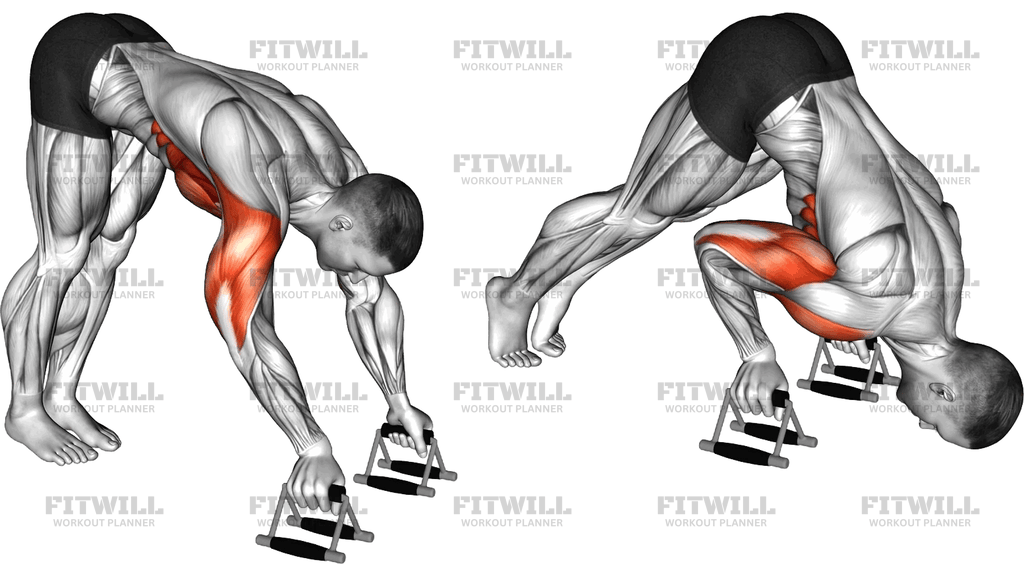
The Pike Push Up With Parallettes is a vertical pressing movement that shifts the classic pike push-up onto a pair of low parallel bars. Instead of placing your palms flat on the floor, you grip two parallette handles set roughly shoulder-width apart, walk your feet in until your hips stack high over your shoulders, and press your upper body toward the floor and back up. The elevated handles change the exercise in two meaningful ways: your head and shoulders can drop below hand level for a longer pressing range, and your wrists stay stacked in a neutral position instead of being bent back under your body weight.
This movement sits between regular push-ups and a handstand push-up, which makes it a go-to progression for anyone building toward inverted pressing. Calisthenics athletes use it as the main strength bridge to handstand push-ups, while general lifters use it as a reliable overhead pressing option when they have no barbells or dumbbells available. Because the body is folded at the hips with the legs acting as a tripod alongside the hands, you get a genuine shoulder-dominant press without needing a wall or a spotter.
The primary work lands on the front delts, with strong support from the triceps as the elbows extend, the upper traps and upper back as they stabilize the shoulder girdle through the bottom position, and the serratus anterior as it controls the shoulder blades. The core and hip flexors work isometrically the entire time to hold the pike position, and the legs stay active to keep the hips from sagging or drifting. Expect the demands on shoulder stability to be just as noticeable as the pressing strength itself.
Setup quality decides how well this exercise goes. Wide or misplaced parallettes turn it into an awkward wide-grip press, and hips that sit too low turn it back into a standard push-up. Aim for hands about shoulder-width, hips high enough that your torso angles steeply toward the floor, and weight distributed over the palms rather than dumped into the shoulders. Foot position will shift slightly between the top and bottom of each rep; that small adjustment is normal as long as the hips stay high.
Executed well, each rep looks like a controlled vertical dip: elbows bend and travel slightly outward as the crown of the head lowers toward the space between or just behind the hands, then press back to straight arms with the shoulders pushed actively toward the ears at the top. Keep the reps slow enough that the head never dives uncontrolled, since that habit is where most shoulder irritation starts. Because it loads the shoulders in an overhead pattern with body weight only, this exercise is easy to scale with reps, tempo, foot elevation, or a floor-based version if the parallette range is too much at first.
[ Workout Log & Planner ]
Put your next workout in Fitwill
Keep your plan and training log ready when you are.


Instructions
- Place two parallettes on the floor about shoulder-width apart, parallel to each other, with enough clearance around them for your head to dip down freely.
- Grip the handles with a firm overhand grip, wrists stacked directly under your shoulders, and step your feet back into a high pike so your hips sit well above your shoulders and your torso angles steeply toward the floor.
- Spread your fingers around the grips and drive the bases of your palms down into the handles to lock in a stable wrist position before you start moving.
- Brace your midsection, squeeze your legs together, and straighten your knees so your body forms a sharp inverted V with the hips as the peak.
- Bend your elbows and lower your body in a straight vertical line, letting the crown of your head travel down toward the floor just behind or between your hands.
- Continue down until your elbows reach roughly 90 degrees or the top of your head lightly approaches the floor, keeping the elbows from flaring fully out to the sides.
- Press forcefully through the palms to extend the elbows and return to the top, finishing with the shoulders actively pushed up toward your ears.
- Exhale as you press up and inhale on the way down, keeping the breath steady instead of holding it through the rep.
- At the end of the set, bend your knees and step or hop your feet forward before letting go of the handles, rather than collapsing out of the pike.
Tips & Tricks
- The most common mistake is letting the hips sink forward as you descend, which turns the set into ordinary push-ups. Film one set from the side and check that the hip crease stays near its highest point at the bottom of every rep.
- If your heels lift off the floor as you lower, walk your feet slightly closer to the hands. The feet should stay planted with the legs working as the rear leg of the tripod.
- Keep your neck relaxed and let the head hang naturally at the bottom. Craning to watch the floor shortens the range and puts unnecessary strain on the upper neck.
- Parallettes let the head pass below hand level, but you only need the depth you can control. Stop the descent where your elbows reach about 90 degrees and build range gradually over weeks.
- Push the floor away at the top of each rep so the shoulder blades spread slightly. This keeps the serratus engaged and prevents the shoulders from pinching at the top.
- If the grips feel unstable, set the parallettes on a non-slip surface and test them with a static hold before doing full reps. A sliding handle at the bottom of a rep is the main equipment risk here.
- Elbow angle matters: let them travel slightly out and back at roughly 45 degrees. Fully flared elbows shift stress into the shoulder capsule, while pinning them straight back fights the vertical pressing path.
- When you can comfortably complete sets of 10-12 controlled reps, elevate your feet on a low step or box to add load before attempting wall-supported handstand push-ups.
- Warm up the wrists and shoulders with a few standard pike push-ups on the floor first, since the deeper range on parallettes hits unfamiliar end-range positions.
Frequently Asked Questions
What muscles does the Pike Push Up With Parallettes work?
The front delts do most of the pressing, supported heavily by the triceps. The upper traps, serratus anterior, and upper back stabilize the shoulder girdle, while the core and hip flexors hold the pike position throughout.
Why use parallettes instead of doing pike push-ups on the floor?
The raised handles let your head and shoulders drop below hand level, which extends the pressing range beyond what the floor allows. They also keep the wrists straight, which is more comfortable for anyone with wrist mobility limits.
Is the Pike Push Up With Parallettes suitable for beginners?
Yes, as long as the depth is scaled to current strength. Beginners can start with floor pike push-ups or shallow parallette reps and progress the range as shoulder pressing strength develops.
How close should my hands be on the parallettes?
Set them about shoulder-width apart, matching the width you would use for an overhead press. Much wider and the movement turns into a wide-grip press that loses its carryover to handstand pressing.
How is this exercise different from a handstand push-up?
In a pike push-up your feet stay on the floor and the legs carry part of your weight, so the load on the shoulders is a fraction of full body weight. It is the standard stepping stone before attempting handstand push-ups against a wall.
How deep should I lower my head during each rep?
Lower until your elbows reach roughly 90 degrees or the crown of your head nears the floor, whichever comes first with control. Depth should increase gradually; forcing the head to the floor before the shoulders are ready is the most common way this exercise causes trouble.
My hips keep dropping during the set. How do I fix that?
Walk the feet slightly closer to the hands, straighten the knees fully, and think about pushing the hips up and back on every rep. Fatigue usually causes the sag, so cutting the set a few reps short while the position holds is better than grinding sloppy reps.
What can I substitute if I do not have parallettes?
Standard floor pike push-ups train the same pattern with a shorter range, or you can elevate the hands on two sturdy flat surfaces such as hex dumbbells or weight plates. Chair-based setups work but are less stable, so test them before loading full reps.
How many reps and sets should I do?
Three to four sets of 5-12 controlled reps is a practical working range. Since the exercise gets harder as the hips rise higher and the feet get elevated, prioritize clean positioning over chasing higher rep counts.
Are there any safety concerns with this exercise?
The main risks are an uncontrolled head dive at the bottom and unstable parallettes sliding on a slick floor. Descend slowly, keep the handles on a grippy surface, and stop the set if your wrists or shoulders start complaining rather than pushing through pain.