Standing Boat Row
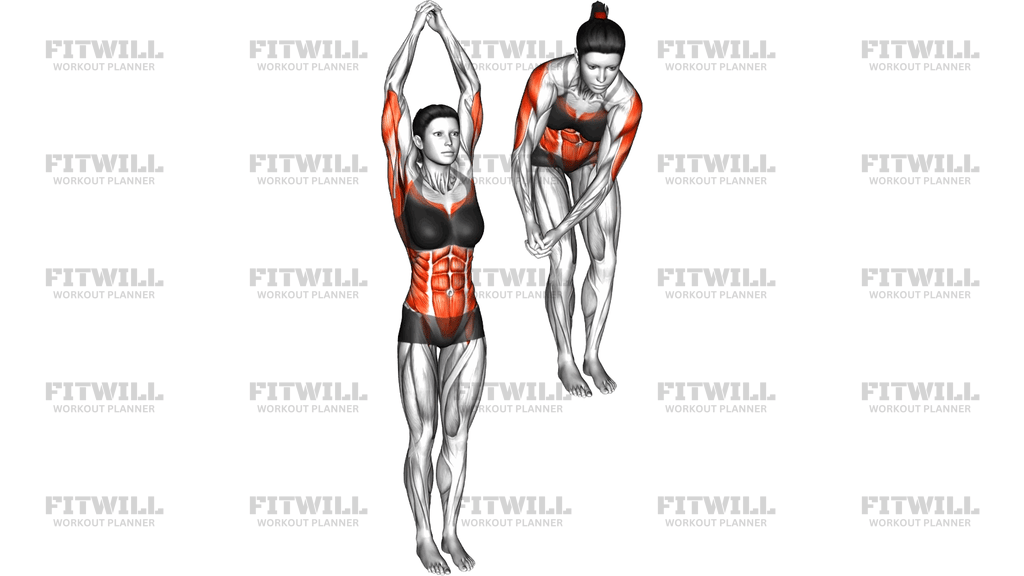
The Standing Boat Row is a bodyweight core exercise that mimics the pulling action of rowing a boat — but instead of sitting in a vessel with oars in hand, you stand tall, interlace your fingers, reach your arms overhead, and then row your clasped hands down and through as your torso hinges forward. The two phases work together: the overhead reach lengthens and opens the front of the body, while the downward row compresses and works the abdominal wall as you fold. It is a controlled, rhythmic movement that links breath to motion, which is why it appears in Pilates-based standing sequences as well as general warm-up and core routines.
Because it requires no equipment and very little space, the Standing Boat Row suits almost anyone. Beginners use it to learn how to hinge at the hips while keeping the spine supported by an engaged core. More experienced trainees use it as a dynamic warm-up before lifting, as active recovery between harder sets, or as part of a standing core circuit for days when getting on the floor is not practical. It is also a useful option for people who find traditional floor-based core work uncomfortable on the hips, neck, or lower back.
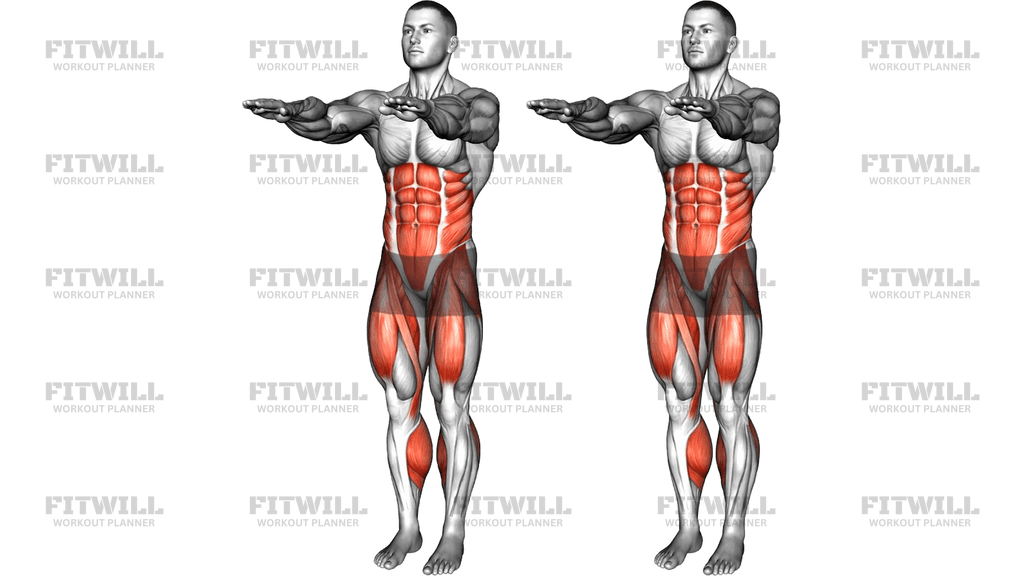
The primary work comes from the abdominals, especially the rectus abdominis and the deeper core muscles that brace the trunk as you fold forward. The shoulders and arms guide the rowing path, the lats and upper back help control the hands as they sweep down, and the muscles along the spine manage the hinge so your torso lowers with control instead of collapsing. The legs stay relatively quiet, working mostly to keep you balanced and rooted through the feet.
Setup matters more than it might seem for a bodyweight movement. Your stance, the interlaced grip, and the height of the overhead reach all determine whether the fold feels smooth or strained. Standing with feet about hip-width apart and weight spread evenly across both feet gives you a stable base. Interlacing the fingers and turning the palms upward as the arms rise helps the shoulders stay open rather than shrugged toward the ears, which keeps the rowing phase clean.
To execute the exercise well, think of the arms and torso moving as one connected piece. As you exhale, row your clasped hands down through the midline of your body while your torso hinges forward from the hips, letting the hands pass between or in front of the legs as your fold deepens. Inhale on the way back up, reversing the path so the arms return overhead as you stand tall. The rhythm should feel like a slow, deliberate rowing stroke — not a ballistic swing.
Common use cases include Pilates standing series, home workouts with no equipment, warm-ups for hinge-heavy lifting days, and low-impact core sessions. From a safety standpoint, the main cautions are simple: move at a pace you can fully control, keep a soft bend in the knees if your hamstrings feel tight, and hinge from the hips rather than rounding aggressively through the lower back. If you feel strain instead of abdominal work, reduce the depth of the fold before anything else.
[ Workout Log & Planner ]
Put your next workout in Fitwill
Keep your plan and training log ready when you are.


Instructions
- Stand with your feet about hip-width apart, weight spread evenly across both feet, and your knees soft rather than locked.
- Interlace your fingers and press your palms together, then raise your clasped hands straight overhead until your arms are fully extended above your head.
- Take a breath in through your nose and lengthen your spine, reaching slightly taller through the crown of your head before starting the row.
- As you exhale, begin pulling your clasped hands down and forward through the midline of your body, as if rowing an oar down through the water.
- Continue the rowing action as your torso hinges forward from the hips, letting the hands travel down between your legs as your fold deepens.
- Keep your back long rather than rounded, and let your head follow the line of your spine as your torso lowers toward the floor.
- At the end of the fold, your arms hang down toward the floor with hands still clasped, and your abdominals should feel actively engaged rather than slack.
- Inhale as you reverse the stroke, driving the movement from your hips and core to stand upright while your clasped hands sweep back up overhead.
- Reset your balance and posture at the top before beginning the next repetition, keeping the row and the fold linked to your breath.
Tips & Tricks
- If your hamstrings limit the fold, soften the knees a little more instead of rounding the lower back to reach deeper.
- A common mistake is letting the shoulders creep up toward the ears during the overhead reach — press the palms together and think about keeping space between your shoulders and ears.
- Avoid turning the movement into a fast arm swing; the tempo should come from your torso hinging, with the arms following the rowing path.
- If your lower back takes over, shorten the range so you stop the fold at the point where you can still keep the spine long.
- Keep your weight centered over your whole foot; shifting onto the toes as you fold forward is a sign the hinge is too deep for your current control.
- Exhale on the way down and inhale on the way up — holding your breath usually shows up as tension in the neck and shoulders.
- If balancing feels shaky, widen your stance slightly or stand near a wall you can touch for light support until the rhythm feels natural.
- Imagine actually pulling an oar through water during the descent; this image keeps the hands drawing through the midline instead of drifting out to one side.
- Do not let the head drop ahead of the spine during the fold — the neck should stay in line with the rest of your back.
Frequently Asked Questions
What muscles does the Standing Boat Row work?
The abdominals do the main work, especially as you brace and control the forward fold. The shoulders, arms, lats, and the muscles along the spine assist by guiding the rowing path and managing the hinge.
Is the Standing Boat Row suitable for beginners?
Yes. It is low-impact and equipment-free, and beginners can limit the depth of the fold while still getting the core and breath coordination benefits. A slightly wider stance makes balance easier at first.
Why are the hands interlaced overhead in the Standing Boat Row?
The interlaced grip connects the arms into a single unit, which keeps the rowing path consistent and helps the shoulders stay open. It also emphasizes the lengthening reach before the fold begins.
How deep should I fold forward during the Standing Boat Row?
Fold only as far as you can keep a long spine and steady balance — for many people that means the torso reaches roughly parallel to the floor or slightly higher. Depth matters less than controlled movement.
My lower back rounds when I fold in the Standing Boat Row. How do I fix it?
Bend the knees a bit more and reduce the fold depth so the movement comes from the hips instead of the spine. Practicing in front of a mirror helps you notice when rounding starts.
Can I use the Standing Boat Row as a warm-up?
Absolutely. Its controlled hinge and overhead reach make it a good dynamic warm-up before lifting or hinge-heavy workouts, and it also works well as a low-impact core drill on its own.
What can I substitute if I cannot balance during the Standing Boat Row?
Stand close to a wall or sturdy chair for light fingertip support, or sit on the edge of a bench and perform the same rowing pattern with a smaller range until your balance improves.
How many repetitions of the Standing Boat Row should I do?
Because it is a controlled, breath-led movement, sets of 8 to 12 slow repetitions work well. Focus on smooth strokes rather than rushing through a high number of reps.
Is the Standing Boat Row safe for people with back sensitivity?
Many people with mild back sensitivity tolerate it well because the legs support the body and the range is adjustable, but keep the fold shallow and stop if you feel pain rather than muscular effort. Check with a qualified professional if you have a history of back problems.