Chop Knee Raise
The Chop Knee Raise is a standing bodyweight core exercise that combines a diagonal chopping motion with a driving knee lift. You start with your hands clasped and extended up and to one side at shoulder height, feet set wide, then pull your arms down and across your body while simultaneously raising the opposite knee toward your hands. The two movements meet at the center of your body, which is exactly where the crunching, rotating squeeze happens.
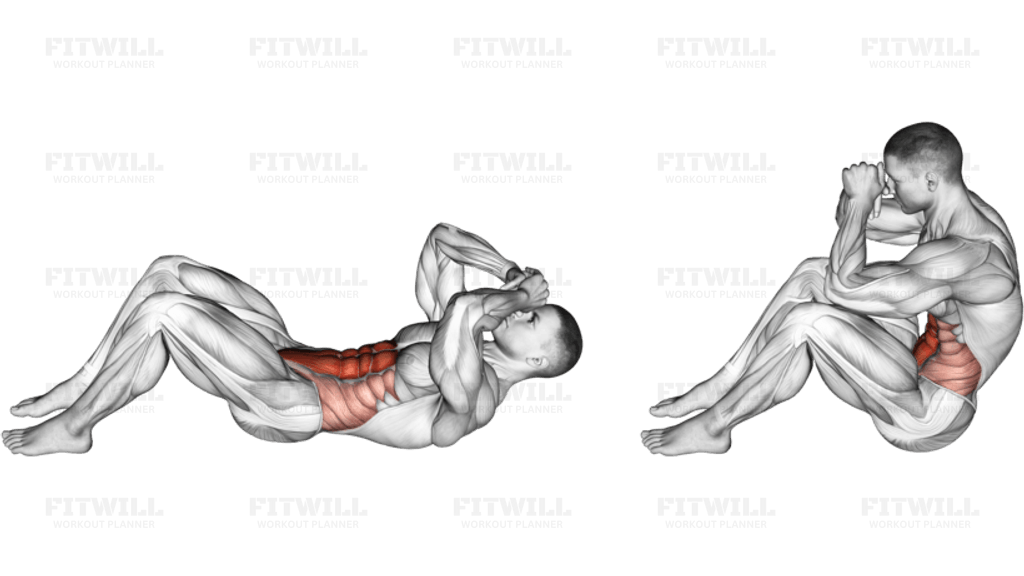
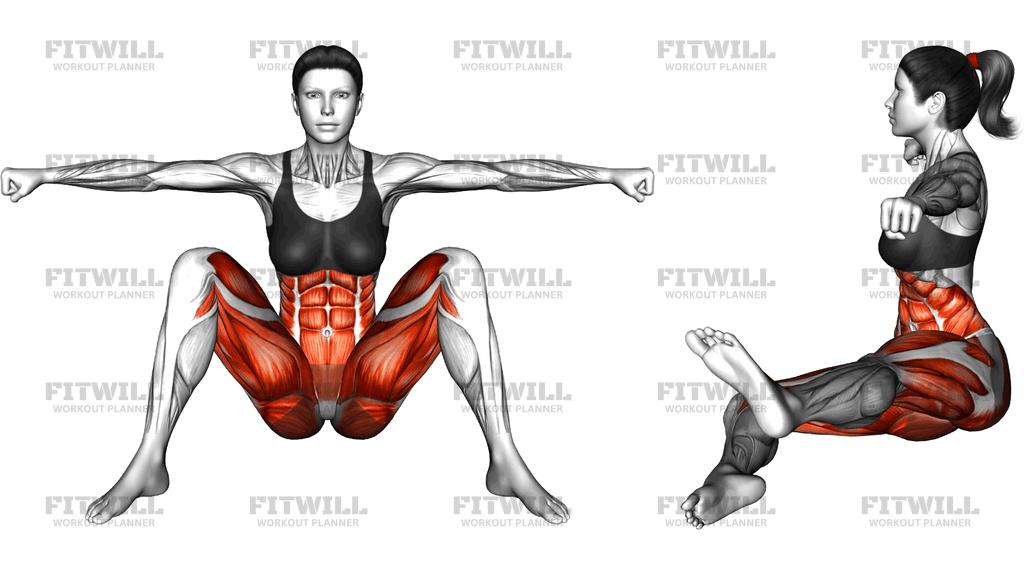
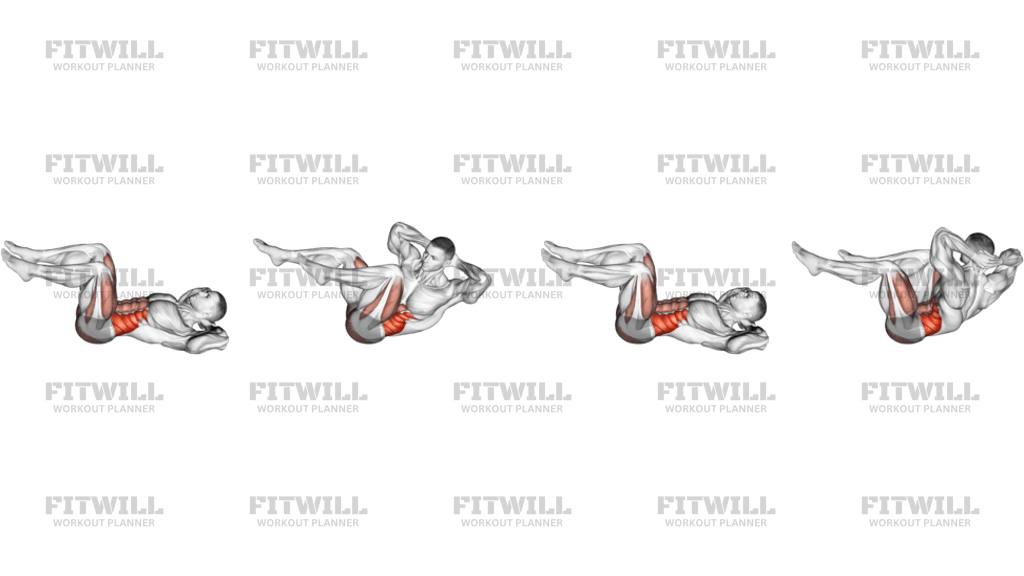
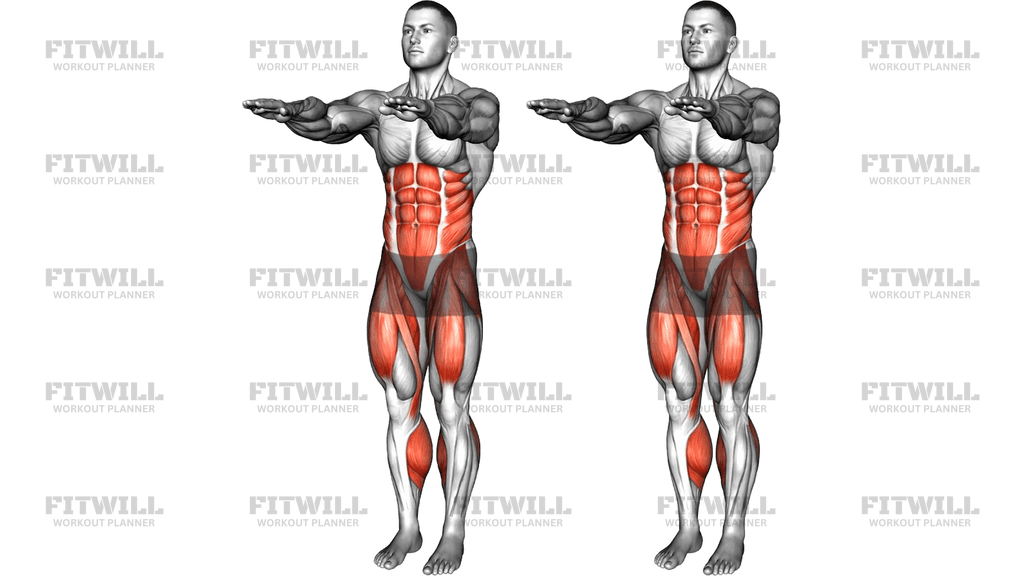
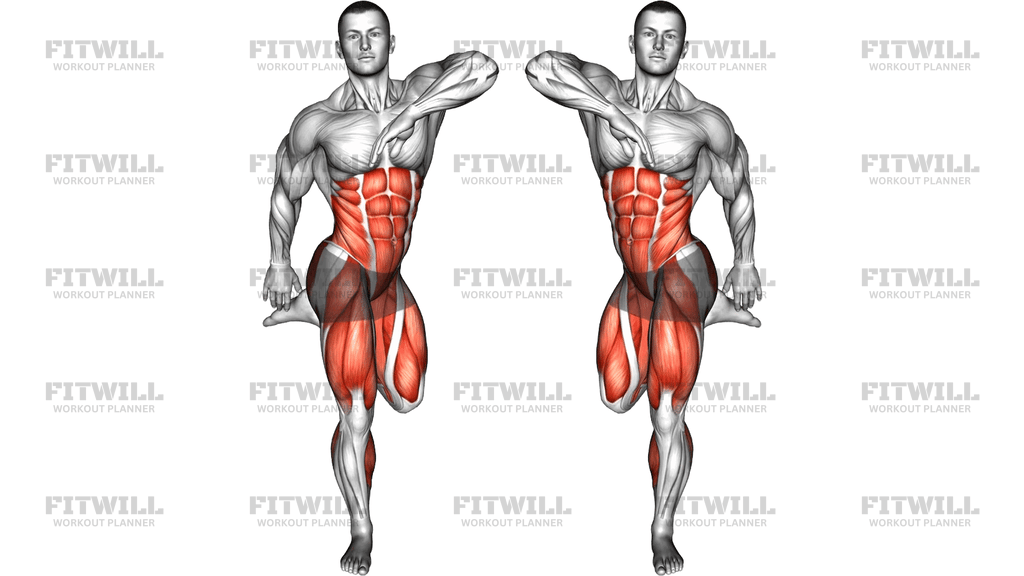
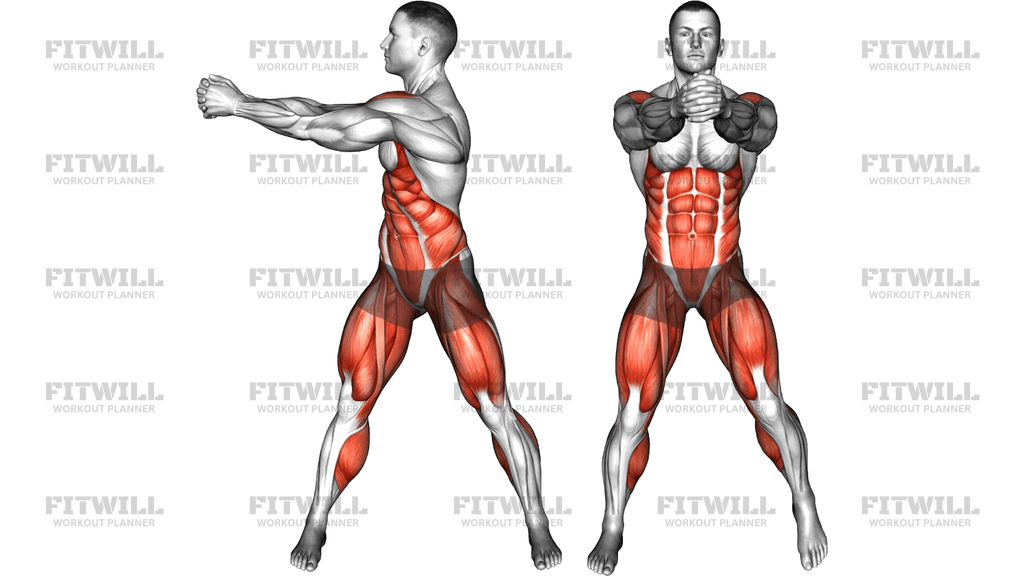
Because it is performed standing, this movement trains your core the way it actually works in sport and daily life: the abs and obliques contract to fold the trunk while the hip flexors lift the leg, and the standing leg has to stabilize the whole system. The highlighted musculature tells the story — the rectus abdominis and obliques do the crunching and rotating, the hip flexors and quads drive the knee up, and the calves and stabilizers of the support leg work quietly the entire time.
This exercise suits a wide range of trainees. Beginners can use it to learn how to brace and flex the trunk without any equipment, while more advanced lifters and athletes use it as a warm-up activation drill or as high-rep conditioning between heavier sets. It is especially useful for anyone who wants rotational core control — martial artists, racket sport players, and runners all benefit from the cross-body coordination it builds.
Setup matters more than it looks. A wide, stable stance gives your support leg a base to balance from, and starting the chop from a genuinely elevated, rotated arm position creates the diagonal path that distinguishes this from a plain knee raise. If your arms start too low or your stance is too narrow, the movement loses its rotation and turns into a sloppy standing crunch.
Execution should feel like one connected motion, not two separate ones. As your hands slice down and across, your knee drives up to meet them, your ribcage curls toward your pelvis, and your torso rotates slightly over the raised leg. Exhale hard at the meeting point, pause briefly, then lower the leg and swing the arms back along the same diagonal under control.
The main safety point is keeping the movement within your balance and flexibility. A chopping path that pulls you off your feet, or a knee driven up so fast that your lower back arches and swings, shifts work away from the abs and onto your spine and hip joints. Stay tall through the support leg, move with intent rather than momentum, and alternate sides evenly to keep the workload balanced.
[ Workout Log & Planner ]
Put your next workout in Fitwill
Keep your plan and training log ready when you are.


Instructions
- Stand with your feet roughly one and a half to two times shoulder width apart, toes turned slightly out, and your weight spread evenly across both feet.
- Clasp your hands together and extend your arms straight out, raising them up and to one side so your torso is already angled toward that side at the start.
- Lift your chest and brace your abdominal wall lightly, keeping a tall spine before any movement begins.
- Begin the chop by pulling your clasped hands down and diagonally across your body toward the opposite hip, letting your shoulders and ribcage rotate with them.
- As the hands pass chest height, drive the knee on the opposite side up and across so it rises to meet your hands near the middle of your body.
- At the meeting point, crunch your ribs down toward the raised knee, squeeze your abs and obliques hard, and exhale sharply.
- Hold the top position for a one-count without letting your torso collapse backward or your standing knee cave inward.
- Lower the knee and swing your arms back up along the same diagonal path in a slow, controlled return to the start.
- Complete all repetitions on one side, or alternate sides each rep, resetting your stance and brace before the next chop.
- Keep breathing steadily throughout — inhale as you return to the start, exhale as the knee and hands come together.
Tips & Tricks
- The most common mistake is swinging the arms without curling the trunk. If your hands travel but your ribcage stays still, your abs are missing the rep — think about shortening the distance between your lower ribs and the raised knee.
- Do not let the raised foot just dangle. Pull the knee up deliberately with your hip flexors and point your toes slightly so the leg moves as one controlled piece.
- Keep the standing leg firmly planted with a soft but stable knee. If you find yourself hopping or rocking with each chop, widen your stance and slow the tempo down.
- Avoid yanking your hands down with your shoulders. The chop should come from the trunk rotating and flexing, with the arms acting as an extension of the torso.
- If your lower back arches as the knee drops, control the descent more — the return path is part of the working range, not a rest.
- Keep your head neutral and look forward rather than following your hands all the way down; this stops you from rounding your upper back excessively.
- Start with your arms genuinely high and rotated to the starting side. A low starting position flattens the diagonal and turns the exercise into a weak standing crunch.
- Alternate sides across sets, not just within one set, if you notice one side chopping faster or higher than the other — a side-to-side difference usually points to a mobility or balance gap worth addressing.
- For more challenge without equipment, pause two full seconds at the top with the knee raised, or slow the lowering phase to a three-count.
Frequently Asked Questions
What muscles does the Chop Knee Raise work?
The primary muscles are the abs, especially the rectus abdominis, with the obliques contributing the rotation. The hip flexors and quads lift the knee, while the standing leg's calves and stabilizers keep you balanced throughout.
Is the Chop Knee Raise suitable for beginners?
Yes, it requires no equipment and the range can be adjusted easily. Beginners should use a slightly smaller chop, a wider stance for balance, and focus on feeling the trunk curl rather than moving fast.
Why does the Chop Knee Raise use a wide stance?
The wide stance gives the support leg a stable base while the opposite knee lifts and the torso rotates across the body. A narrow stance makes balancing the main challenge and reduces how hard the abs can work.
Should the hands and knee actually touch during the Chop Knee Raise?
They should meet, but touching is not mandatory. Aim for the knee to rise close to the hands near the center of your body; forcing contact can make you round your back or lose balance if your mobility is limited.
Can I use the Chop Knee Raise as a warm-up?
Absolutely. Done slowly for higher reps with no added load, it activates the abs, obliques, and hip flexors and grooves the cross-body coordination that most rotational sports rely on.
What is the most common mistake in the Chop Knee Raise?
Using arm momentum instead of trunk flexion — the hands swing down but the torso stays upright. Fix it by deliberately curling your ribcage toward the raised knee and slowing the chop until you feel the abs doing the work.
How does the Chop Knee Raise differ from a regular standing knee raise?
A plain knee raise only lifts the leg, while the Chop Knee Raise adds a diagonal, rotating trunk flexion that brings the obliques and upper abs into play. The meeting of hands and knee in the middle is what makes it a true core exercise rather than just a hip flexor drill.
What can I use instead of the Chop Knee Raise?
Standing cross-body crunches, cable woodchops paired with knee lifts, or hanging knee raises with a twist all train similar patterns. If balance is the limiting factor, hold a sturdy support with one hand and perform the chop one-sided.
Is it safe for people with lower back sensitivity?
Generally yes if performed slowly with a controlled range, since the spine stays loaded in a standing position rather than flexed on the floor. Keep the chop within a comfortable range, avoid jerky arm swings, and stop if you feel any sharp discomfort.