Seated Turn And Crunch
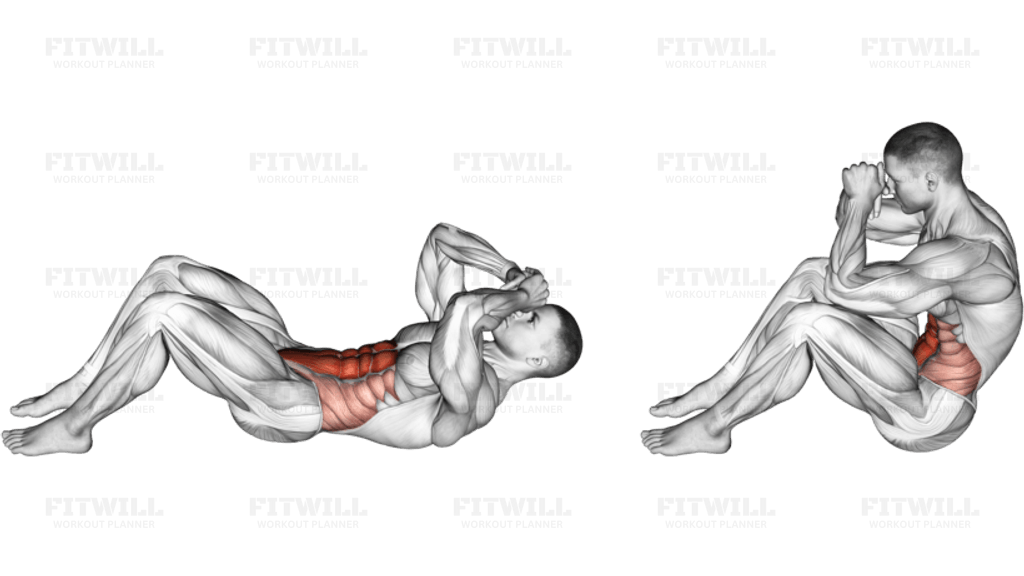
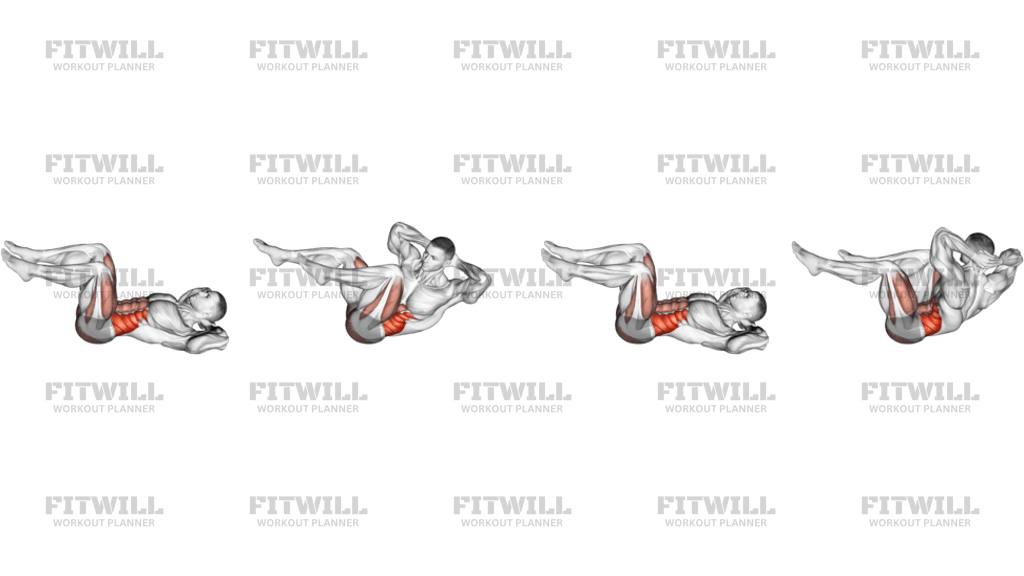
The Seated Turn And Crunch is a bodyweight core exercise performed from a reclined seated position on the floor. You balance on your sit bones with your knees bent and feet lifted, place your hands lightly behind your head, and combine a torso crunch with a rotational turn of the upper body. Each rep pulls the ribcage toward the hips while the shoulders twist from side to side, which is why it works the front of the abs and the side wall of the waist at the same time.
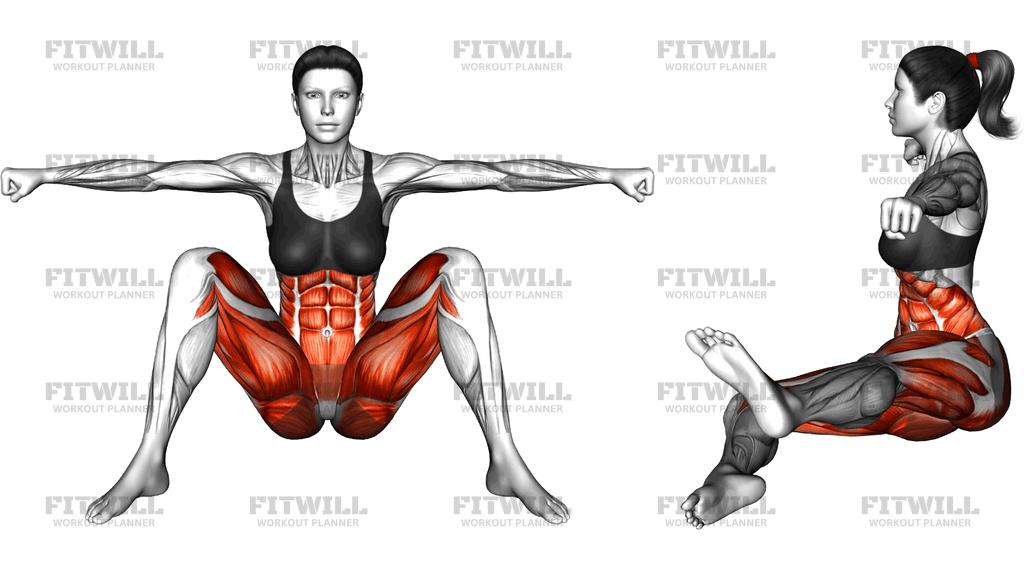
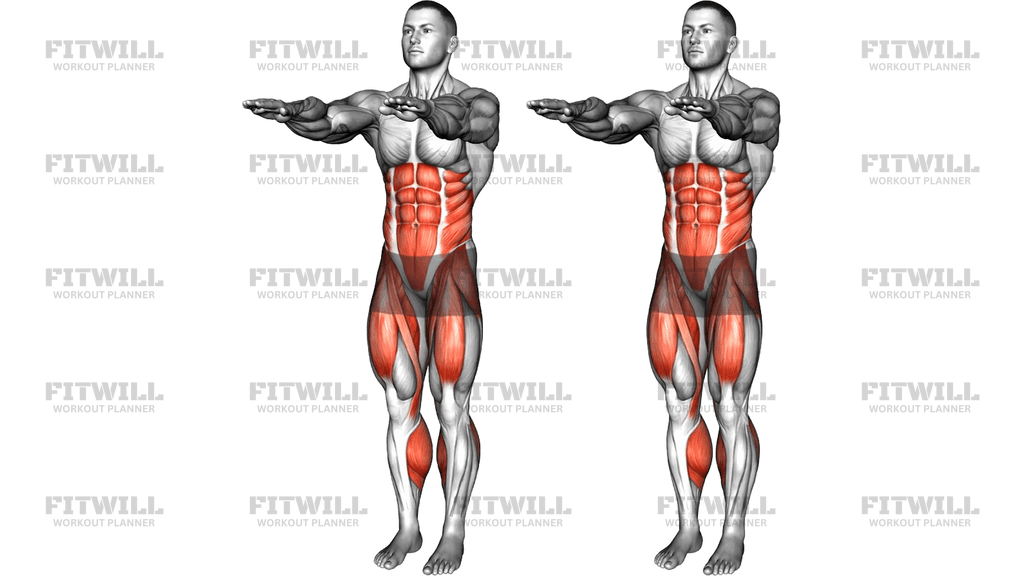
The two highlighted areas in this movement are the rectus abdominis, which drives the crunch, and the hip flexors, which hold your thighs up while your feet hover off the floor. The obliques fire hard as you rotate, and the deep core works continuously just to keep you from tipping backward. Because you are balancing rather than lying flat, the whole trunk has to stay tense from start to finish.
This exercise suits anyone with some basic crunch experience who wants to progress to a more demanding core movement without equipment. It is common in abdominal circuits, home workouts, and athletic conditioning programs where rotational trunk control matters. Since it requires no gear beyond a floor, it is easy to slot into a warm-up finisher or a dedicated ab block.
Setup matters here more than in a standard crunch. If you sit too upright, the move becomes a leg-holding exercise; if you lean back too far with a rounded lower back, you lose balance and strain the spine. Aim for a torso angle of roughly 45 degrees, chest lifted, and a long spine before you start turning. The knees stay bent and still while the rotation comes from the ribcage, not from swinging the arms or legs.
Execution should be smooth and deliberate. Crunch the chest toward the knees, twist so one elbow travels across the body toward the opposite knee, return through the center, and twist to the other side before lowering slightly and repeating. Exhale on each crunch, keep the neck relaxed with the hands supporting rather than pulling the head, and stop the set when your balance starts to break down rather than when you are completely exhausted.
As with any loaded spinal flexion and rotation drill, control beats speed. Keep the range moderate at first, avoid yanking the head forward, and build up reps gradually. If you feel the work shifting into your lower back or neck, reset your torso angle and shorten the set.
Fitwill
Log Workouts, Track Progress & Build Strength.
Achieve more with Fitwill: explore over 9600 exercises with images and videos, access built-in and custom workouts, perfect for both gym and home sessions, and see real results.
Start your journey. Download today!




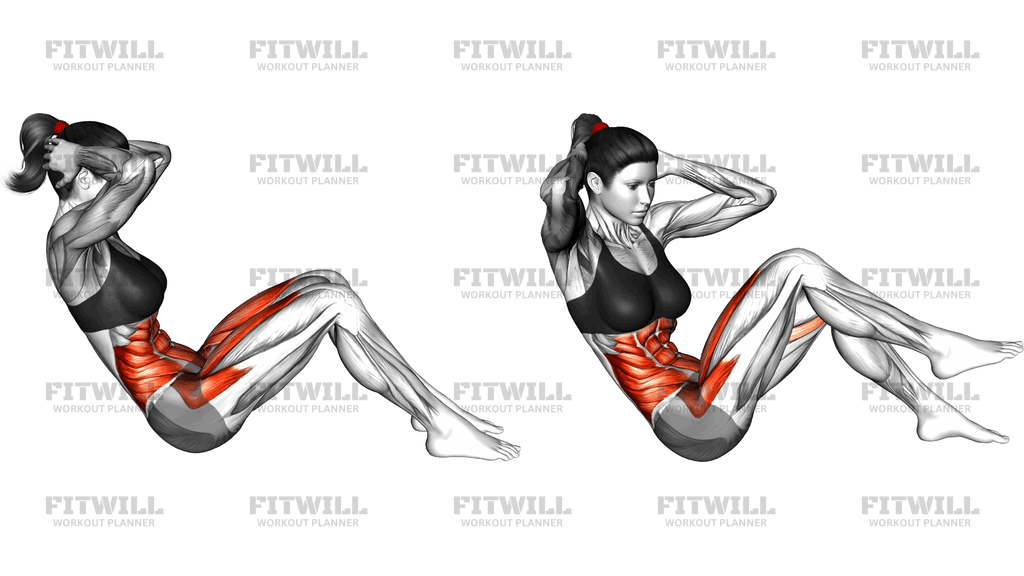
Instructions
- Sit on the floor or a mat with your knees bent and lean your torso back to about 45 degrees, balancing on your sit bones.
- Lift your feet slightly off the floor so your weight rests on your hips and glutes, and keep your knees together and still.
- Place your hands lightly behind your head with elbows flared out wide, fingers touching the head without pulling on the neck.
- Brace your abs and lift your chest so your spine stays long instead of rounded before you begin moving.
- Exhale and crunch your ribcage toward your hips while twisting your upper body so one elbow drives across toward the opposite knee.
- Pause briefly at the end of the turn, feeling the abs and the side of the waist contract together.
- Untwist back through the center without letting your torso collapse upright, then crunch and rotate to the opposite side.
- Inhale as you return through the center and prepare for the next turn; keep breathing steadily on every rep rather than holding your breath.
- Complete your reps, then lower your feet to the floor and sit upright to release the hip flexors and abs before the next set.
Tips & Tricks
- The most common mistake is turning from the arms and elbows instead of the ribcage. Keep the elbows wide and let the shoulder girdle rotate, so the obliques do the work.
- If your balance wobbles, you are probably leaning back too far. Reduce the recline angle until you can hold the position steadily, then progress.
- Do not tug your head forward with your hands; the hands are only a cradle for the skull, and pulling is a fast route to neck strain.
- Keep your knees fixed in space. If they swing with each turn, the hip flexors take over and the rotational work on the waist drops off.
- Lowering your feet to the floor between sides is fine when fatigued, but return them to the hover before starting the next crunch to keep the abs engaged.
- Round only through the upper and mid back on the crunch. If you feel the crunch in your lower back, you are flexing from the lumbar spine instead of the ribs.
- Tempo control matters more than rep count here. Two seconds out, a short squeeze, and two seconds back will beat fast, swinging reps every time.
- Shorten the range before you shorten the hold. A half turn done with tension trains the waist better than a full turn done with momentum.
- Because the hips do a lot of isometric holding, stretch the hip flexors after your set if they feel tight or cramped.
Frequently Asked Questions
Which muscles does the Seated Turn And Crunch work the most?
The rectus abdominis drives the crunch and the external and internal obliques handle the turn, while the hip flexors hold your thighs up the entire time. The deep core also works hard to keep you balanced on your sit bones.
Why are my hip flexors burning more than my abs in the Seated Turn And Crunch?
With the feet lifted, the hip flexors work isometrically to hold the thighs up, and they fatigue quickly if they are weak. Try lowering one foot or both feet to the floor between reps, or reduce the crunch depth until your abs can contribute more.
Is the Seated Turn And Crunch suitable for beginners?
It is best treated as a step up from standard crunches because the balance demand is significant. Beginners can start by keeping the feet on the floor and practicing only the crunch and turn before lifting the feet.
Should my feet stay off the floor during the Seated Turn And Crunch?
Hovering the feet increases the challenge on the abs and hip flexors, but it is not mandatory. If your torso collapses or your balance breaks, keep the feet lightly touching the floor and focus on the crunch and rotation quality.
How is the Seated Turn And Crunch different from a bicycle crunch?
In a bicycle crunch you lie on your back and pedal the legs, while here you sit reclined and hold a static leg position, so the legs stay quiet and the rotation comes purely from the upper body. The seated version also adds a constant balance requirement.
Can I do the Seated Turn And Crunch if I have lower back sensitivity?
Flexion plus rotation under load can bother a sensitive lower back, so keep the range small, stay tall through the lumbar spine, and stop if symptoms appear. If discomfort persists, choose less rotational core drills and consult a qualified professional.
How many reps of the Seated Turn And Crunch should I do?
Count one rep per full left-and-right cycle and aim for sets of 8 to 15 with clean balance throughout. When your torso angle collapses or your knees start swinging, end the set even if reps remain.
What can I use instead of the Seated Turn And Crunch at home?
Seated torso twists with feet down, standing band rotations, or slow bicycle crunches all train similar rotation and flexion patterns. Each substitution trades off some of the balance demand of the seated version.
Should I hold my breath during the crunch and turn?
No. Exhale as you crunch and twist, inhale as you return through the center, and keep a steady rhythm so your trunk tension does not spike and drop unevenly.