High Lunge To Hamstring Stretch
High Lunge To Hamstring Stretch is a flowing bodyweight movement that links two of the most useful lower-body positions into one continuous sequence. You begin in a tall lunge with the front knee bent and both arms reaching overhead, then shift your weight back, straighten the front leg, and fold forward over it to lengthen the hamstring. Moving between these two shapes without resetting turns a static stretch into a dynamic mobility drill that covers both ends of the leg at once.
The two positions are near opposites, which is exactly why pairing them works so well. In the high lunge, the back hip is extended and the hip flexors of that rear leg are on stretch, while the front leg builds stability through the quad and glute. When you rock back and straighten the front knee, the emphasis flips to the hamstring and calf of the forward leg while the back leg keeps the hips square and the body honest. Few movements hit the front-of-hip and back-of-thigh restrictions in the same breath.
This sequence suits runners, cyclists, and lifters whose hips and hamstrings get short from repetitive stride patterns or long hours sitting. It also works well as part of a yoga-based warm-up, a cool-down after leg training, or a standalone morning mobility routine. Because you are standing on one leg for the entire flow, you are quietly training balance and single-leg control, which transfers directly to lunges, squats, and running mechanics.
Setup and alignment are what separate a productive rep from a wasted one. The front foot stays planted with the knee tracking over the middle of the foot, the back leg stays active with the heel reaching long, and the hips stay squared forward rather than twisting open. During the hamstring portion, the fold should come from the hips with a long, neutral spine, not from rounding the lower back to chase the floor with your hands.
To execute it well, treat the transition itself as the exercise. Press through the front heel, engage the back leg, and move slowly enough that you can feel the weight shift travel through the hip. Inhale as you rise into the lunge with arms overhead, exhale as you hinge back over the straightened leg. Rushing the switch is the most common error, followed by letting the back heel and hips collapse toward the floor.
Practice three to five smooth cycles per side, holding each position for one to two breaths if you want a more static feel or moving continuously for a more dynamic warm-up. Stop short of sharp pulling behind the knee or in the groin, and keep a slight softness in the standing knee if your hamstrings are particularly tight. Over time, the goal is a larger, more controlled arc between the two positions, not a deeper fold achieved by straining.
[ Workout Log & Planner ]
Put your next workout in Fitwill
Keep your plan and training log ready when you are.


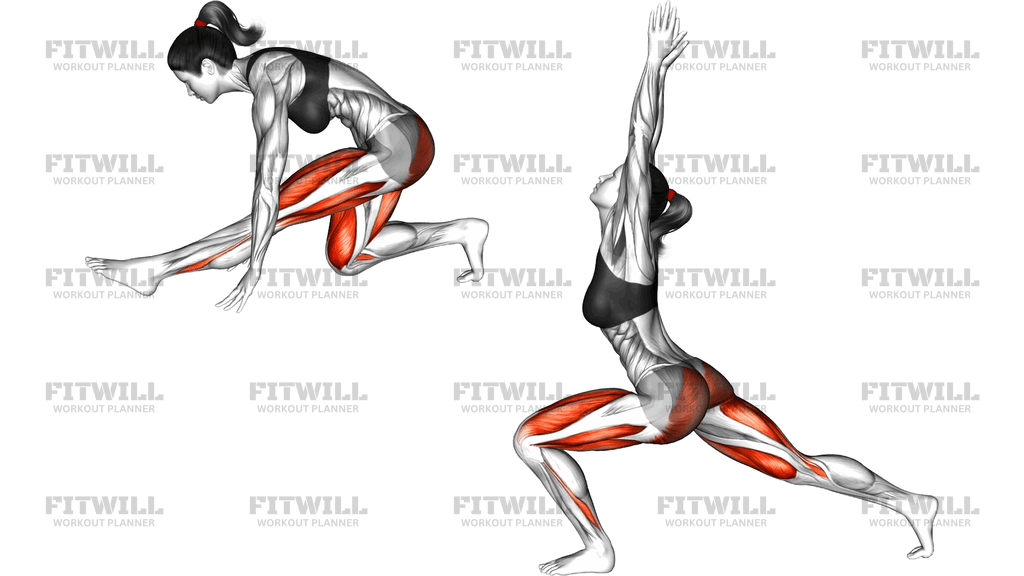
Instructions
- Stand at the top of a mat with feet hip-width apart, then step one foot forward into a generous stride, roughly two to three feet, keeping both toes pointed ahead.
- Bend the front knee so it stacks directly over the ankle, and press the back heel toward the wall behind you with the back leg fully straight and the rear foot at about a forty-five-degree angle.
- Sweep both arms straight overhead with palms facing each other, lift the chest, and draw the front ribs down so you are in a tall high lunge rather than leaning forward.
- Brace the core lightly and squeeze the back glute to keep the hips squared to the front of the mat before any movement begins.
- Inhale, then exhale as you shift your weight back over the back foot, straightening the front leg and easing the hips rearward.
- Flex the front foot so the toes lift toward the shin, then hinge forward from the hips with a long, flat back, letting your fingertips frame the front foot or reach toward the toes.
- Hold the hamstring stretch for one to two full breaths, keeping the back leg strong and the hips level instead of letting the back heel sink toward the floor.
- Inhale and press through the front heel to travel back up into the high lunge, raising the arms overhead and bending the front knee over the ankle again.
- Keep breathing steadily throughout the flow: inhale to rise into the lunge, exhale to fold into the stretch.
- Complete three to five cycles, then step the feet together, reset your stance, and repeat the entire sequence on the other leg.
Tips & Tricks
- If your fingertips cannot reach the floor in the hamstring portion, rest your hands on your shin or a pair of yoga blocks instead of rounding your spine to close the distance.
- Watch that the front knee does not drift past the toes or cave inward as you rock back and forth; a mirror or filming sideways will show it immediately.
- The most common mistake is collapsing the back heel toward the floor during the stretch half of the flow, which turns off the hip flexor lengthening, so keep reaching the heel back the whole time.
- Keep the front foot fully planted through the transition; lifting the heel or rolling to the outer edge as you shift weight back is a sign the stride is too long.
- Hinge from the hip crease rather than pulling down with the head and shoulders, imagining the chest traveling forward over the straight leg before it descends.
- If the back of the standing knee feels pinched during the hamstring stretch, add a small bend to that knee and focus on tilting the sitting bones up instead.
- Move deliberately between the two positions, since momentum lets you skip the exact range where the hamstrings and hip flexors need to work.
- Keep the arms actively reaching overhead in the lunge rather than letting them hover, so the shoulders and upper back stay involved instead of hanging passive.
- Place the sequence after your main training or use it as an isolated mobility block, since very deep static holds before heavy lifting can temporarily reduce power output.
Frequently Asked Questions
Which muscles does High Lunge To Hamstring Stretch target?
It primarily lengthens the hamstrings of the front leg during the fold and the hip flexors of the back leg during the lunge. The glutes, calves, quads, and core stabilizers work to hold the positions and control the transition.
Is High Lunge To Hamstring Stretch suitable for beginners?
Yes, because the intensity is entirely self-regulated by how far you fold and how deep the lunge sits. Beginners should shorten the stance, bring hands to the shin or blocks, and prioritize a flat back over reaching low.
Why does the front knee need to stay over the ankle in the high lunge position?
Stacking the knee over the ankle keeps the joint supported and puts the load into the quad and glute instead of stressing the knee. It also creates a stable base for the weight shift back into the hamstring stretch.
Should my back knee touch the floor during the flow?
No, in this version the back leg stays straight and lifted the entire time. If you need an easier option, drop the back knee down for the lunge portion and rise for the hamstring fold.
How long should I hold each part of High Lunge To Hamstring Stretch?
For a dynamic warm-up, move continuously and spend about one breath in each position. For a deeper cool-down stretch, hold the lunge and the fold for two to three breaths each before switching.
My hands never reach the floor in the hamstring stretch. Is that a problem?
Not at all, and forcing it usually means the lower back is rounding instead of the hamstring lengthening. Place your hands on your shin or on yoga blocks and keep the spine long.
Can I replace this with a seated hamstring stretch instead?
A seated stretch covers the hamstring but loses the hip flexor work and single-leg balance the lunge provides. If standing is uncomfortable, an easier substitute is a low lunge into half split on the floor, which keeps a similar hamstring and hip flexor pairing.
How many reps should I do per side?
Three to five smooth cycles per leg works well for most people. If you are using it as a pre-workout warm-up, keep the pace moving; if it is a post-workout stretch, slow down and hold longer.
Is it normal to feel this behind the knee rather than in the middle of the hamstring?
Sensation behind the knee is common because the hamstring tendons and calf attachments sit there, but sharp pulling is a signal to ease off. Soften the front knee slightly and focus on tilting the hips back to shift the stretch into the belly of the hamstring.
When should I avoid High Lunge To Hamstring Stretch?
Skip it if you have an acute knee, hip, or ankle injury that single-leg loading aggravates, or if balance issues make a standing lunge unsafe. In those cases, use a supported version with a hand on a wall or chair.