Prone Thoracic Rotation
Prone Thoracic Rotation is a floor-based mobility drill that opens up the mid-back, the area of the spine that most people lose rotation in first. You lie face down, prop yourself up on one forearm, and rotate your chest and top shoulder up and away from the floor, letting the spine twist through its upper segments while the hips stay heavy on the mat. Because your ribcage is supported against the ground, it is much harder to cheat the movement with your lower back, which is exactly why this position is so effective for isolating thoracic rotation.
This drill is especially useful for desk workers, drivers, and anyone who spends long hours sitting, since prolonged sitting tends to stiffen the upper back and pull the shoulders forward. It is also a go-to warm-up for lifters before squats, overhead presses, golf, tennis, or throwing sports, where clean upper-body rotation matters. People recovering general stiffness in the mid-back often use it as a gentle daily mobility reset.
The main work happens in the thoracic spine, but the visible effort comes from the obliques driving the rotation, with the rear shoulders, upper back, and chest assisting as the torso opens toward the ceiling. The bottom forearm and shoulder work isometrically to keep you propped and stable, and the legs stay relaxed but grounded so the rotation comes from the ribs rather than the pelvis.
Setup matters more than speed here. Keep the supporting elbow directly under the shoulder, stack your hips, and press the bottom hip into the floor before you start rotating. If the hips lift or twist, the lumbar spine takes over and the mid-back never actually moves. Rotate slowly, follow your top hand or elbow with your eyes, and pause briefly at the end of the range rather than forcing a bigger twist.
Treat this as a quality-over-quantity movement: five to eight slow, controlled rotations per side usually beats twenty rushed reps. Expect the range to feel different side to side, which is normal, and work each side to its own comfortable end point instead of matching them.
[ Workout Log & Planner ]
Put your next workout in Fitwill
Keep your plan and training log ready when you are.


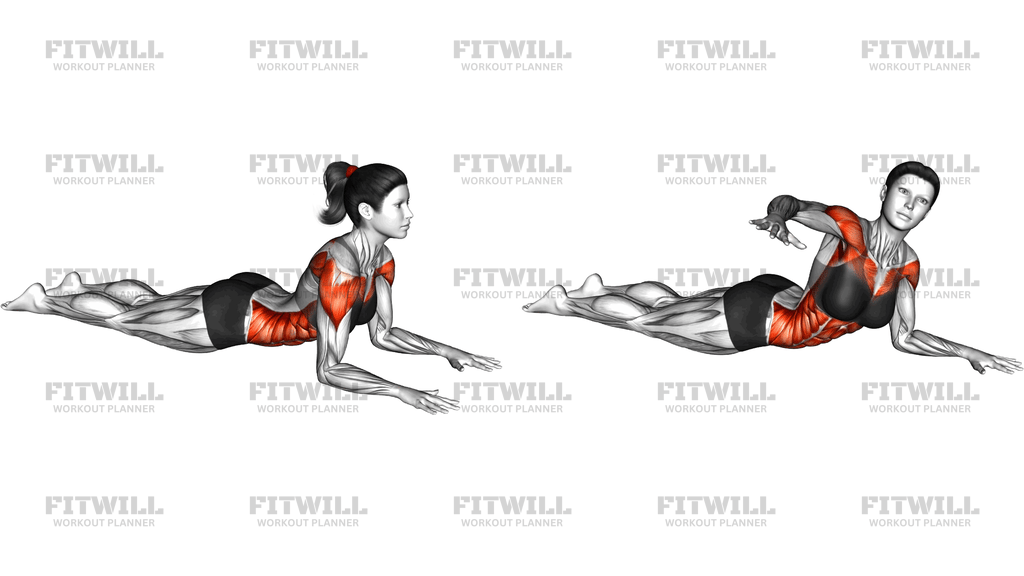
Instructions
- Lie face down on an exercise mat with your legs extended straight behind you and your feet relaxed.
- Bring your bottom-side forearm flat on the floor directly under your shoulder so your upper body is propped up, and rest your top hand behind your head or reach the top arm out in front of you.
- Press the hip on your supporting side firmly into the floor and squeeze your glutes slightly to lock the pelvis in place.
- Brace your midsection lightly and take a breath in while keeping your chest open.
- As you exhale, rotate your top shoulder up and back toward the ceiling, letting your chest turn open while your hips and legs stay planted.
- Follow the movement with your head and eyes so your neck rotates with your torso instead of cranking ahead of it.
- Pause for one to two seconds at your comfortable end range, feeling the stretch across the chest and the rotation in the mid-back.
- Lower your torso back down slowly and with control until your chest returns toward the mat, without collapsing onto the supporting shoulder.
- Complete your repetitions on one side, then switch the supporting forearm and rotate to the opposite direction.
Tips & Tricks
- The most common fault is letting the top hip roll backward as you rotate, which turns a thoracic drill into a lower-back twist; re-press the supporting hip down before every rep.
- If your supporting shoulder tires out or shrugs up toward your ear, widen the base by placing that forearm slightly farther out and relax the bottom shoulder away from the neck.
- Move at the speed of a slow exhale. Racing through the rotation lets momentum substitute for actual mid-back range.
- Keep the rotation coming from the ribs and shoulders, not from pulling harder on the hand behind your head, which can strain the neck.
- If you feel a pinch in the front of the top shoulder as you open up, reduce how far you rotate rather than pushing through discomfort.
- A brief pause at the top of each rotation does more for range than extra reps; hold the end position for a calm breath before lowering.
- It is normal for one side to rotate noticeably farther than the other. Train both sides to the same effort level, not the same distance.
- Breathe out during the rotation and in as you return. Holding your breath tends to stiffen the ribcage you are trying to mobilize.
Frequently Asked Questions
What does Prone Thoracic Rotation target?
It primarily works rotational mobility in the thoracic spine, with the obliques driving the turn and the upper back, rear shoulders, and chest assisting as the torso opens. The supporting forearm and shoulder work to stabilize you throughout.
Why am I propped up on one forearm during Prone Thoracic Rotation?
The forearm prop pins the lower ribs and pelvis against the floor so the twist is forced into the mid-back instead of the lower back. Lying completely flat would let your lumbar spine cheat the movement.
Is Prone Thoracic Rotation suitable for beginners?
Yes, it is low load and easy to scale. Beginners can rotate to a smaller angle and rest the top hand on the floor instead of behind the head until the range improves.
Should I do Prone Thoracic Rotation before or after training?
It works well as part of a warm-up before pressing, squatting, or rotational sports, and it can also be used after training or in the evening to ease mid-back stiffness. Keep the reps slow either way.
Why does one side rotate farther than the other in Prone Thoracic Rotation?
Side-to-side differences in thoracic rotation are very common, especially in people who favor one arm in sports or daily habits. Work each side to its own comfortable end range rather than forcing the stiffer side to match.
My lower back feels this instead of my mid-back. What should I fix?
Your pelvis is probably twisting with you. Re-press the supporting hip into the mat, tighten your glutes slightly, and rotate a shorter distance until you can keep the hips completely still.
Can I do Prone Thoracic Rotation without an exercise mat?
Yes, any firm but padded surface such as carpet or a towel works. Very soft surfaces like a bed make it harder to keep the hips grounded and stable.
How many reps of Prone Thoracic Rotation should I do?
Five to eight slow rotations per side is plenty for most people. If your supporting shoulder fatigues before that, stop and switch sides.
Is it safe if I have shoulder or back discomfort?
The movement is gentle, but any position that causes sharp pain should be avoided. Reduce the rotation angle, keep the top arm reaching forward instead of behind your head, and check with a qualified professional if discomfort persists.