Forward Fold And Rock
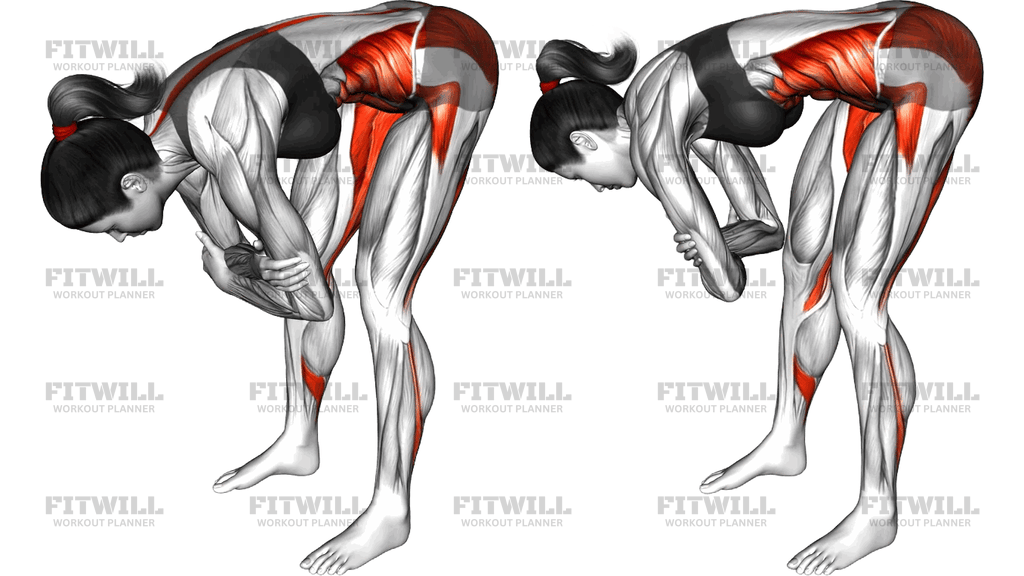
Forward Fold And Rock is a standing flexibility drill that combines a deep forward hinge with gentle, rhythmic rocking. You fold forward from the hips, clasp your elbows behind or beneath your legs, and then shift your weight subtly from toes to heels so the stretch travels through the hamstrings, calves, and lower back instead of sitting in one spot. The rocking component is what separates this from a static toe-touch hold — it lets you gradually explore your end range without forcing it.
This movement is most useful for people with tight posterior chains: desk workers whose hips and hamstrings have shortened from sitting, runners and cyclists who accumulate tension in the backs of their legs, and lifters who want to prepare for deadlifts, squats, or good mornings. It also works well as a cooldown after leg training, when the muscles are warm and respond more readily to lengthening.
The primary targets are the hamstrings along the back of the thigh, with meaningful stretch reaching the glutes, the erector spinae of the lower back, and the calves as your weight shifts toward the heels. Crossing the arms and holding the elbows adds gentle feedback — it keeps the torso relaxed and helps you resist the urge to pull yourself down with your hands, which is a common way people overload the lower back in forward folds.
Setup matters more than it looks. A hip-width stance with soft knees protects the joints and lets the pelvis tilt forward properly; locked knees shift stress to the ligaments behind the knee and can cause you to round from the spine instead of hinging at the hips. Rock slowly and deliberately — the goal is to feel the stretch migrate from mid-hamstring toward the calf and lower back, not to bounce aggressively, which can trigger a protective contraction in the very muscles you are trying to lengthen.
Breathe steadily throughout, exhaling as you settle deeper into the fold. Come up slowly and in stages, especially if you have been folded for a while, since standing up quickly from a hanging position can cause dizziness. If touching the floor is out of reach, that is completely fine — the elbow clasp means your hands never need to reach the ground, so this version is friendlier to tight hips than a classic toe touch.
Fitwill
Log Workouts, Track Progress & Build Strength.
Achieve more with Fitwill: explore over 9600 exercises with images and videos, access built-in and custom workouts, perfect for both gym and home sessions, and see real results.
Start your journey. Download today!




Instructions
- Stand with your feet hip-width apart, barefoot or in flat shoes, weight spread evenly across both feet.
- Soften your knees slightly and hinge forward from the hips, letting your torso hang down toward your thighs.
- Cross your forearms and grasp opposite elbows, letting your arms and head hang heavy.
- Let your upper body relax completely so your torso hangs from the hips rather than being held by tension.
- Rock gently forward onto the balls of your feet, then shift back onto your heels, feeling the stretch move from the calves and hamstrings into the lower back.
- Continue this slow rocking rhythm for 20 to 45 seconds, letting each rock take you slightly deeper only if it feels comfortable.
- Breathe steadily throughout, and exhale fully each time you settle into the deepest part of the fold.
- When finished, stop rocking, release your elbows, place your hands on your thighs, and roll or hinge back up to standing one vertebra at a time.
- Stand tall for a moment and take a breath before repeating or moving on.
Tips & Tricks
- If your knees lock without you noticing, set a small bend and hold it — the stretch should be felt in the muscles, not behind the kneecap.
- Keep your weight spread across the whole foot; dumping everything into your heels turns the fold into a balance exercise instead of a hamstring stretch.
- The rocking should be small and controlled, a few centimeters of shift at most. Big swings turn this into momentum training, which the hamstrings will fight against.
- If your head feels strained, tuck the chin slightly and let the neck go completely passive rather than craning to look at your legs.
- Tight hamstrings? Widen your feet slightly or bend the knees more. You can straighten them progressively over weeks as the range improves.
- Avoid pulling on your elbows to force yourself deeper — the clasp is for arm placement and relaxation, not leverage.
- If your lower back rounds painfully rather than stretches, reduce the depth of the fold and focus on tilting the pelvis forward instead of collapsing the spine.
- Do this stretch after training or a warm shower rather than cold first thing in the morning; warm muscle tissue lengthens more comfortably.
- Come up slowly if you feel lightheaded — hanging the head below the heart changes blood pressure, and a staged return prevents that sudden rush.
Frequently Asked Questions
What muscles does Forward Fold And Rock stretch?
It primarily lengthens the hamstrings, with the stretch also reaching the glutes, calves, and the erector spinae of the lower back as your weight shifts during the rocking.
Why clasp the elbows instead of reaching for the floor?
Holding your elbows keeps the arms passive and removes the temptation to yank yourself deeper with your hands, which commonly strains the lower back in forward folds. It also makes the exercise accessible if your hands cannot reach the floor.
Should my knees be straight or bent during Forward Fold And Rock?
Keep a soft bend, especially if you are new to the movement. As your flexibility improves, you can gradually reduce the bend to deepen the hamstring stretch, but never lock the knees hard.
How long should I rock in the fold?
Twenty to forty-five seconds per set works well, either as a single hold or as two to three shorter rounds. Stop while the sensation is still a comfortable stretch rather than sharp discomfort.
Is rocking better than just holding a static forward fold?
The gentle rocking spreads the stretch across the hamstrings, calves, and lower back instead of loading one point, and the small movement helps you ease into range gradually. Static holds have their place too, so you can finish with a brief still hold after rocking.
Is this a good stretch before deadlifts or squats?
Yes, after a general warm-up it can prepare the posterior chain for hinging movements. Keep the rocking gentle pre-training so you do not temporarily reduce muscle tension too much right before lifting.
My balance feels shaky when I rock. What should I do?
Stand near a wall or chair with a fingertip nearby for light support, and make the front-to-back weight shift smaller. Stability usually improves within a few sessions as your ankles and feet adapt.
Can I do Forward Fold And Rock every day?
Yes, gentle stretching of this kind is generally fine daily as long as you stay within a comfortable range. If the hamstrings feel sore from training, shorten the duration rather than skipping the movement entirely.
Who should be careful with this exercise?
Anyone with a recent hamstring strain, acute lower back pain, or conditions affecting the discs of the spine should keep the fold shallow or check with a qualified professional first. Dizziness in the folded position is a signal to rise slowly or skip the deep fold.