High Plank Shoulder Tap
The High Plank Shoulder Tap is an anti-rotation core exercise performed from the top of a push-up position. Instead of moving up and down, you stay locked in a straight-arm plank while lifting one hand to touch the opposite shoulder, then alternating sides. The entire challenge comes from refusing to let your torso twist or your hips sway every time one arm leaves the floor.
Because the demand is on resisting rotation rather than creating it, this movement trains the deep core and obliques in a way that crunches and sit-ups simply cannot. Your shoulders and triceps also work hard to hold a stable, straight-arm support, and the glutes and legs stay engaged to keep the plank line honest from shoulders to ankles. It is a popular choice in warm-ups, core circuits, and athletic training because it mimics the kind of single-arm stability needed in running, throwing, and pushing.
Setup matters more than most people realize. Hands should sit directly under the shoulders with fingers spread wide for a broad base, feet slightly wider than hip width to give you a steadier stance, and the body forming one straight line. If your hips start high in a pike or sag toward the floor, the exercise loses its core challenge and starts loading the lower back and shoulders instead.
To execute it well, brace your abs and squeeze your glutes before the first tap, then lift one hand slowly, touch the opposite shoulder, and place the palm back down with control before switching. A common error is rushing the taps, which turns the drill into a hip-rocking contest. Slow the tempo down and the same set becomes noticeably harder.
This is a body-weight movement, so you can do it almost anywhere — on a mat at home, in a hotel room, or as part of a gym warm-up. Beginners can start with fewer reps or a wider foot stance, while advanced lifters can bring the feet closer together, add a pause at the shoulder, or slow each tap to a three-second count. If wrist discomfort shows up, an exercise mat or a slight change to hand position on a stable surface usually solves it.
[ Workout Log & Planner ]
Put your next workout in Fitwill
Keep your plan and training log ready when you are.


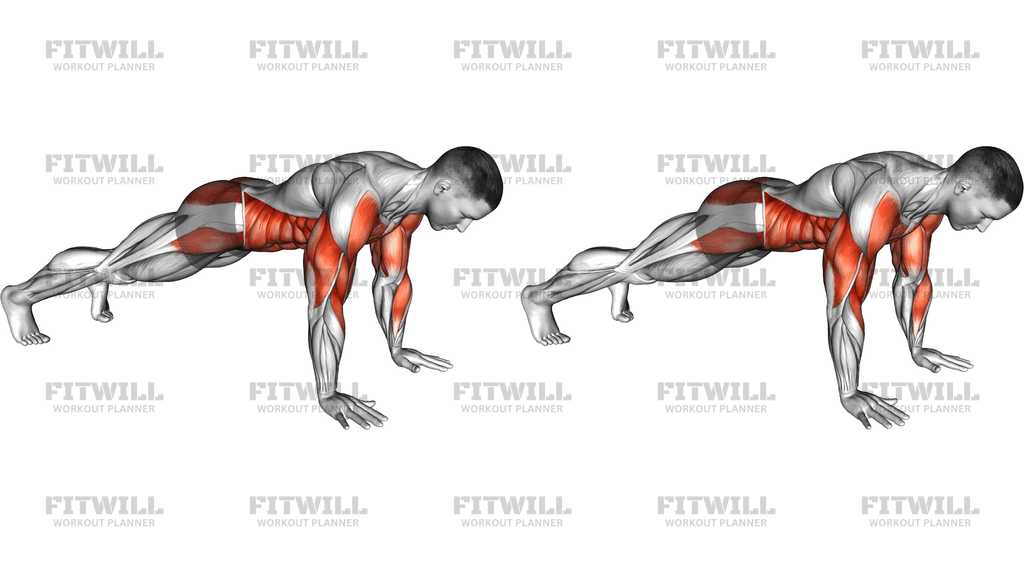
Instructions
- Place an exercise mat on the floor and set up on your hands and knees, then walk your hands forward until your arms are straight and stacked directly under your shoulders.
- Step your feet back to a high plank with your body in one straight line from shoulders to heels, feet a little wider than hip width for stability, toes tucked and legs active.
- Spread your fingers wide and press the floor away so your upper back is not caving in toward the mat.
- Brace your abs firmly and squeeze your glutes before moving, as if someone were about to nudge your hips from the side.
- Keeping your hips level, lift your right hand off the floor and tap your left shoulder in a slow, controlled arc.
- Place the right palm back down in its original spot, re-establishing a full press into the floor before moving on.
- Repeat the tap with your left hand to your right shoulder, continuing to alternate for the desired number of reps.
- Breathe steadily throughout, exhaling as you lift the hand and inhaling as you set it back down, never holding your breath.
- Between sets, drop to your knees or step back and shake out your wrists before resetting into a fresh, braced plank.
Tips & Tricks
- If your hips rock side to side with every tap, widen your feet to shoulder width or step one foot out slightly wider until you build more anti-rotation control.
- Keep the working hand's fingers spread and knuckles pressed into the mat; a collapsed palm is a common reason wrists ache during this drill.
- Do not let the tap become a slap — touching the opposite shoulder slowly keeps the core under tension and hides the fact that the movement looks easy.
- Watch for the shoulder of the supporting arm drifting toward your ear; press the floor away and keep that arm long.
- Your head is part of the plank line — look at a spot on the floor just ahead of your hands rather than craning up at the wall or dropping your chin to your chest.
- If you feel it in your lower back instead of your abs, check your hip height first; a sagging pelvis is the most frequent cause of back discomfort in this exercise.
- Slide something light and flat under your feet on a slippery surface so your toes do not drift outward as you tap.
- Start with fewer, cleaner reps — ten taps with zero hip movement beats thirty taps that turn into a torso twist.
- On a hard floor, a folded towel or mat under the knees is a useful bail-out position between sets rather than a mid-set modification.
Frequently Asked Questions
Which muscles does the High Plank Shoulder Tap work the most?
The primary work comes from the abs and deep core, especially the obliques, which must resist the rotation created each time a hand lifts. The shoulders, triceps, chest, and glutes support isometrically to hold the plank position.
Why do my hips swing side to side during High Plank Shoulder Taps?
Hip swing means your core is not yet resisting the rotation, or your feet are too close together for your current strength. Slow the tempo, widen your stance, and consciously squeeze the glutes before each tap.
Is the High Plank Shoulder Tap good for beginners?
Yes, provided the tempo stays slow and the plank position is honest. Beginners can also start from a lower surface, such as hands on a bench, to reduce the load while learning the anti-rotation pattern.
Should my feet be together or apart in the High Plank Shoulder Tap?
A slightly wider than hip-width stance gives you a more stable base and makes it easier to keep the hips square. As your control improves, bring the feet closer together to increase the challenge.
What can I substitute if tapping my shoulder is too hard?
Try plank shoulder taps with hands elevated on a bench, or perform slow alternating plank leg lifts, which train a similar anti-rotation demand with less load on the upper body.
How can I protect my wrists during High Plank Shoulder Taps?
Spread your fingers wide, press through the whole palm rather than the heel of the hand, and use an exercise mat or folded towel for padding. Rotating your fingers slightly outward can also relieve strain.
How fast should I do the High Plank Shoulder Tap?
Slow and deliberate beats fast every time in this drill. Aim for roughly one tap every two seconds, placing the palm fully back on the floor before switching hands.
Is it normal to feel the High Plank Shoulder Tap in my shoulders and arms?
Yes, some shoulder and triceps fatigue is expected because one arm is supporting your entire upper body. If the burn prevents you from keeping a straight plank, shorten the set or elevate your hands to reduce the load.
How many reps and sets of High Plank Shoulder Tap should I do?
Two to three sets of ten to twenty total taps is a solid starting point, focusing on zero hip movement. You can place it in a warm-up or as a core finisher depending on your session.
Can I do the High Plank Shoulder Tap every day?
Because it is a low-load, body-weight drill, it can be performed frequently, but your shoulders and wrists still need recovery from hard sessions. Listen to how your joints feel and keep most days at a moderate effort.