Cable Straight Leg Diagonal Kickback
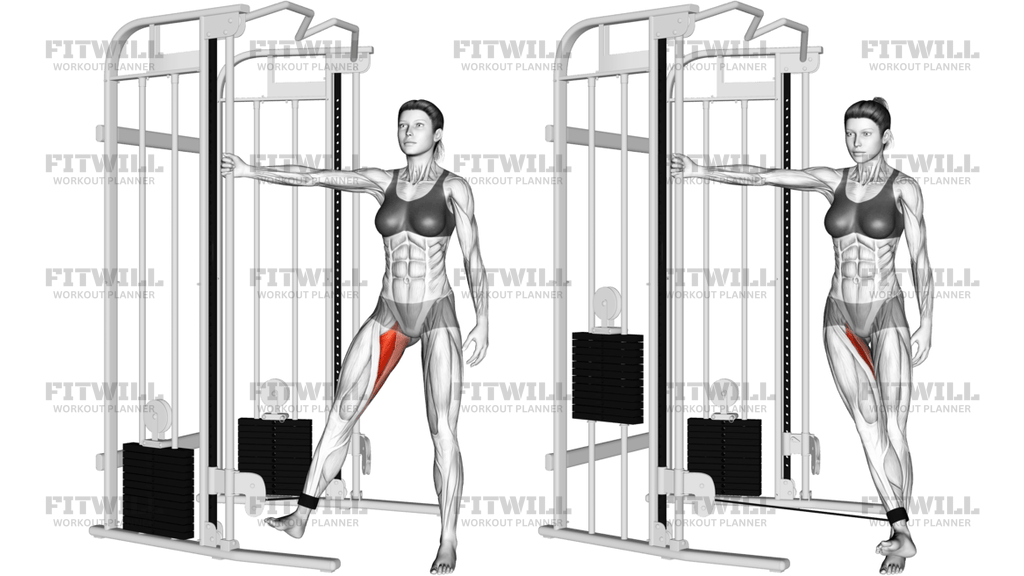
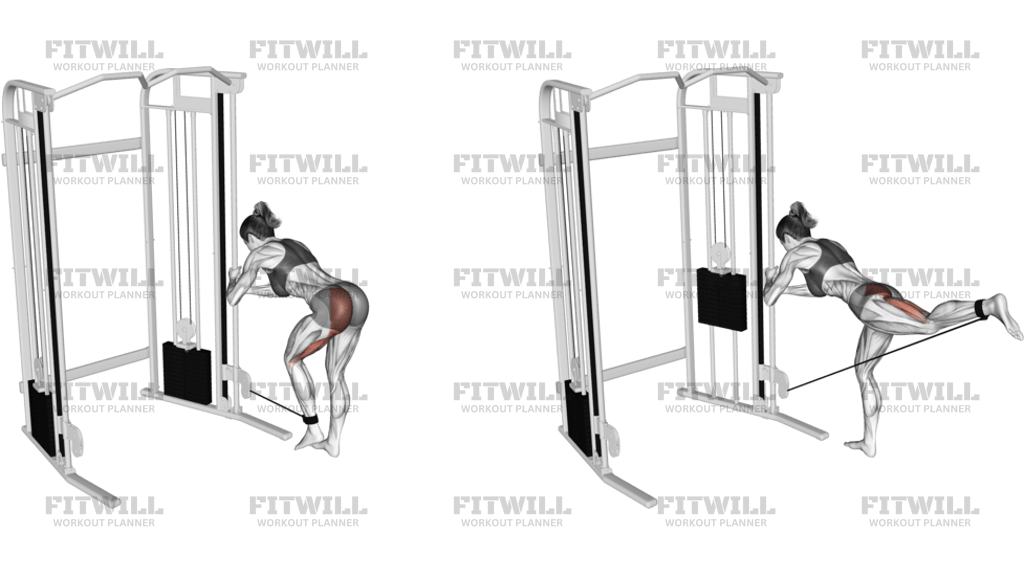
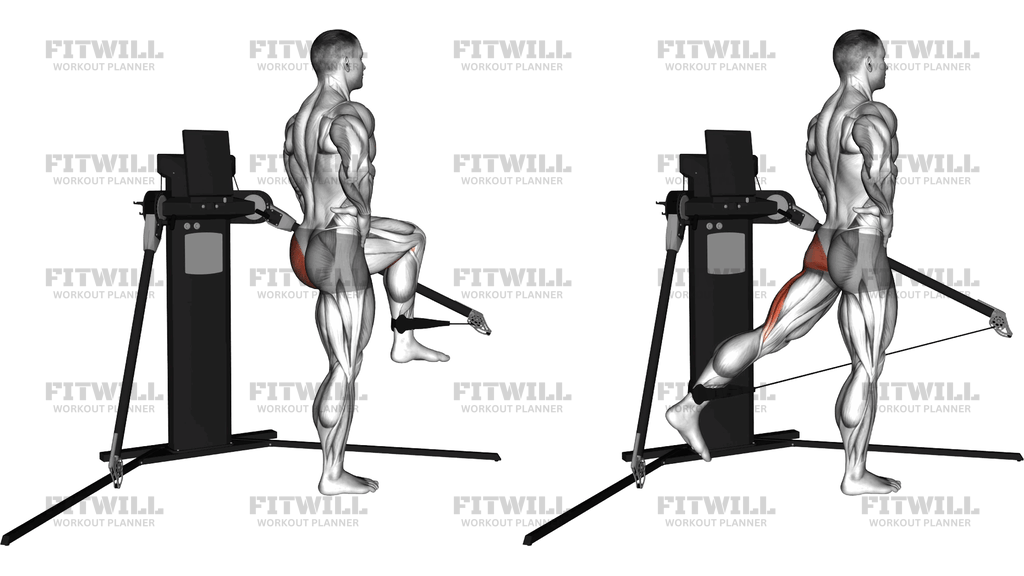
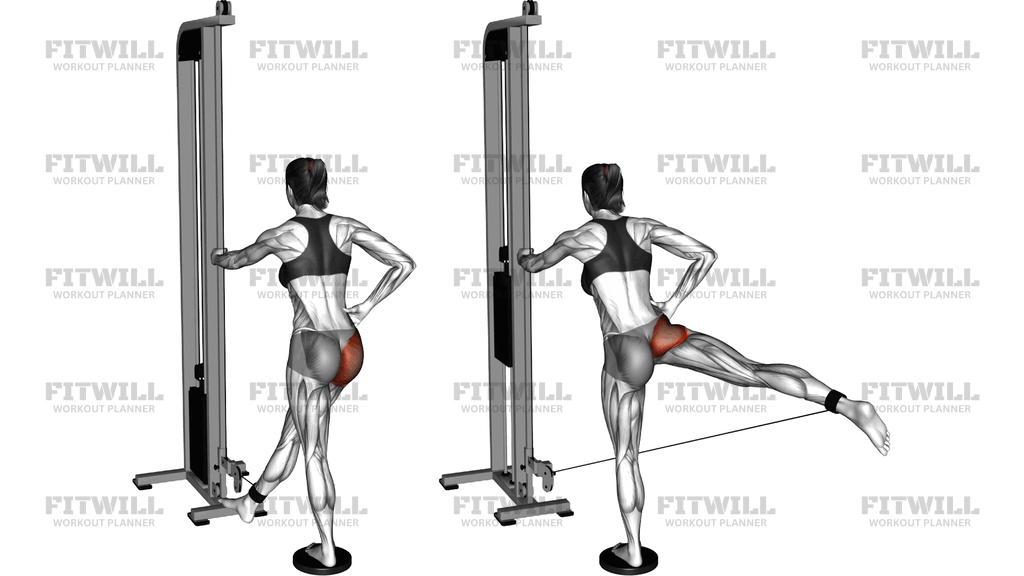
The Cable Straight Leg Diagonal Kickback is a single-leg glute exercise performed standing beside a cable machine with an ankle strap attached to the low pulley. Instead of kicking straight back or straight out to the side, you drive the working leg back and outward along a diagonal path, blending hip extension with hip abduction in one smooth arc. This combination is what makes the movement special: it hits the gluteus maximus through extension while the gluteus medius and upper glute fibers work to control the outward angle, giving the whole glute complex a shared workload.
This exercise suits a wide range of trainees. Lifters who want to round out glute development after squats and hip thrusts will appreciate the constant tension the cable provides, since the resistance does not disappear at the top of the rep the way it does with free-weight kickbacks. It is also a solid choice for anyone building single-leg hip stability, because you spend the entire set balancing on one foot while the other leg moves under load. Many coaches also use it as an activation drill before heavier lower-body sessions.
Setup matters more here than in most glute work. The strap must sit snugly around the ankle of the working leg, the pulley must stay at its lowest position, and you need enough distance from the machine that the cable pulls taut at your starting position. Standing side-on with one hand braced on the machine frame gives you the support to keep your torso steady, which is the main challenge once the leg starts moving against resistance. A slight forward lean at the hips helps the glutes do the work instead of the lower back.
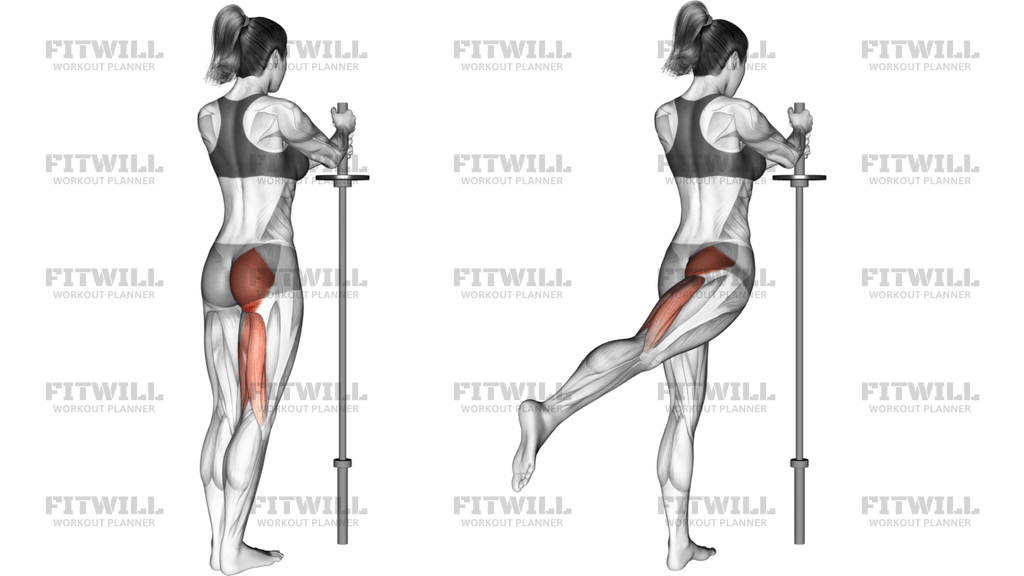
To execute the rep, sweep the strapped leg back and out behind you along the diagonal line the cable creates, keeping the knee mostly straight but not locked. Squeeze the glute at the end of the arc, hold for a beat, then resist the cable as it pulls the leg back to the start. The return deserves as much attention as the kick itself, since the eccentric portion is where much of the muscle-building stimulus lives.
Common use cases include glute-focused training days, lower-body accessory work after compound lifts, rehabilitation-style hip programming under professional guidance, and as a controlled way for beginners to learn what genuine glute contraction feels like without loading the spine. Because each leg works independently, it also exposes and helps correct left-to-right strength differences.
Keep the weight honest and the movement clean. The most frequent errors are swinging the leg for momentum, rotating the torso to cheat the arc, and arching the lower back to fake extra range. If you cannot stop the leg briefly at the top of the kick, the load is too heavy. Move in a range where your torso stays square and your glute, not your hip joint capsule or lower back, is clearly doing the work.
Fitwill
Log Workouts, Track Progress & Build Strength.
Achieve more with Fitwill: explore over 9600 exercises with images and videos, access built-in and custom workouts, perfect for both gym and home sessions, and see real results.
Start your journey. Download today!




Instructions
- Attach an ankle strap around your working leg and clip it to the low pulley of a cable machine, making sure the pulley sits at its lowest setting.
- Stand facing sideways to the machine with the strapped leg closer to the pulley, far enough away that the cable is taut before the rep begins.
- Grip the machine frame with the hand on the same side as your standing leg and place your free hand on your hip for balance.
- Hinge slightly forward from the hips, brace your core, and keep your shoulders and hips squared forward rather than twisted.
- Keeping the working leg essentially straight, sweep it back and out to the side along the diagonal path the cable traces behind your body.
- Kick until the leg is behind and slightly outside your hip line, then squeeze the glute hard and pause for a second at the end of the arc.
- Exhale as you kick back, and inhale slowly as you resist the cable on the way back to the starting position.
- Lower the leg under control until it is directly under or slightly across your body, without letting the weight stack slam down between reps.
- Complete all reps on one side, then unclip or carefully switch the strap to the other ankle and repeat with equal effort.
Tips & Tricks
- If your torso rotates as the leg swings back, you are turning the exercise into a momentum swing. Cut the weight roughly in half and relearn the arc with a square chest.
- The diagonal path is the point of the exercise. If your leg travels straight back, you are doing a standard kickback; if it travels straight out, you are doing an abduction. Trace the line the cable actually creates.
- Locking the knee hard at the top shifts tension toward the hamstring and joint. Keep the leg straight but soft so the glute stays the prime mover.
- Rather than cranking the leg as high as possible, chase the squeeze at the end of the kick. Height gained by arching the lower back adds nothing for the glutes.
- Keep most of your weight over the midfoot of the standing leg. Rocking onto the toes means the cable load is pulling you off balance, so step slightly further from the machine or lighten it.
- A one-second pause at the top of each kickback is worth more than five fast reps, because the cable tension makes the contracted position genuinely demanding.
- If the ankle strap chafes or slides, reposition it higher on the calf-adjacent part of the ankle and snug the Velcro before starting, not mid-set.
- Do not let the working leg cross far in front of your body at the start, as this rounds the lower back and turns the rep into a hip-flexor stretch instead of a glute contraction.
- Train your weaker leg first and match the reps with the stronger side to keep any imbalance from widening.
Frequently Asked Questions
Which muscles does the Cable Straight Leg Diagonal Kickback work?
The gluteus maximus is the primary mover, with the gluteus medius and other outer hip muscles contributing because the kick combines extension with abduction. The hamstrings assist slightly, and the standing leg works to keep you balanced.
Why does the Cable Straight Leg Diagonal Kickback use a diagonal path instead of a straight-back kick?
The diagonal blends hip extension and hip abduction, which loads the gluteus maximus and the upper glute fibers together. A straight-back kick emphasizes extension only, while a straight-out lift emphasizes abduction only.
Is the Cable Straight Leg Diagonal Kickback suitable for beginners?
Yes, and the cable setup actually helps beginners because the machine provides a handhold for balance and light, adjustable resistance. Start with a very light weight and focus on feeling the glute contract before adding load.
How far should I stand from the cable machine during this exercise?
Stand far enough that the cable is already taut with your working leg under your body, so the resistance is present from the first inch of the kick. If the cable goes slack at the start, step away from the machine.
Why is my lower back sore instead of my glutes after the Cable Straight Leg Diagonal Kickback?
That usually means you are arching your lower back to chase extra leg height instead of extending at the hip. Hinge forward slightly, brace your core, and shorten the range until the glute does the work.
Can I do the Cable Straight Leg Diagonal Kickback without an ankle strap?
An ankle strap is strongly preferred because a handle or bar held between the foot is unstable and hard to control on a diagonal path. If no strap is available, a resistance band anchored low can reproduce a similar arc at home.
How heavy should I go on this exercise?
Choose a weight you can kick back and out smoothly, pause for a second at the end, and return without swinging or twisting. If you need momentum to finish the arc, the load is beyond what your glutes can handle.
Should I hold onto the machine frame with one hand or both hands during the Cable Straight Leg Diagonal Kickback?
One hand on the frame is enough; the other hand on your hip gives you a reference point to notice if your torso starts rotating. Holding on with both hands is unnecessary and can pull you into a twisted position.
How does the Cable Straight Leg Diagonal Kickback compare to a quadruped kickback or glute machine?
The cable version is standing, so it adds a balance and hip-stability demand the floor-based versions lack, and it keeps tension through the entire arc. It is generally lighter in load but more targeted through the diagonal glute line.
Is it safe to do this exercise every day?
Daily low-load sets are generally fine as an activation drill, but for muscle-building work treat it like any resistance exercise and allow the glutes a day or more of recovery between demanding sessions. Stop if you feel sharp pain at the hip joint.