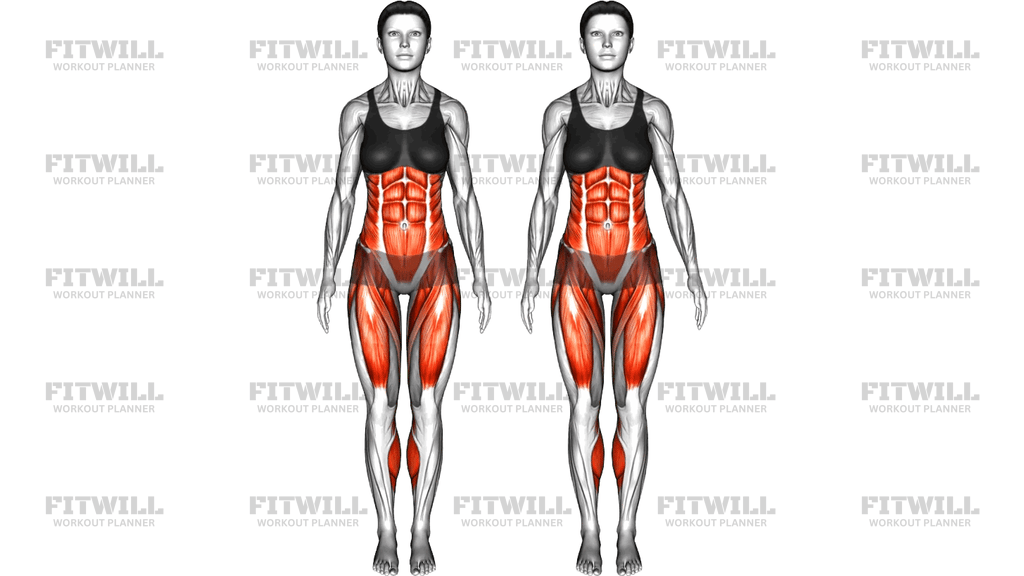
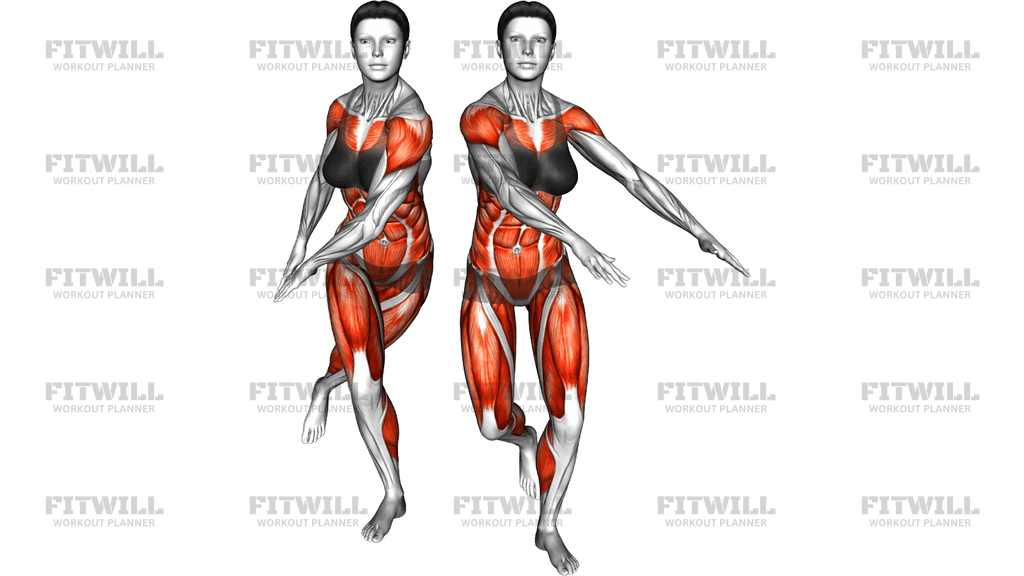
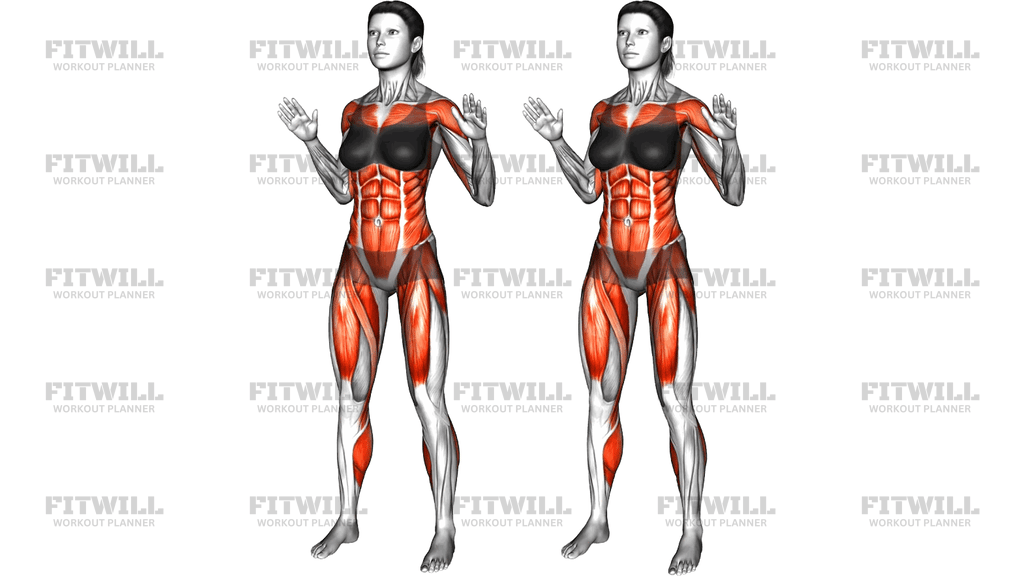
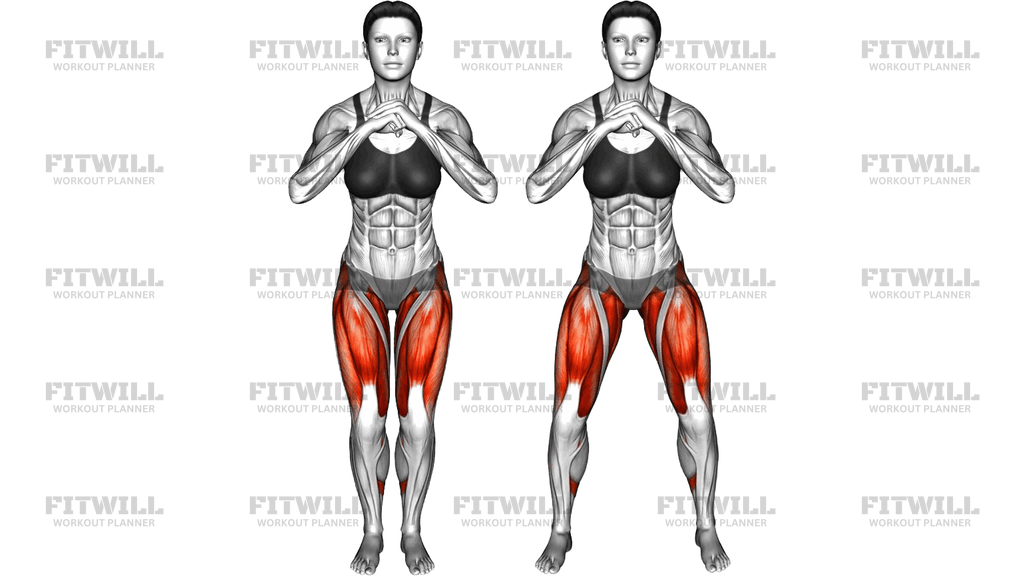
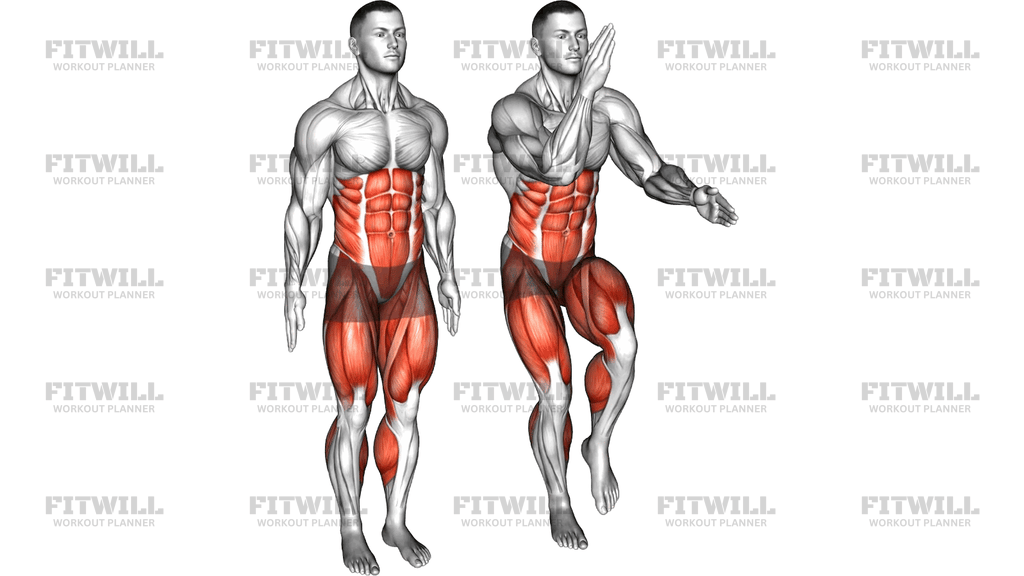
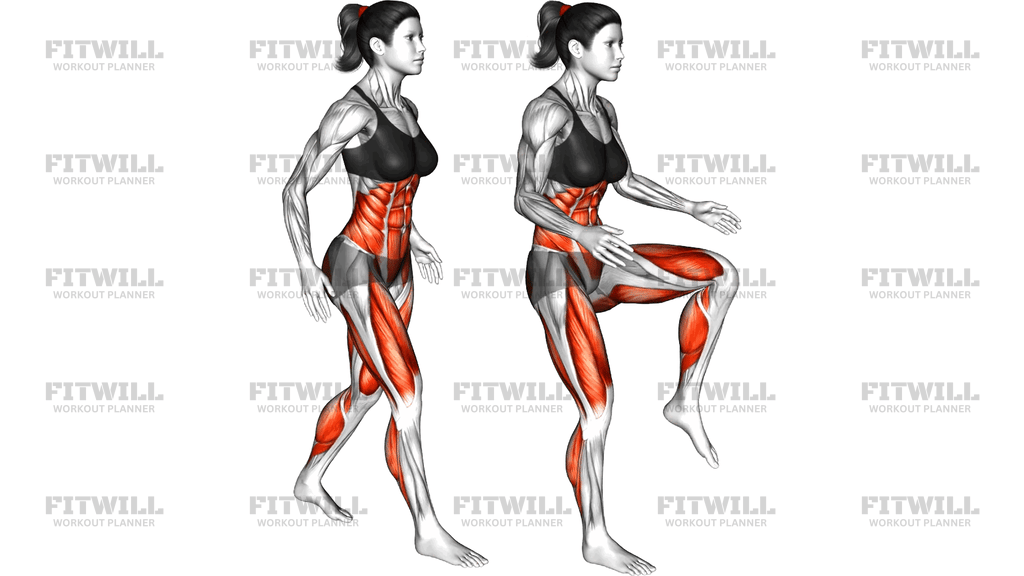
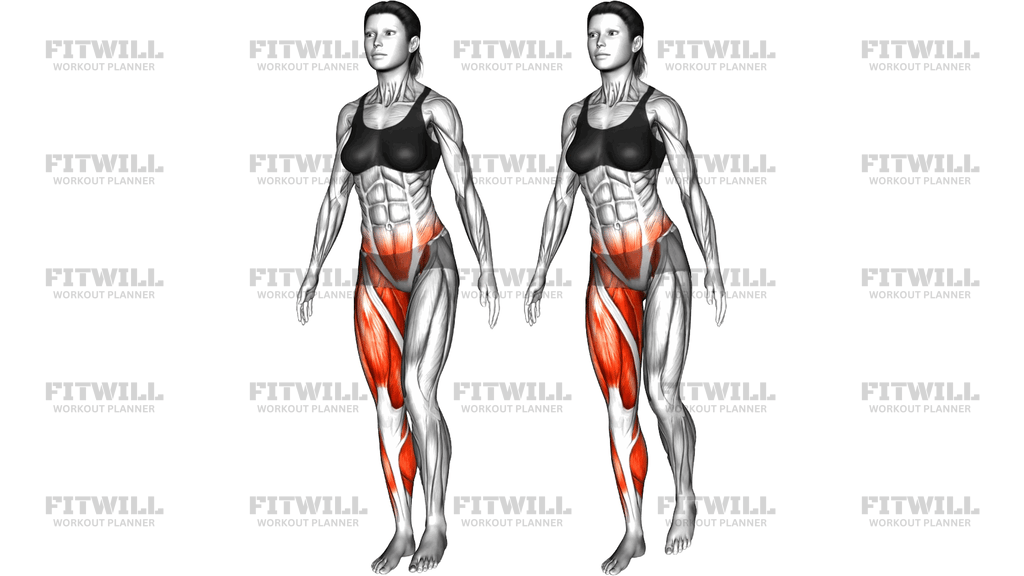
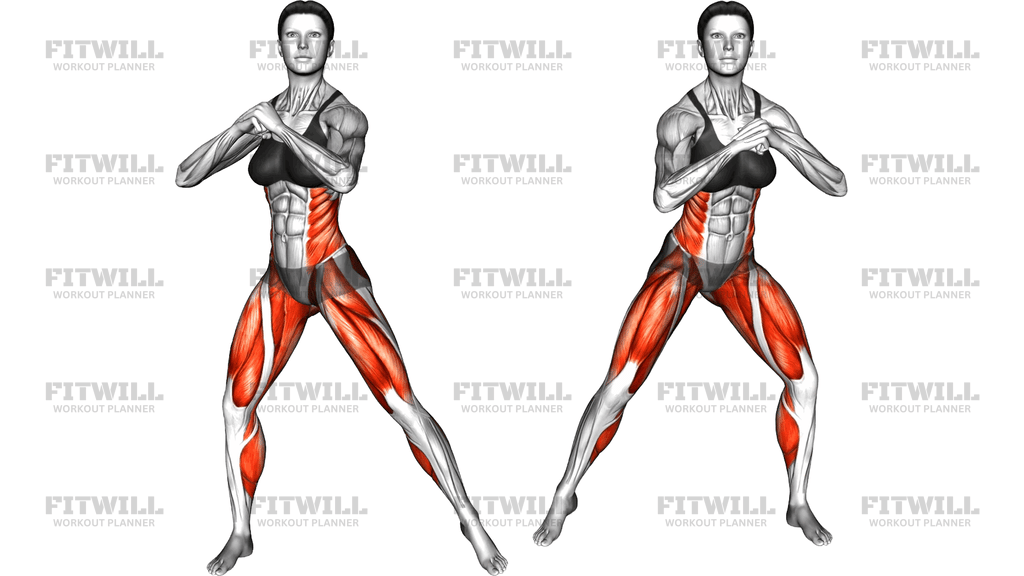
Reverse Lunge Forward Lunge
The Reverse Lunge Forward Lunge is a bodyweight lunge variation where you step one leg backward into a reverse lunge, return to standing, and then step that same leg forward into a forward lunge before bringing it back. This back-and-forth stepping pattern with a single leg trains both directions of the lunge in one continuous sequence, challenging your thighs, glutes, and balance from two angles.
Because you complete both the reverse and forward lunge on one leg before switching sides, the exercise places a sustained balance and stability demand on the working leg and the muscles around your hips. The quads do much of the work lowering and raising your body, while the glutes and hamstrings drive you back up to standing, and the calves and deep core stabilize every step.
This variation works well for anyone training at home with no equipment, or as a warm-up and activation drill before heavier lower body lifting. It is also a practical teaching tool: the reverse lunge is generally easier on the knees, while the forward lunge exposes weaknesses in control and alignment, so pairing them helps you learn what a stable lunge actually feels like.
Setup matters more than speed here. Stand tall with feet hip-width apart, hands clasped at your chest or resting at your sides, and keep your torso upright throughout. Every step should land with your weight over the middle of the front foot, and both knees should bend to roughly right angles at the bottom of each lunge.
To execute it well, think about stepping, lowering under control, driving through the front heel to stand, and then repeating the same quality of movement in the opposite direction. Rushing the transitions is the most common error, and it usually shows up as a wobbly landing or a collapsed torso. Move deliberately until the pattern feels automatic.
A typical set runs 8 to 12 total lunges per leg, alternating one reverse and one forward step with the same leg before switching sides. If balance is a limit, hold onto a wall or the back of a chair lightly with one hand until your stability improves.
[ Workout Log & Planner ]
Put your next workout in Fitwill
Keep your plan and training log ready when you are.


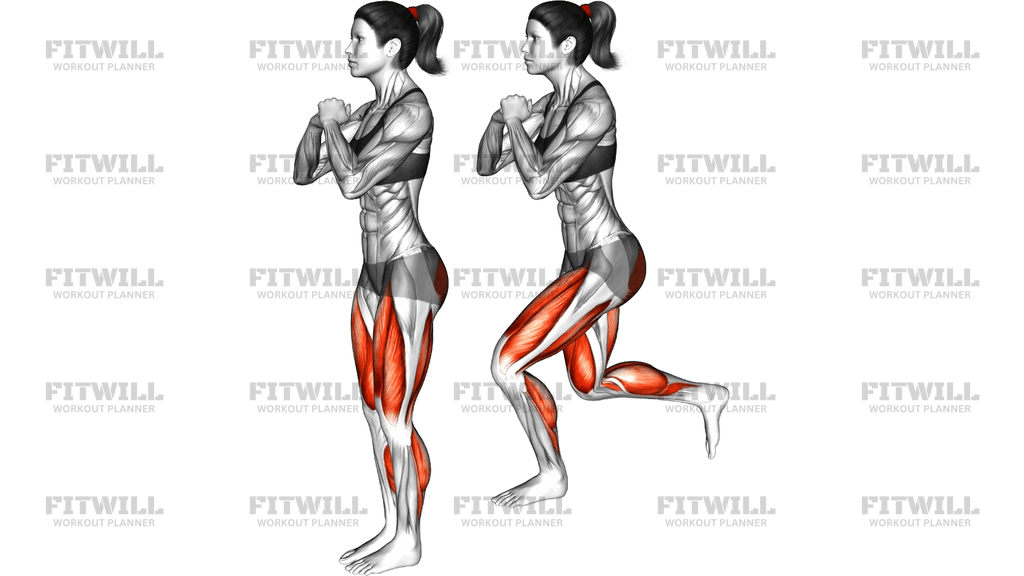
Instructions
- Stand tall with your feet hip-width apart, arms relaxed or with hands clasped in front of your chest for counterbalance.
- Brace your core lightly and shift your weight onto one leg, keeping your torso upright and your gaze forward.
- Step your free leg straight back and lower until both knees bend to about 90 degrees, with the back knee hovering just above the floor.
- Press through the heel of your front foot to stand and bring the back leg fully back to hip-width, standing tall between reps.
- From the same standing position, step that same leg forward and lower into a forward lunge, keeping your front knee stacked over your ankle.
- Drive back through the front heel to return to standing and reset your balance before the next rep.
- Exhale as you lower into each lunge and inhale as you press back up to standing.
- Complete all prescribed reverse-plus-forward reps on one leg, then switch and repeat on the other side.
- If you lose balance mid-set, pause fully upright with both feet down before continuing rather than rushing the next step.
Tips & Tricks
- The forward lunge is the harder half of this pair because your balance point shifts as the foot lands. Slow the descent noticeably on the forward step and plant the whole foot before lowering.
- Watch for the front knee caving inward, especially on the forward lunge. Think about spreading the floor with your front foot to keep the knee tracking over the middle of the foot.
- Short steps are a frequent mistake. If your back knee cannot reach a comfortable bend or your front heel lifts, take a slightly longer step in both directions.
- Avoid letting your torso collapse forward as you tire. Keep your chest lifted and ribs stacked over your hips on every rep.
- Do not rush the stand-up phase between the reverse and forward lunge. That moment of single-leg balance is where much of the stability work happens.
- Keep the back knee dropping straight down rather than swinging out to the side during the reverse lunge.
- If your knees feel achy, spend a few weeks doing only the reverse portion, then add the forward step back in once the pattern feels solid.
- Control the landing of the forward foot. A heavy, slapping step usually means you are falling into the lunge instead of lowering with your leg strength.
Frequently Asked Questions
Which muscles does the Reverse Lunge Forward Lunge work?
The quads and glutes are the main drivers, with the hamstrings assisting on the way up. The calves and core work continuously to keep you balanced on one leg through both lunge directions.
Why do a reverse lunge and a forward lunge together instead of one direction only?
Each direction stresses the hip and knee differently, so pairing them trains the leg from two angles in one rep. It also highlights control differences, since most people find the forward lunge harder to stabilize.
Is the Reverse Lunge Forward Lunge suitable for beginners?
Yes, as long as the range stays comfortable and the steps are long enough for good alignment. Beginners can hold a wall or chair lightly for balance and start with shallow lunges before working toward right-angle knees.
Should I complete all reps on one leg before switching?
Yes. Staying on one leg for the full set of reverse-plus-forward reps builds the balance and single-leg endurance that make this variation distinct from alternating lunges.
Why does my front knee hurt on the forward lunge but not the reverse lunge?
The forward lunge pushes more load into the front knee because the braking happens as your foot lands. Take a longer step, keep your weight over the middle of the front foot rather than the toes, and lower more slowly; if discomfort continues, stick to reverse lunges.
How can I make the Reverse Lunge Forward Lunge harder?
Hold a dumbbell in each hand at your sides or a single weight at your chest, or slow the lowering phase to three seconds per rep. Both options increase the demand without changing the movement pattern.
What is a good substitute if balance is a limiting factor?
Split squats, where your feet stay planted in a staggered stance, remove the stepping challenge while still training the same leg muscles. You can also perform only reverse lunges, which are easier to control.
How do I know if my step length is correct?
At the bottom of each lunge, your front shin should be roughly vertical with the knee over the ankle, and your back knee should bend comfortably near the floor. If your front heel lifts or the knee shoots past your toes, lengthen the step.
How many reps and sets should I do?
Start with 2 to 3 sets of 6 to 8 reverse-plus-forward cycles per leg, resting about a minute between sides. Increase reps or add load once you can complete every rep with steady balance and clean knee tracking.