Standing Calf Raise (On A Staircase)
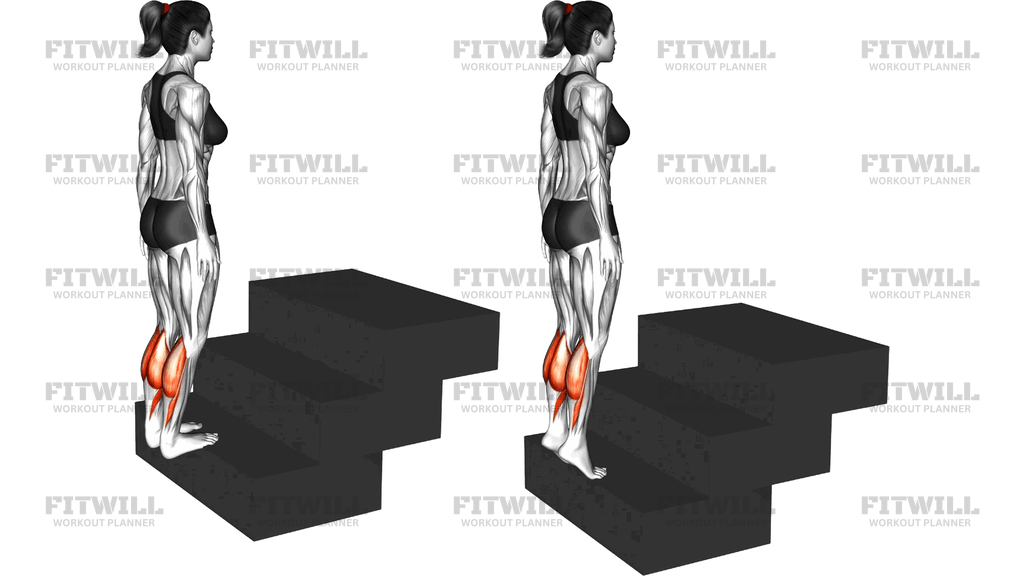
The Standing Calf Raise (On A Staircase) is a bodyweight movement performed on a stair or sturdy step, with the balls of your feet on the edge and your heels hanging freely off the back. Because the heel can drop below the level of the step, this version gives you a deeper stretch at the bottom of every rep than floor-based calf raises, and the added range is exactly why it's worth seeking out a staircase to do them.
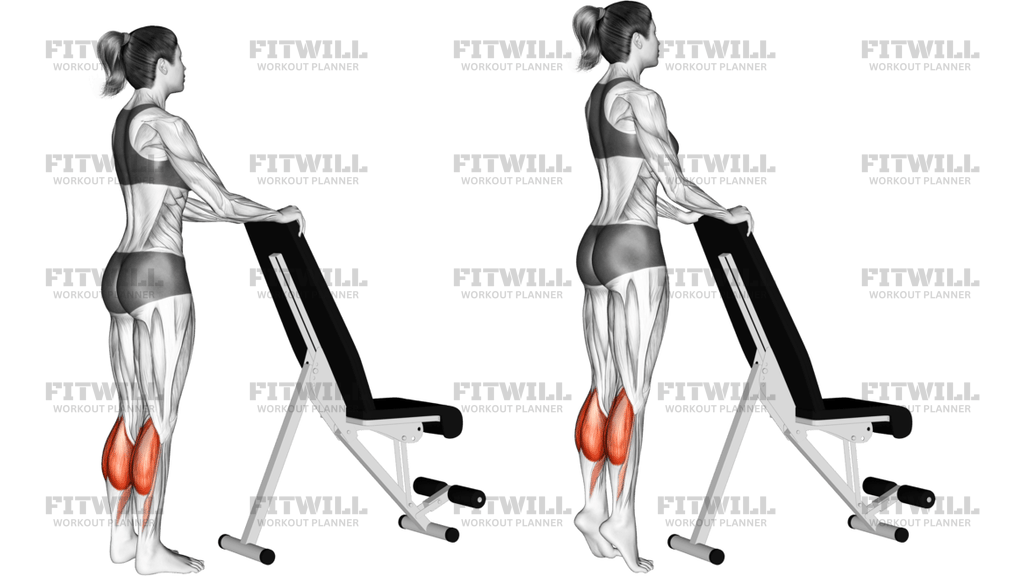
This exercise primarily targets the gastrocnemius, the visible two-headed muscle that gives the calf its shape, with the soleus working underneath it to help you rise and lower with control. The ankle stabilizers also get plenty of work, since balancing on a narrow edge forces the smaller muscles around the ankle joint to keep you steady on every repetition.
It's a great choice for anyone training at home or traveling with no equipment, since a staircase is all you need. It suits beginners building baseline calf strength, runners and hikers who want calves that can handle hills and push-off, and lifters who want to pre-exhaust or finish their calves without loading a machine or barbell.
Setup matters more here than most people expect. Stand with only the front third of each foot on the step so your heel can travel below the edge without catching, and position yourself near a wall, rail, or banister for light fingertip support. A step that's too high or an edge that digs into your arch will cut the range short and shift stress away from the calf.
To perform it well, keep your legs straight but not locked, rise as high onto your toes as you can, pause briefly at the top, then lower your heels slowly below the step until you feel a solid stretch. The lowering phase is where most of the benefit lives, so resist the urge to bounce at the bottom. Keep your body upright rather than leaning forward over the stairs, which turns the movement into something closer to a balance drill than a calf exercise.
Use moderate reps with strict form, and once bodyweight sets feel easy, you can hold a dumbbell or backpack in one hand to add load. Stop if you feel sharp pain in the ankle or Achilles, and ease into the stretched range gradually if you're new to training calves through a full range.
[ Workout Log & Planner ]
Put your next workout in Fitwill
Keep your plan and training log ready when you are.


Instructions
- Stand on the bottom step of a staircase with the balls of both feet on the edge and your heels hanging off the back of the step.
- Place your fingertips lightly on a wall, rail, or banister beside you for balance, and stand tall with your legs straight but not locked.
- Brace your core softly and shift your weight fully onto the forefoot so your heels can move freely up and down.
- Inhale and lower your heels slowly below the level of the step until you feel a firm stretch along the back of your calves.
- Exhale and press through the balls of your feet to rise as high onto your toes as your range allows.
- Squeeze the calves hard at the top for a one-second pause before starting the next rep.
- Lower under control over two to three seconds, keeping the edge of the step under the ball of the foot the entire time.
- Keep your torso upright and your hips stacked over your ankles; avoid bending forward or pushing off with your hands on the rail.
- Complete your target reps, then step off the staircase carefully, since the edge is easiest to miss when your calves are fatigued.
Tips & Tricks
- If the edge digs into your arch, slide your foot forward or back slightly until the pressure sits just behind the toes on the ball of the foot.
- Bouncing out of the bottom stretch is the most common fault on stairs; if you can't stop the bounce, reduce the depth of the stretch or slow the descent further.
- Relying on the handrail for upward drive quietly removes load from the calves, so touch it for balance only and keep the pressing work in your feet.
- Keep your knees straight to bias the gastrocnemius; if you want to shift emphasis toward the soleus, bend the knees slightly and keep them bent for the whole set.
- Work both heels through the same depth every rep by picking a fixed top and bottom position rather than letting fatigue shorten the range as the set goes on.
- Train one leg at a time if balance wobbles you; placing the free foot loosely behind the working ankle makes single-leg versions more manageable.
- If your calves cramp on the first sets, which is common with a stretched range, cut the reps in half for a session or two and build back up.
- Wear flat shoes or go barefoot as shown here; cushioned running shoes compress on the edge and make the ankle position less stable.
- Add load only when you can control a full range for 15-20 strict reps, holding a dumbbell in one hand while the other stays on the rail.
Frequently Asked Questions
Which muscles does the Standing Calf Raise (On A Staircase) work?
The gastrocnemius is the main muscle trained, with the soleus assisting throughout each rep. The ankle stabilizers also work continuously because you are balancing on the edge of a step.
Why use a staircase instead of doing calf raises on the floor?
The step lets your heels drop below the level of your forefoot, giving you a larger range of motion than a floor-based raise. That extra stretch at the bottom is the main reason this version is more demanding.
How much of my foot should be on the step?
Only the ball of the foot and the base of the toes should rest on the edge, with the heel fully off the step. If your arch is pressing into the edge, adjust your foot position before starting your set.
Is the Standing Calf Raise (On A Staircase) good for beginners?
Yes, as long as you start with a modest range and use the handrail only for balance. Beginners often find the bottom stretch intense at first, so shortening the descent for the first few sessions is a sensible way to start.
Should I keep my knees straight or bent?
Keep them straight for the standard version, which places more demand on the gastrocnemius. Slightly bent knees shift more work to the soleus, which can be a useful variation.
How many reps and sets should I do?
Two to four sets of 10-20 controlled reps works well for most people, with the top of the range becoming attainable as your control improves. Prioritize a slow lowering phase over chasing higher numbers.
How do I make the Standing Calf Raise (On A Staircase) harder?
Add load by holding a dumbbell or a weighted backpack in one hand, or move to single-leg reps with the free foot hovering behind your working ankle. Both options increase the demand without needing any extra setup.
Is it safe to do calf raises on a stair edge every day?
Daily light practice is generally fine for healthy ankles, but hard sets that leave the calves sore need 48 hours or so to recover. If you notice persistent Achilles or ankle discomfort, reduce frequency and depth.
What can I use if I don't have a staircase?
A sturdy step platform, a thick stable book on the floor, or a low curb works in a pinch. Just make sure the surface cannot slide or tip, and keep a wall or rail within reach for balance.
Why do my calves shake or cramp during this exercise?
Balancing on a narrow edge through a long range asks a lot of a small muscle group, and cramping is common early on. Shorten the range, reduce your reps, and stay hydrated; the cramping usually fades as your calves adapt.