Plank To Pike
Plank To Pike is a body weight core movement performed on the forearms, taking you from a straight forearm plank into an inverted pike position and back. It combines the stability demand of a plank with the dynamic hip hinge and spinal flexion of a pike, so your abs are asked to do more than simply hold still. The exercise appears in core circuits, Pilates-inspired routines, and calisthenics warm-ups because it bridges the gap between static holds and more advanced movements like pike push-ups or V-ups.
The main work comes from the abdominal wall, especially the lower abs and deep core, which must shorten to lift the hips and then lengthen under control as you lower back to the plank. Your shoulders and triceps support the weight through the entire range, and your hamstrings and calves get a genuine stretch at the top of the pike. Because the movement happens on the forearms rather than the hands, wrist stress stays low, making it a practical choice for people who find push-up variations uncomfortable on the wrists.
Setup matters more than it might seem. Elbows directly under the shoulders create a stable base so the torso can travel without the shoulders collapsing, and the feet close together with weight on the balls of the feet let the hips pivot cleanly. If the elbows drift forward or the feet sit too wide, the hips cannot rise high and the whole thing turns into a sloppy plank shift instead of a pike.
To execute it well, think of the pike as a folding action driven by the hips and ribs, not a rocking motion. Press the forearms into the floor, tuck the pelvis, and pull the hips up and back until the body forms an inverted V, letting the head relax between the arms. Reverse the path slowly, peeling the spine down segment by segment until you land back in a rigid plank with a straight line from shoulders to heels.
This exercise suits beginners building core strength as well as more experienced trainees who want a controlled, equipment-free core drill between harder sets. Use higher reps for endurance work, or slow the tempo down and pause at the top of the pike to make a small number of reps feel demanding. If you feel it mostly in your lower back rather than your abs, the plank position is likely sagging, and that needs fixing before adding volume.
[ Workout Log & Planner ]
Put your next workout in Fitwill
Keep your plan and training log ready when you are.


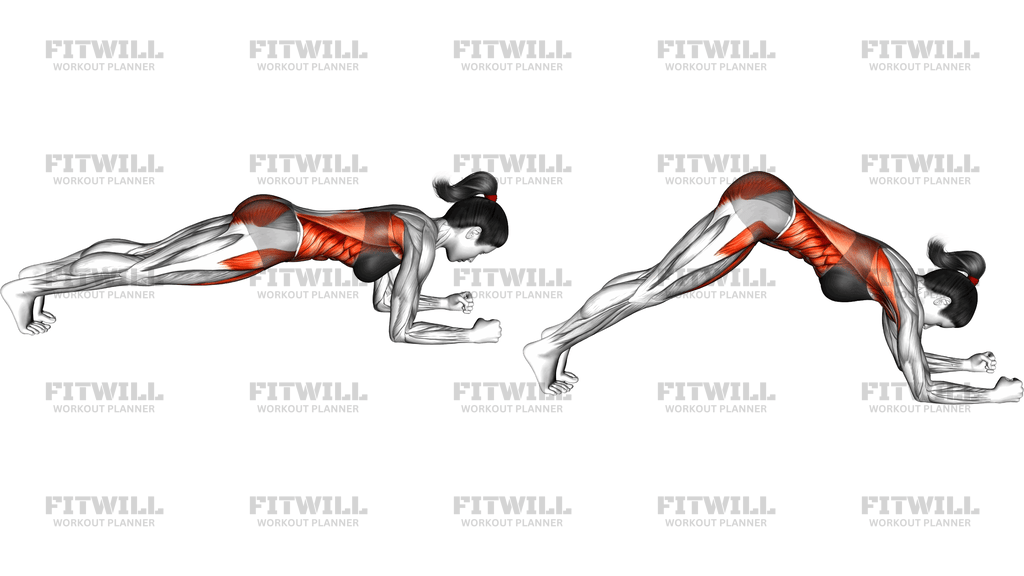
Instructions
- Place an exercise mat on the floor and set up on your forearms with your elbows directly under your shoulders, forearms parallel and pointing forward.
- Extend your legs back, keep your feet about hip-width apart or closer, and rest your weight on the balls of your feet so your body forms one straight line from shoulders to heels.
- Brace your abdominal wall by gently drawing the belly button toward the spine, squeeze your glutes lightly, and press your forearms firmly into the floor.
- Exhale as you push the floor away and lift your hips up and back, letting the head drop between the arms so the body forms an inverted V.
- At the top of the pike, press through the forearms and elbows, keep the legs as straight as your hamstrings allow, and hold briefly to feel the abs shorten and the spine round slightly.
- Inhale as you reverse the path, lowering the hips forward and down in a controlled arc until your body returns to the straight forearm plank line.
- Reset the plank position each rep: check that the hips are level, the lower back is not sagging, and the shoulders are still stacked over the elbows.
- Breathe steadily throughout, exhaling on the way up into the pike and inhaling on the way back down.
- Move at a tempo of roughly two seconds up and two seconds down, keeping the heels low and the neck relaxed between the arms the whole time.
Tips & Tricks
- The most common mistake is turning the movement into a small hip bob: if your hips only rise a few inches, deliberately think about pushing your chest toward your thighs and letting your heels drop lower.
- Keep your elbows glued under your shoulders; when the elbows slide forward during the pike, the shoulders take over and the abdominal work drops off noticeably.
- Avoid dropping back into the plank by gravity. The lowering phase, where the abs lengthen under tension, is where much of the benefit lives, so fight the urge to rush it.
- If tight hamstrings stop your hips from rising high, bend the knees slightly rather than rounding your whole back or shifting weight into the shoulders.
- Let the head hang between the arms at the top instead of craning to look forward; looking up flattens the pike and strains the neck.
- Squeeze the glutes as you return to the plank to prevent the hips from shooting up or the lower back from dipping when you land.
- Wider feet make the movement easier by shortening the lever, so if the full version is too hard, start with feet spread and narrow them over time.
- If your shoulders fatigue before your abs feel anything, hold the plank portion for a shorter count and spend more time at the top of the pike where the abs work hardest.
Frequently Asked Questions
What muscles does the Plank To Pike work?
The primary movers are the abs, particularly the lower abs and deep core, which lift and lower the hips. The shoulders, triceps, and glutes work statically to support and stabilize the body throughout.
Is Plank To Pike suitable for beginners?
Yes, as long as you can hold a forearm plank for about 30 seconds. Beginners can reduce the range by lifting the hips only partway or performing the movement with feet set wider apart.
Why is Plank To Pike done on the forearms instead of the hands?
The forearm position lowers the load on the wrists and shifts more emphasis onto the abdominal wall, since the reduced leverage at the shoulders forces the hips and abs to do the folding work.
How high should my hips go at the top of the pike?
Aim for an inverted V where the hips are the highest point and the head hangs between the arms. How high you get depends on hamstring flexibility, so a slightly smaller range with a straight back beats a forced, rounded pike.
Why do I feel Plank To Pike in my shoulders more than my abs?
That usually means your elbows have drifted forward or you are sinking into the shoulders instead of pressing the floor away. Reset the elbows under the shoulders and focus on driving the movement from the hips.
Can I substitute another exercise for Plank To Pike?
Dolphin pose holds, pike push-ups on the hands, or slow V-ups train overlapping patterns. If you want the closest match without wrist strain, practice alternating forearm plank holds with hip lifts.
Is it safe for my lower back?
When performed with a braced core and a controlled return to the plank, it is generally well tolerated. Discomfort typically appears when the lower back sags at the bottom, so stop and correct the plank line if you feel straining in that area.
How many reps and sets should I do?
Start with 2 to 3 sets of 8 to 12 slow reps. If the movement feels easy, pause for two to three seconds at the top of the pike rather than simply adding more reps.
Should my feet move during the exercise?
No, the feet stay planted on the balls of the feet while the hips pivot over them. If your feet shuffle forward as you lift, the hips are not doing the work, so lighten the range and keep the feet fixed.