Seated Sky Gaze
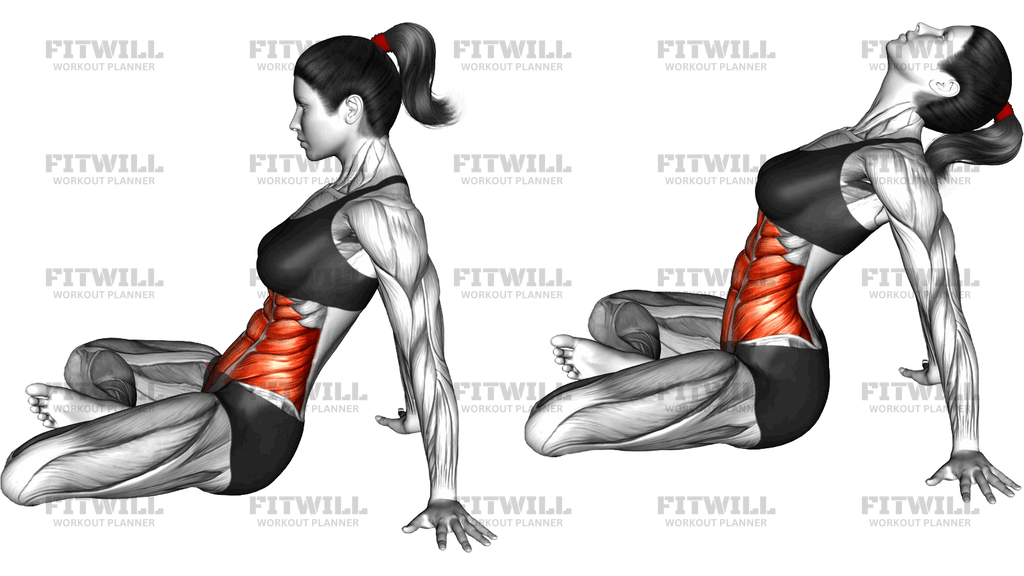
The Seated Sky Gaze is a bodyweight stretch performed on the floor, where you sit with your legs folded to one side, plant your hands behind your hips, and slowly arch your torso backward while tilting your head to look up toward the ceiling. The highlight of the movement is the long opening sensation through the abdominal wall, but the position also lengthens the front of the neck and encourages gentle extension through the mid and lower back. Because it requires no equipment beyond floor space, it fits easily into the end of a workout, a yoga-style cool-down, or a short midday reset.
This stretch is especially useful for anyone whose day involves a lot of sitting or forward-leaning posture. Desk workers, cyclists, and lifters who train a lot of pressing and core work often carry a shortened, compressed feeling through the front of the trunk. The Seated Sky Gaze reverses that pattern by placing the spine into controlled extension while the arms support your weight behind you. It is commonly used after ab training, when the rectus abdominis and obliques have been worked hard and respond well to being lengthened.
The setup matters more than it might look. The folded leg position and the hand placement behind the hips determine how much of the stretch lands in your abdomen versus your lower back. If your hands sit too far behind you, the shoulders take over and the stretch loses its focus on the trunk. If your hands sit too close, you can jam into the lumbar spine. Hands roughly under or slightly behind the shoulders, fingers pointing away from you, give you a stable base to lean back from.
To execute it well, think of the movement as a slow lean rather than a drop. Shift your weight into your palms, let the chest lift and travel forward and up, and allow the head to follow only after the torso has already begun to extend. Looking up too early or forcing the neck back creates strain in the cervical spine, which is the most common issue people run into with this stretch. The end position should feel like a broad opening across the stomach and front of the ribcage, with mild tension in the neck and a comfortable pull through the folded hips.
Hold the top position for twenty to thirty seconds while breathing steadily, then return upright by pressing through the hands and engaging the abdominals to control the way back. Because the legs are folded to one side, you may notice the stretch is slightly stronger on one side of the waist; switching the leg cross for a second hold keeps things even. Anyone with neck issues, acute lower back pain, or a recent abdominal or hip injury should approach this movement cautiously and keep the range small.
[ Workout Log & Planner ]
Put your next workout in Fitwill
Keep your plan and training log ready when you are.


Instructions
- Sit on the floor with both legs bent and folded over to one side, knees stacked or resting close together, and your sitting bones grounded.
- Place your palms flat on the floor behind your hips, about shoulder-width apart, with fingers pointing away from your body.
- Sit tall at the start, stacking your ribcage over your pelvis and letting your shoulders relax away from your ears.
- Take a slow breath in, then begin shifting your weight into your hands as you let your chest lift and your torso lean back.
- Allow your upper back to arch gradually, keeping your hips and legs heavy on the floor rather than lifting them with you.
- Once your torso is extended, slowly tilt your head back and direct your gaze upward toward the sky or ceiling.
- Hold the stretched position for twenty to thirty seconds, breathing evenly and avoiding any holding of the breath.
- To come out, tuck your chin first, then press through your palms and draw your torso upright using your abdominals.
- Reset your posture briefly, then either repeat on the same side or switch the fold of your legs and perform the stretch on the opposite side.
Tips & Tricks
- The most common mistake is throwing the head back first, which dumps tension into the neck. Lead with the chest and let the head arrive last.
- If your shoulders shrug up by your ears as you lean back, actively press the floor away and draw the shoulder blades down before extending further.
- Keep the stretch at a level of mild tension, not sharp pain. A strong pull across the stomach is expected; pinching in the lower back means you have gone too far.
- If the folded leg position bothers your knees, sit on a folded towel or thin cushion to raise your hips and reduce the angle at the knee.
- Keep your weight supported through your hands throughout the hold. If your arms shake or tire quickly, reduce the depth of the lean rather than sinking into the shoulders.
- Exhale as you lean back into the stretch. Many people unconsciously hold their breath, which makes the abdominals grip instead of release.
- Because the legs fold to one side, the obliques on one side of your waist may feel the stretch more. Matching the hold on both sides keeps the stretch balanced.
- Do not bounce at the end range. The Seated Sky Gaze works best as a static hold where the depth builds gradually as you exhale.
- If your wrists complain in the hand position, turn your fingers slightly outward or make fists and rest on the knuckles instead of flat palms.
Frequently Asked Questions
What muscles does the Seated Sky Gaze stretch?
The primary target is the rectus abdominis along the front of the trunk, with the obliques assisting because of the folded leg position. The front of the neck and the muscles around the lower back are also placed into gentle extension.
Is the Seated Sky Gaze a strength exercise or a stretch?
It is a stretch. Your arms provide support, but the intent is to lengthen the abdominal wall and open the front of the torso, not to build force or load muscle.
When is the best time to do the Seated Sky Gaze?
It works well after core or ab training, at the end of a workout, or any time you have been sitting in a flexed position for a long stretch. Warm muscles generally tolerate the extension more comfortably.
Why are the legs folded to one side instead of crossed in front?
The side fold tips the pelvis and biases the stretch slightly toward one side of the waist, which reaches the obliques along with the rectus abdominis. Switching the fold lets you cover both sides evenly.
My neck feels strained when I look up. What should I change?
Extend the torso fully before the head moves, and tilt the chin back only a small amount. You do not need to look straight up for the stretch to work; the opening comes from the chest and trunk.
Is it safe to do the Seated Sky Gaze with lower back pain?
People with acute lower back pain should be cautious with any extension position. If you choose to try it, keep the lean shallow, support most of your weight in your hands, and stop immediately if symptoms worsen.
Can beginners do the Seated Sky Gaze?
Yes. Beginners should simply use a shorter lean and hold the head in a neutral or only slightly tilted position. The depth can increase over time as the shoulders, hips, and trunk adapt.
What can I substitute if the seated position is uncomfortable?
A standing back extension with hands on the hips, or a prone press-up on the floor, reaches the abdominal wall through a similar extension angle without the folded leg position.
How long should I hold the Seated Sky Gaze?
Twenty to thirty seconds per side is a solid default, repeated once or twice. If you are using it purely to relax after training, a longer hold of forty to sixty seconds with slow breathing can feel good.