Deep Lunge To Hamstring Stretch
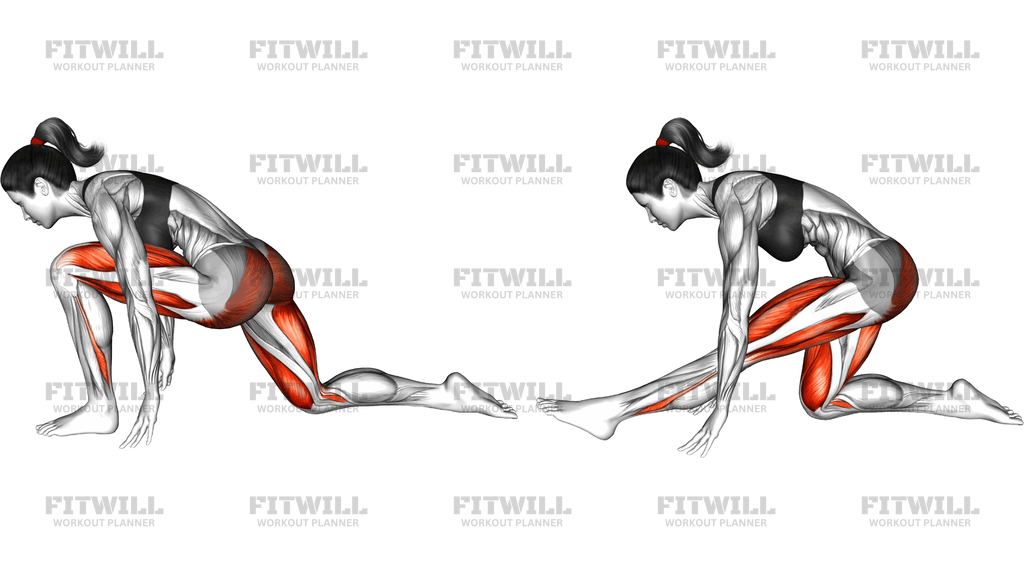
The Deep Lunge To Hamstring Stretch is a flowing two-position stretch that moves you from a low lunge into a straight-leg hamstring stretch without ever standing up. You start in a deep lunge with both hands planted on the floor for support, then shift your hips back and straighten the front leg so the heel stays down and the toes pull up. The movement targets the hamstrings of the front leg first, but it also reaches the hip flexors of the trailing leg, the glutes, the calves, and the lower back, making it one of the more complete lower-body mobility drills you can do with no equipment.
This stretch is especially useful for anyone who sits for long stretches of the day, since prolonged sitting shortens the hip flexors and leaves the hamstrings feeling tight and sluggish. Runners, cyclists, and lifters who hammer squats and hinges will also get a lot out of it, because the lunge-to-hamstring transition hits both ends of the thigh in one sequence. It works well as part of a warm-up when held briefly, or as a longer cool-down hold when you want to settle into the tissue and breathe.
The setup matters because your hands are your foundation throughout. Planting them on the floor about shoulder-width apart lets you control how much weight shifts forward into the lunge and how far back you travel into the hamstring position. Without that support, most people either round their lower back to fake flexibility or lose the heel contact that makes the hamstring stretch effective. Keeping the front heel anchored and the toes lifted is what separates a real hamstring stretch from just bending over.
To execute it well, step into a long lunge, drop the back knee toward the floor, and let your hips sink forward so you feel the front of the trailing hip open. Then press through your hands, rock your weight back, and straighten the front leg while pulling the toes toward your shin. Your chest travels toward your thigh as your hips move backward, and you should feel a clear line of tension running down the back of the front leg. Move between the two positions slowly, letting your breath set the rhythm rather than bouncing.
One of the practical strengths of this movement is how easily it scales. Tighter folks can keep a soft bend in the front knee during the hamstring phase or shorten the stance; more flexible people can deepen the lunge or hold the extended position longer. Because everything happens close to the floor with your hands down, the risk of losing balance is low, which makes it a safe choice for beginners as well as experienced trainees. The main safety points are simple: never force the back knee hard into the ground, keep the front knee tracking over the foot rather than caving inward, and ease out of the stretch if you feel any sharp or pinching sensation rather than a broad muscle pull.
[ Workout Log & Planner ]
Put your next workout in Fitwill
Keep your plan and training log ready when you are.


Instructions
- Step your right foot forward into a long lunge and lower your back left knee toward the floor, resting the top of the left foot on the ground.
- Place both palms flat on the floor on either side of your front foot, roughly shoulder-width apart, with your arms straight and supporting part of your body weight.
- Keep your front heel firmly planted and your knee stacked roughly over your ankle as you settle into the lunge.
- Gently press your hips forward and down to open the front of the trailing hip, breathing steadily as you hold for a moment.
- Press through your hands and shift your hips straight back, straightening the front leg while keeping the heel down.
- Pull the toes of the front foot up toward your shin and let your chest lower toward your thigh, feeling the stretch along the back of the leg.
- Hold the hamstring position for 15-30 seconds, breathing slowly and letting the stretch deepen slightly on each exhale.
- Bend the front knee and shift your weight forward to glide back into the deep lunge position with control.
- Complete your desired repetitions or hold on this side, then switch legs and repeat the full sequence on the other side.
Tips & Tricks
- If your hands do not reach the floor comfortably, place them on yoga blocks or a low step instead of forcing a rounded spine to touch down.
- A common mistake is letting the front heel lift when you shift back into the hamstring position; consciously drive the heel into the floor or the stretch loses its target.
- Avoid locking the front knee hard in the extended position; a soft, almost-straight knee keeps tension on the hamstring without straining the joint.
- If the top of your back foot hurts on the floor, tuck the toes under or fold a mat under the knee for padding.
- Do not let the front knee drift inward as you move; keep it tracking in line with your second toe through both positions.
- Keep your neck relaxed and your gaze slightly forward or down rather than craning up, so your upper body stays long over the leg.
- The temptation is to bounce between the two positions for range; slow, controlled transitions with a brief hold at each end produce a better and safer stretch.
- If your hamstrings are very tight, keep a slight bend in the front knee during the back-shift phase and work toward straightening it over weeks, not in one session.
- Exhale as you shift back into the hamstring stretch; exhaling naturally lowers tension and helps you sink a little deeper without forcing it.
Frequently Asked Questions
Which muscles does the Deep Lunge To Hamstring Stretch target?
The primary target is the hamstrings of the straightened front leg, with the hip flexors of the trailing leg opening during the lunge phase. The glutes, calves, and lower back also receive a gentle stretch as you move between the two positions.
Is the Deep Lunge To Hamstring Stretch suitable for beginners?
Yes, because your hands stay on the floor for support the whole time, which makes balance easy and lets you control the depth. Beginners can bend the front knee slightly during the hamstring phase and shorten the stance until flexibility improves.
Should I hold each position or flow between them?
Both work, depending on your goal. For a warm-up, flow slowly between the lunge and the hamstring stretch for several repetitions; for a cool-down, hold the hamstring position for 15-30 seconds and the lunge position for a similar time.
Why does my back knee hurt when I do the Deep Lunge To Hamstring Stretch?
The kneecap is likely pressing directly into a hard surface. Place a folded mat or towel under the knee, rest on the top of the thigh closer to the floor, and avoid sinking your full weight onto that knee.
My front heel keeps lifting when I shift back. How do I fix it?
This usually means the hamstring is pulling you past your current range. Bend the front knee slightly, keep your hands pressed down to load less weight onto the leg, and gradually work toward a straighter knee as flexibility improves.
Can I do the Deep Lunge To Hamstring Stretch every day?
Yes, it is a low-load body weight stretch and can be performed daily, especially if you sit a lot or run regularly. Just keep the intensity moderate and never push into sharp pain.
What can I use if I cannot reach the floor with my hands?
Place your hands on two yoga blocks, a low step, or a sturdy chair seat. The support height can be reduced over time as your hip and hamstring mobility improves.
Is this stretch better before or after a workout?
Use short, moving repetitions before lower-body training or running to prepare the hips and legs, and use longer static holds after training when the muscles are warm and you want to restore range of motion.
How far should I lower my chest toward my thigh in the hamstring position?
Only as far as you can keep the front heel down and your back reasonably long. Reaching further by rounding your lower back just moves the stretch away from the hamstring and can strain the spine.