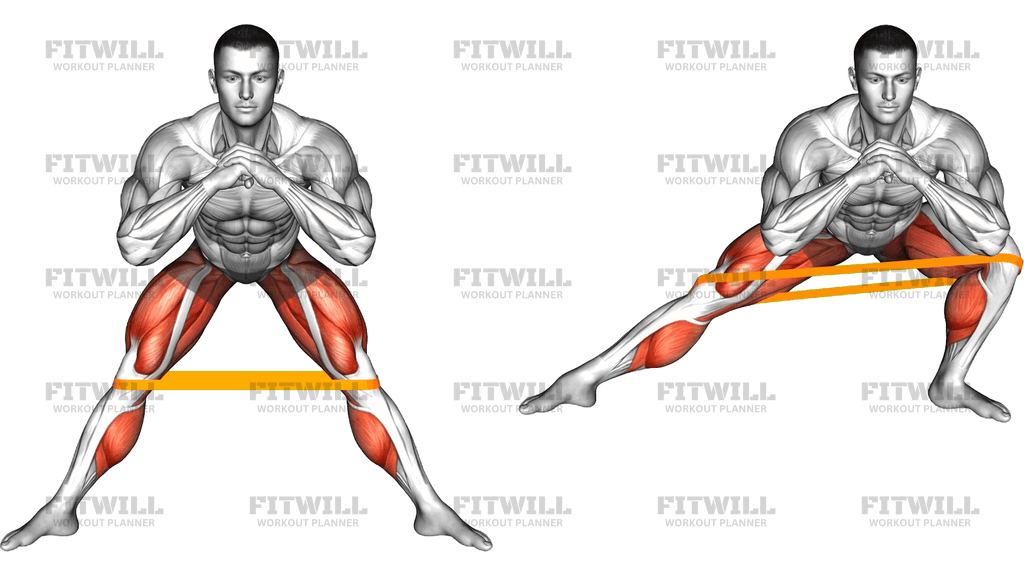
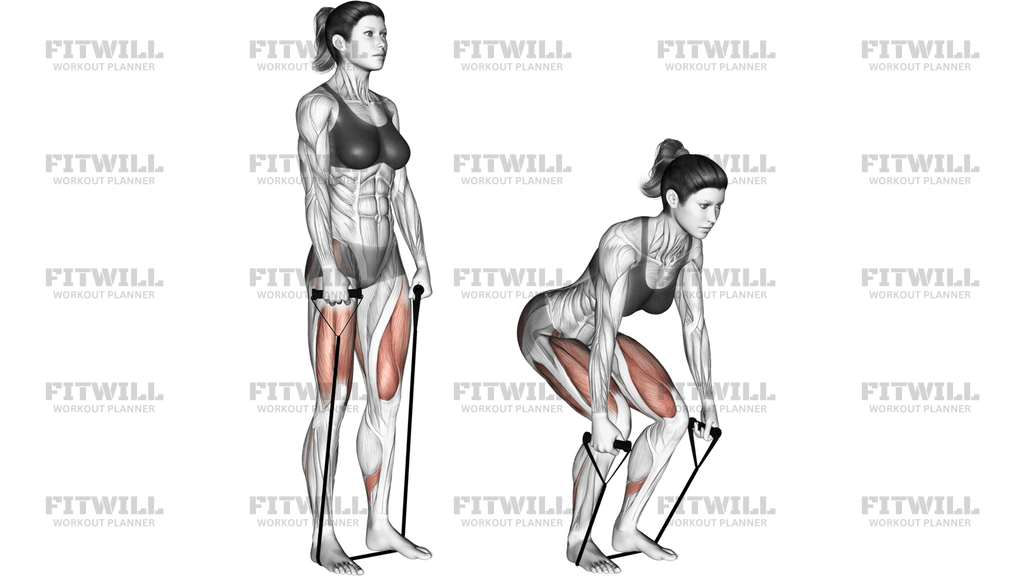
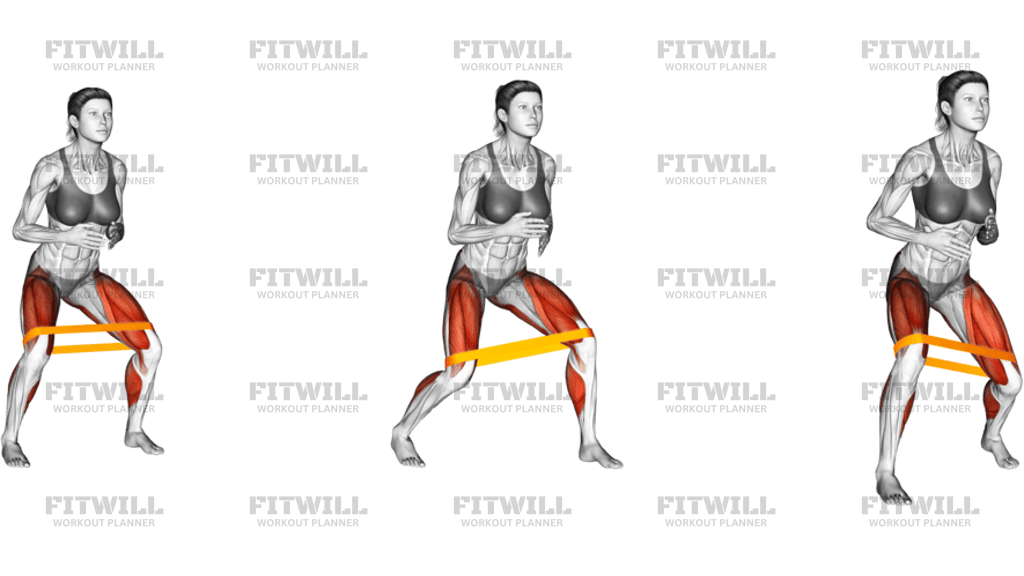
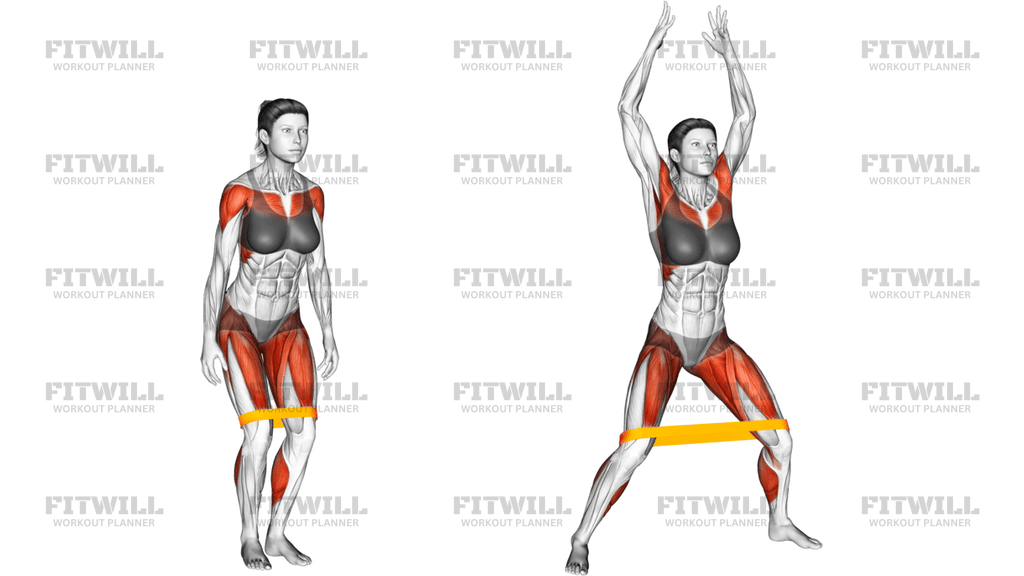
Resistance Band X Side Walk
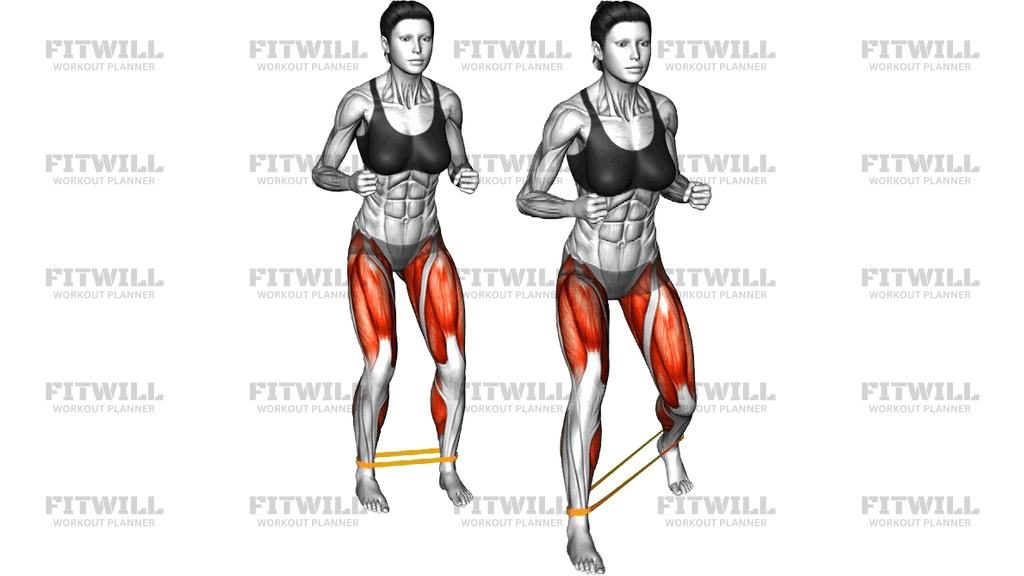
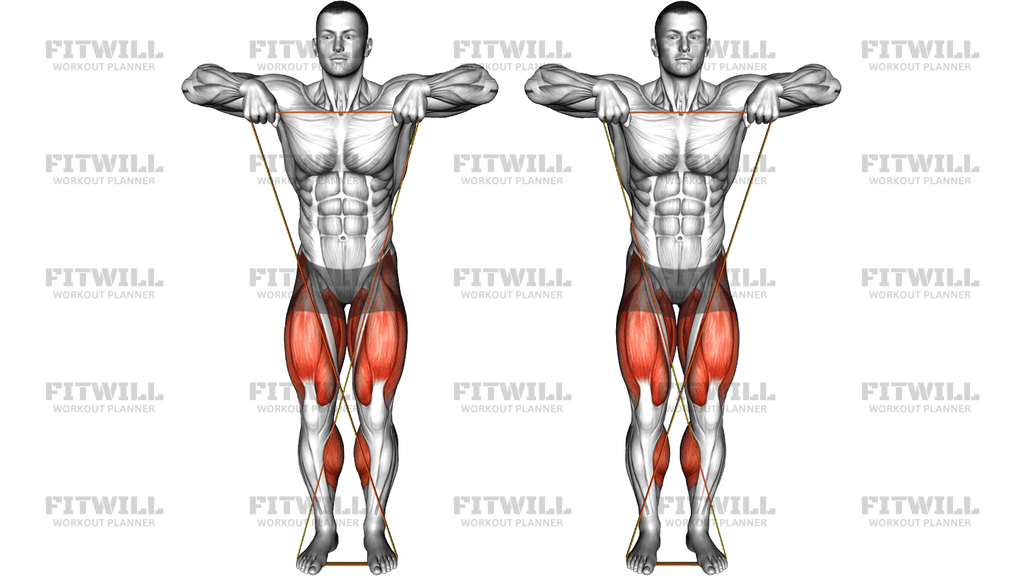
The Resistance Band X Side Walk is a lateral walking drill performed with a long resistance band looped under both feet and crossed in front of the body so it forms an X between your legs. You hold the opposite ends of the band up at shoulder height with your elbows bent and lifted out to the sides, then step sideways against the band's pull. The crossing setup means the band is always dragging each foot toward the midline, so every lateral step has to fight that inward tension — which is exactly what makes this version different from a standard band side walk with a simple loop around the legs.
The main target is the gluteus medius and the outer hip muscles, which control the alignment of your pelvis and thigh every time you stand, walk, run, or change direction. The quads and calves work to support each step, while the shoulders and upper back stay busy isometrically because you are holding the band ends up in an upright-row-style arm position for the entire set. Your core braces continuously to stop your torso from leaning or twisting as the band pulls.
This movement is especially useful for people whose outer hips are undertrained: desk workers with hips that feel stiff or unstable after long sitting, runners and lifters who want better knee tracking during squats and lunges, and anyone rehabbing into lateral movement patterns after a layoff. Because the load comes from the band rather than from gravity or external weight, it is easy to scale and gentle on the joints while still providing real, measurable tension.
Setup matters more here than in most band drills. The band must sit flat under the arches of both feet, and the X crossing must happen in front of your shins — one strand going from each hand to the opposite foot. If the strands cross behind you or the band rides up onto your toes, the resistance direction changes and the outer hips stop doing the work. Choose a band tension that lets you hold the hands at shoulder height without shrugging or dropping the elbows mid-set.
To execute it well, keep the steps short and deliberate. Each step sideways should be roughly shoulder-width, with the trailing leg following under control rather than being snapped back by the band. Stay in a slight athletic stance with soft knees, chest tall, and keep constant tension on the band — never let it go slack between steps. Work an equal number of steps in each direction so both sides get the same volume.
The most common mistake is turning this into a fast shuffle with a slouched torso. Speed reduces the time under tension on the outer hips and invites the knees to cave inward, which defeats the purpose of the X setup. Treat every step as a small, controlled single-leg balance challenge: press through the whole foot, keep the working knee stacked over the toes, and let the outer hip — not momentum — move you.
[ Workout Log & Planner ]
Put your next workout in Fitwill
Keep your plan and training log ready when you are.


Instructions
- Stand in the middle of a long resistance band with both feet about hip-width apart, the band running under the arches of each foot.
- Cross the band in front of your shins so each strand runs diagonally to the opposite side, forming an X between your legs.
- Grip one end of the band in each hand — the end attached to the opposite foot — and raise your hands to shoulder height with elbows bent and lifted out to the sides, similar to the top of an upright row.
- Brace your core, soften your knees into a slight athletic stance, and keep your chest tall and gaze forward.
- Step sideways with your lead leg about shoulder-width, pressing the band down into the floor with the trailing foot as tension increases.
- Bring the trailing foot toward the lead foot under control, stopping before the band goes slack so tension stays on the outer hips the whole time.
- Continue stepping sideways for the planned number of steps, keeping the hands at shoulder height and the elbows from dropping toward the ribs.
- Breathe steadily — inhale as you prepare each step, exhale as you step and control the trailing leg in.
- Walk back the same number of steps in the opposite direction so both legs perform equal work, then stand up, release the band one hand at a time, and reset.
- Repeat for additional sets, keeping the band crossing in front of the shins on every rep.
Tips & Tricks
- If your shoulders burn out before your hips do, the band is too heavy — the arm position in the X Side Walk is meant to be sustainable, so drop to a lighter band and keep the hands at shoulder height.
- Watch for the knees drifting inward on each step; the crossed band actively pulls your feet together, so consciously press the stepping knee out over the toes.
- Keep the band flat under the arches, not the toes — if it rides forward onto the balls of your feet, the calves take over and the outer hips lose tension.
- Do not let the trailing foot snap back to the lead foot; the eccentric control of bringing it in against the band's pull is where much of the glute work happens.
- If you keep shrugging your elbows up toward your ears, actively pull your shoulder blades down and back before your first step and recheck that position every few steps.
- Keep the steps short — a wide lunge-like step lets the band slacken on the trailing side and turns the drill into a balance exercise instead of a lateral strength one.
- Stay in a slight squat position rather than standing fully upright; a soft knee bend keeps the glutes loaded and protects the lower back from arching.
- If the band strands rub uncomfortably against your shins, wear long pants or reposition the crossing point slightly lower so it sits over the front of the ankles.
- Count steps in one direction, then match that number on the return — uneven distances are the easiest way to create a side-to-side strength gap.
- Pause for one second with both feet set after each step to feel the outer hip of the standing leg working before you take the next one.
Frequently Asked Questions
What muscles does the Resistance Band X Side Walk work?
The primary targets are the gluteus medius and outer hip muscles, which resist the band's inward pull on every lateral step. The quads and calves support each step, the shoulders and upper back work isometrically to hold the band ends at shoulder height, and the core braces throughout.
Why is the band crossed in an X instead of just looped around my legs?
The X crossing makes each strand run from one hand to the opposite foot, so the band actively drags both feet toward the midline. This means you must actively abduct — push out — with every step, giving the outer hips constant resistance in both directions rather than only when the band stretches wide.
Is the Resistance Band X Side Walk good for beginners?
Yes, it is beginner-friendly as long as you use a light band and short steps. Start with 8 to 10 steps in each direction and prioritize keeping the crossing in front of your shins and your hands at shoulder height over covering distance.
Why do my shoulders fatigue before my hips during this exercise?
Holding the band ends up in the upright-row position loads the shoulders and upper traps isometrically for the whole set. If they give out first, use a lighter band or rest your hands at chest height between sets — the hip benefit comes from the footwork, not from how hard you pull with your arms.
How far apart should my steps be?
Roughly shoulder-width per step is enough. The goal is continuous tension on the crossed band and a stable knee over the toes, not a wide split — big steps slacken the band and shift the work toward balance and momentum.
Can I do the Resistance Band X Side Walk as a warm-up?
Absolutely, and it works well before squats, lunges, running, or any sport involving lateral movement. Use a light band and one slow set of 10 steps per side to wake up the outer hips without fatiguing them.
What can I substitute if I only have a short loop band?
A standard loop band around the ankles or just above the knees gives a similar lateral-walk effect, though without the crossing or the shoulder component. You lose the midline pull of the X setup, so focus extra attention on keeping the knees pressed out against the band.
Should my knees be bent or straight during the walk?
Keep a soft, consistent bend in both knees, as if settling into a shallow athletic stance. Straight legs reduce glute engagement and make it harder to control the trailing foot against the band's pull.
How many sets and steps should I do?
Two to three sets of 10 to 15 steps in each direction is a solid working range. Rest about 30 to 45 seconds between sets, and stop the set when your steps slow down or your knees start drifting inward.
Is it safe for my knees?
When done with controlled steps and the knee tracked over the toes, this drill is generally well tolerated and is often used to build the hip strength that supports the knees. If you have a current knee injury or feel pain during the movement, reduce the band tension and step range or check with a qualified professional first.