Easy Pose (Hands On Belly And Chest)
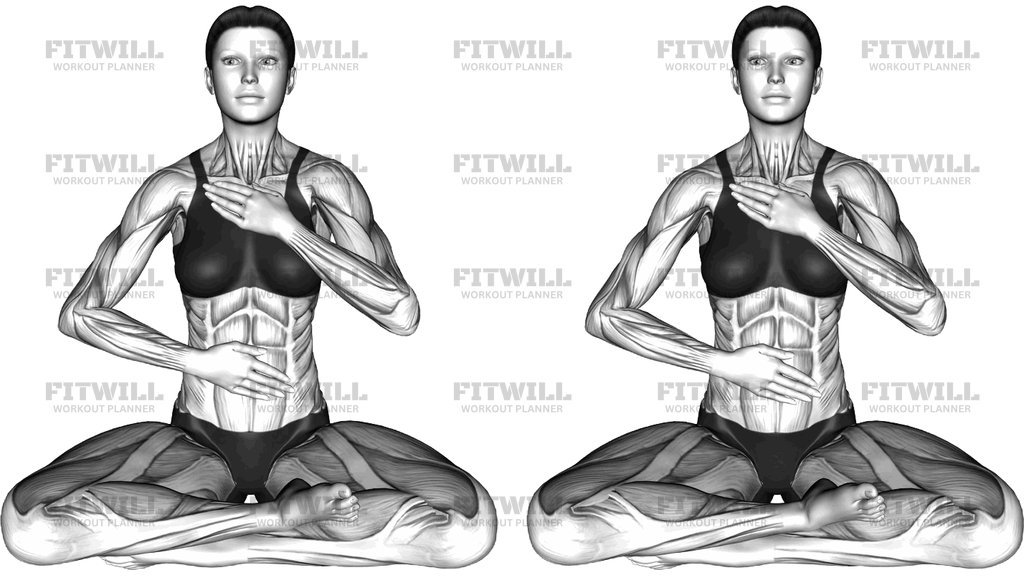
Easy Pose (Hands On Belly And Chest) is a seated breathing drill built on the classic cross-legged yoga position, with one palm resting on your belly and the other on your upper chest. The hands are not decoration — they act as feedback tools, letting you feel exactly where your breath is moving. When done well, the lower hand rises first as the diaphragm descends and the belly expands, while the upper hand stays relatively quiet until the ribcage finishes filling in the final portion of the inhale.
This exercise is useful for almost anyone. Lifters use it to reconnect with their breath before heavy training or between sets of demanding work. People who sit at a desk all day often breathe shallowly into the upper chest, and this drill retrains the habit of breathing low and wide. It is also a common starting point for stress management, meditation, and cool-downs, because slow nasal breathing with a long exhale nudges the nervous system toward a calmer state.
What it trains is less about muscle strength and more about control and awareness of the diaphragm and deep abdominal muscles. As you inhale, the belly should gently press into the lower hand without force or pushing. As you exhale, the belly falls naturally back toward the spine. The chest hand gives you a reference point so you can notice whether you are compensating with the shoulders and upper chest, which is the most common compensation in shallow breathers.
The setup matters because a collapsed or slouched seated position compresses the abdomen and makes diaphragmatic breathing harder. Sit tall on your sitting bones, let the knees drop toward the floor, and keep the spine long without stiffening it. If your hips are tight and your lower back rounds when you sit cross-legged, elevating your hips on a folded blanket or cushion changes everything — the pelvis tilts slightly forward and the breath has room to move.
To execute it well, keep the face, jaw, and shoulders relaxed and let the breath be smooth and quiet rather than forced. There is no need to take enormous breaths; a comfortable, steady volume repeated consistently teaches more than a few dramatic gulps of air. Start with a minute or two and build toward five to ten as it becomes natural.
Safety-wise, this is a very gentle exercise, but two points are worth noting. Never strain or hold the breath to the point of light-headedness — if you feel dizzy, return to normal breathing. And if sitting on the floor bothers your knees or hips, there is no shame in performing the exact same hand placement and breathing pattern sitting upright on a chair with the feet flat on the floor.
[ Workout Log & Planner ]
Put your next workout in Fitwill
Keep your plan and training log ready when you are.


Instructions
- Sit on the floor with your legs crossed comfortably in Easy Pose, each foot resting beneath the opposite knee. Place a folded blanket or cushion under your sitting bones if your hips feel tight or your lower back rounds.
- Rest your left palm flat on your belly, just below the navel, and your right palm flat on the center of your upper chest, below the collarbones. Keep both hands relaxed, with fingers together and no pressing.
- Lengthen your spine by imagining the crown of your head lifting toward the ceiling. Let your shoulders soften down and back, and allow your knees to release toward the floor without forcing them.
- Close your eyes or lower your gaze, and take one normal breath through the nose to settle before you begin the deliberate pattern.
- Inhale slowly through your nose for about four seconds. Direct the first part of the breath so your belly expands into your lower hand; only in the last portion should you feel your upper hand rise slightly as the ribs expand.
- Exhale smoothly through your nose for about four to six seconds, letting your belly fall gently back toward your spine. Keep the exhale relaxed rather than squeezed.
- Continue this rhythm for eight to twelve breaths, keeping your jaw loose and your shoulders still. Check in with your upper hand — the less it moves, the more the breath is coming from the diaphragm.
- If you feel light-headed at any point, stop counting and breathe normally until it passes.
- To finish, take one final slow breath, release your hands to your knees, sit for a few quiet breaths, then uncross your legs and change the cross of your ankles if you plan to repeat on the other side.
Tips & Tricks
- If your belly refuses to expand no matter what you do, try the same hand placement lying on your back first. Supine breathing gives the diaphragm the easiest possible start, and the skill transfers back to the seated position.
- Rounded shoulders and a slumped spine are the biggest quiet killers of this drill — a slouch compresses the belly so the breath escapes upward into the chest. Sit on a cushion to lift the hips above the knees.
- Watch for the tell-tale sniff or gulp at the top of the inhale. It usually means the breath is too big. Shrink the volume until the entire cycle feels effortless.
- Do not push the belly outward forcefully on the inhale. Expansion should feel like the breath is filling you, not like you are shoving your abs forward to fake it.
- Keep the chin level. Jutting the chin forward shortens the neck and encourages upper-chest breathing, which is exactly what the hand on the chest is there to reveal.
- Counting silently can help pace the breath, but if counting makes you tense, simply aim for an exhale slightly longer than the inhale.
- If your knees hover high and your hips complain, widen your feet slightly away from your body or sit with your back lightly against a wall — the breathing pattern matters more than the depth of the cross-leg.
- Practicing at the same time daily, such as right after waking or before bed, builds the habit faster than long occasional sessions.
- Switch which ankle sits on top between sessions so the seated position stays balanced on both sides of the hips.
Frequently Asked Questions
What does the hand on the belly and the hand on the chest actually do in Easy Pose (Hands On Belly And Chest)?
Each hand is a feedback sensor. The lower hand shows belly expansion from the diaphragm, and the upper hand reveals whether the breath is escaping up into the chest and shoulders.
Which muscles does Easy Pose (Hands On Belly And Chest) work?
It is not a strength exercise in the usual sense. It primarily trains control of the diaphragm and the deep abdominal muscles, with the core working gently to keep you sitting tall.
Is Easy Pose (Hands On Belly And Chest) suitable for complete beginners?
Yes, it is one of the most beginner-friendly breathing drills because the hands give instant, unambiguous feedback. Start with one to two minutes and build gradually.
My chest hand rises much more than my belly hand — is that wrong?
It means you are breathing shallowly into the upper chest, which is common for desk workers. Slow the breath down and consciously soften the belly on each inhale so the lower hand moves first.
Can I do Easy Pose (Hands On Belly And Chest) in a chair instead of on the floor?
Yes. Sit upright with your feet flat on the floor and your hands in the same positions — the breathing pattern is identical and the benefits are the same.
How long should each session of Easy Pose (Hands On Belly And Chest) last?
One to two minutes is a solid start. As the pattern feels natural, five to ten minutes works well as a standalone practice or a cool-down.
Why do I feel dizzy when doing Easy Pose (Hands On Belly And Chest)?
Dizziness usually comes from breathing too deeply or too fast, or from holding the breath. Return to normal, unforced breathing and resume with a smaller, comfortable breath volume.
Should the exhale in Easy Pose (Hands On Belly And Chest) be through the nose or the mouth?
Nose breathing on both ends keeps the breath smooth and quiet and naturally encourages a longer exhale. If your nose is blocked, a slow mouth exhale is an acceptable fallback.
Is it a mistake to force the belly out hard on every inhale?
Yes — pushing the belly forward is a common overcorrection. Aim for gentle, effortless expansion driven by the breath itself rather than by muscular effort.
Can Easy Pose (Hands On Belly And Chest) help before heavy lifting or hard training?
Many lifters use it as a brief primer to establish tall posture and diaphragmatic breathing before bracing under load. Two or three minutes is plenty as part of a warm-up.