Plank Hands Tap Feet Tap
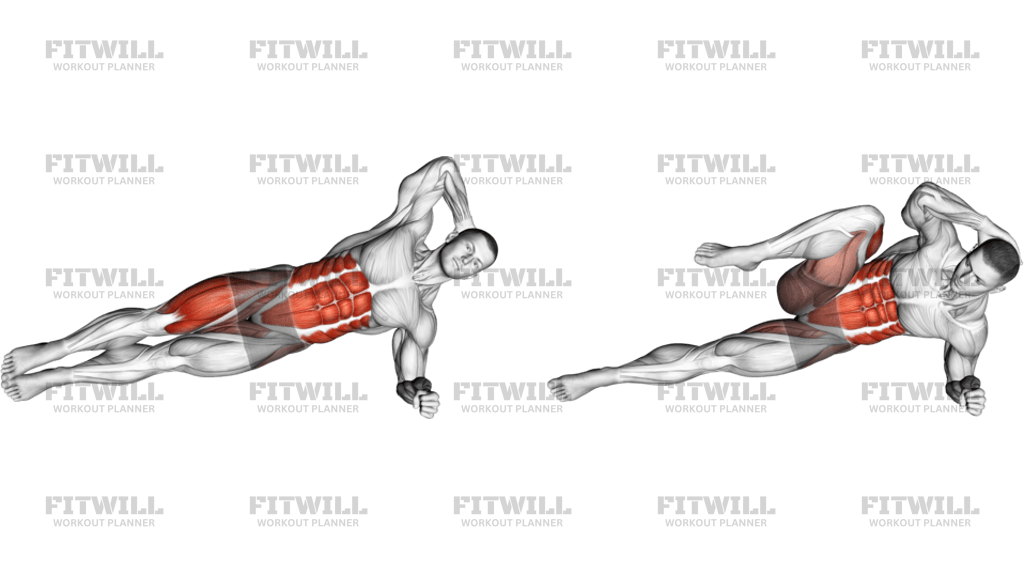
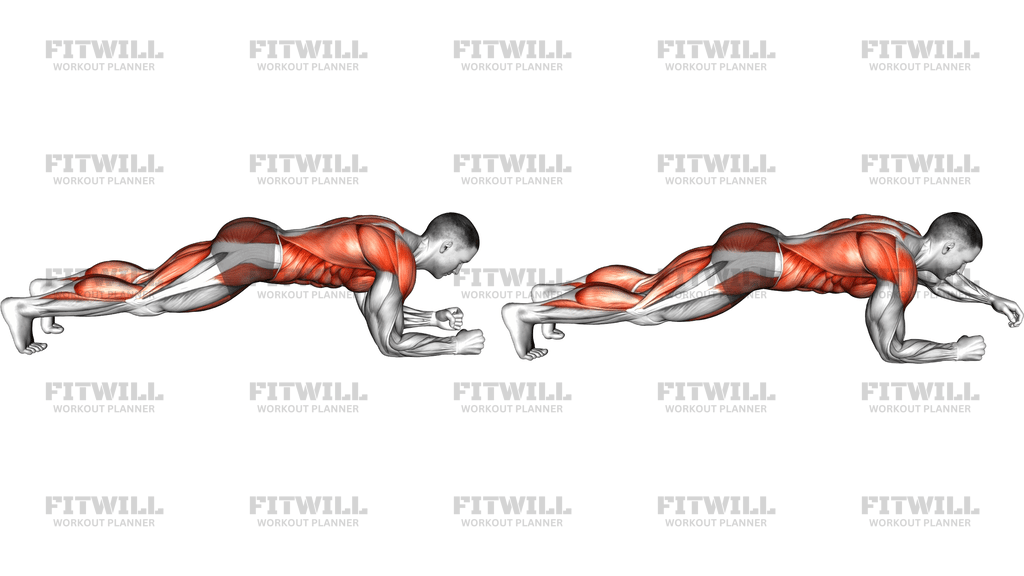
Plank Hands Tap Feet Tap is a body-weight plank variation that keeps you in a forearm plank while you alternately reach one hand forward to tap the floor in front of you and tap one foot out to the side. Each tap briefly removes a point of support, which forces your trunk to resist rotation and side-bending far more than a static plank ever would. The second frame of the movement shows the extended-arm position clearly: one forearm stays planted while the other hand reaches forward, and the torso should stay square to the floor throughout.
This exercise is useful for anyone who can hold a solid forearm plank for thirty seconds or more but needs a new challenge. Because it combines an arm tap and a foot tap in one sequence, it raises the coordination demand as well as the stability demand, making it a good fit for core circuits, warm-up activations, and athletic training where anti-rotation control matters. It requires no equipment beyond a mat or clear floor, so it travels well and slots into almost any session.
The primary work comes from the deep core and abdominal wall, which have to brace continuously as your base shifts. The obliques work hard to stop your hips from twisting or sagging every time a hand or foot leaves the floor, while the shoulder of the planted arm stabilizes and the hip abductors on the standing side control the foot tap. Expect your shoulders and glutes to be involved, but the exercise should feel like a trunk-stability movement first.
Setup matters here because a poor plank position gets worse, not better, when you add taps. Set your elbows directly under your shoulders, widen your feet slightly past hip width for a steadier base, and lock in a straight line from head to heels before you move anything. Execution comes down to small, controlled taps with minimal trunk movement: if your hips swing or rotate with each reach, shorten the range or slow the tempo. Quality of position beats number of reps in every set of this movement.
A practical approach is to alternate one hand tap with one foot tap, or complete all hand taps on one side before switching, depending on how much stability challenge you want. Stop the set when you notice your hips rising, your lower back dipping, or your breath getting choppy, since those are the earliest signs the brace has failed. Done with control, Plank Hands Tap Feet Tap is a time-efficient way to build trunk stiffness that carries over to lifting, running, and everyday movement.
[ Workout Log & Planner ]
Put your next workout in Fitwill
Keep your plan and training log ready when you are.


Instructions
- Set up on a mat or clear floor in a forearm plank with your elbows stacked directly under your shoulders and your forearms parallel or lightly clasped.
- Widen your feet slightly beyond hip width, press the floor away with your forearms, and form one straight line from head through hips to heels.
- Brace your abdominal wall as if bracing for a light push, squeeze your glutes, and take a steady breath before moving.
- Reach one hand forward and tap the floor a short distance in front of your shoulder, keeping your hips square to the floor.
- Bring that hand back under its shoulder with control, then tap the opposite foot out to the side a few inches and return it.
- Continue alternating a hand tap with a foot tap, moving only as far as you can without letting your trunk rotate or your hips drop.
- Keep your planted elbow fixed under its shoulder; do not let it drift inward or roll as the other hand reaches.
- Breathe continuously throughout, exhaling gently on each tap rather than holding your breath.
- Finish the set by returning to a still forearm plank for a few breaths, then lower your knees to the floor to come out of the position.
Tips & Tricks
- The most common fault is hip rotation on the hand tap. Place a water bottle on your lower back or have a partner watch: if it tips or slides, you are twisting, so reduce the reach distance.
- If your lower back dips as soon as your foot lifts, your base is too narrow for your current control. Widen your feet a few more inches and rebuild from there.
- Keep the tap light and quick to the floor. Hovering the hand or foot in the air turns a controlled stability drill into a strain on the lower back.
- Squeeze the glute on the support side during the foot tap. This locks the pelvis level and stops the hip from hiking.
- Spread your fingers or lay the forearm flat and press firmly into the floor; a lazy planted arm is a frequent reason the shoulder tires before the core does.
- Slow the tempo rather than stopping when fatigued. Two-second taps with a steady trunk build more control than fast taps with a wobbling one.
- If you feel it mostly in your shoulders, check that your elbows are under your shoulders and not ahead of them, which shifts load into the shoulder joint.
- Do this exercise early in a session, while fresh. Attempting it at the end of a workout usually means a compromised brace and sloppy taps.
Frequently Asked Questions
What muscles does Plank Hands Tap Feet Tap work?
The deep core and abs do the main bracing work, with the obliques strongly involved in resisting rotation during each tap. The shoulders, forearms, and glutes contribute as stabilizers for the planted arm and the foot tap.
Is Plank Hands Tap Feet Tap suitable for beginners?
Beginners should first be able to hold a still forearm plank for about thirty seconds with good form. From there, start by tapping only the feet, or tap the hand a very short distance forward, and progress to the full alternating pattern.
Why do my hips rotate when I reach my hand forward?
Hip rotation usually means the reach is too long or the brace is too loose. Shorten the tap distance, spread your feet wider, and actively press the opposite forearm into the floor to anchor the trunk.
Should I do a hand tap and a foot tap together or alternate them?
Alternating one hand tap with one foot tap spreads the load and keeps the rhythm manageable. Tapping the hand and foot on the same side at the same time removes more support and is a harder progression.
How wide should my feet be for this plank variation?
Set your feet slightly wider than hip width. A wider stance gives you a steadier base for the taps; as your control improves, you can narrow the feet to increase the challenge.
What can I use instead of Plank Hands Tap Feet Tap?
A standard forearm plank with alternating shoulder taps or a plank with slow leg lifts trains a similar anti-rotation effect. Both are easier entry points if the combined hand and foot taps are too demanding.
How many reps should I do?
Work in time blocks of twenty to forty seconds or counts of eight to twelve alternating taps per side. End the set as soon as your hips sag, rise, or rotate, rather than pushing to a fixed number.
Is it normal to feel this in my lower back?
You should feel your abs and obliques working, not your lower back. If your back fatigues or aches, your hips are likely dropping; lift them slightly, re-brace, and if the feeling persists, return to a static plank until your control improves.