Seated Back Stretch Both Hands To Feet
The Seated Back Stretch Both Hands To Feet is a simple floor stretch where you sit with your knees bent, lean your chest toward your thighs, and reach both hands forward to hold your feet. As you settle into the position, your spine rounds gently into flexion, which lengthens the muscles that run along the spine while the back of your shoulders and arms are drawn into the stretch as well. It is one of the most accessible full posterior chain stretches because it requires no equipment and can be done anywhere you have room to sit on the floor.
This movement primarily targets the lower back and the long muscles that support the spine, with the lats, rhomboids, and glutes contributing to the stretch as your torso folds forward. Because your knees are bent rather than straight, the hamstrings are involved but not at maximal length, which makes this a friendlier option than a straight-leg seated forward fold for people with tight hips or limited flexibility. The bent-knee position also lets you focus on the rounding of the back itself instead of chasing a toe-touch.
It works well as a recovery stretch after deadlifts, rows, squats, or any training day that leaves your back feeling compressed or stiff. Office workers who sit for long hours often find it helpful in the evening, since prolonged sitting shortens the hip flexors and leaves the spinal muscles feeling dull and achy. It is also a common cool-down pose in general flexibility routines and pairs naturally with gentler spinal warm-up movements earlier in a session.
Setup matters more than most people expect. Sit far enough from your feet that your hands can reach them with your arms nearly extended, keep the feet about hip-width apart, and let your knees bend so your chest has somewhere to travel. If your feet are too close, your knees rise high and crowd your chest; if they are too far, you turn it into a hamstring stretch and lose the back-rounding effect that gives this exercise its name.
To execute it well, hinge forward from the hips first, then allow your upper back to round as your hands take hold of the outer edges of your feet. Pull lightly with the arms to deepen the fold, breathe slowly, and let each exhale soften the position a little more. Never yank yourself forward or bounce; the stretch should feel like a steady, tolerable pull along the spine and hips. Hold for roughly twenty to thirty seconds, come up slowly, and repeat two to three times.
People with acute back pain, disc-related issues, or recent spinal injury should skip deep seated flexion and consult a professional before attempting it. For everyone else, mild muscular discomfort is normal, but sharp pain, numbness, or tingling down the leg means you should ease out of the position immediately and choose a gentler variation.
[ Workout Log & Planner ]
Put your next workout in Fitwill
Keep your plan and training log ready when you are.


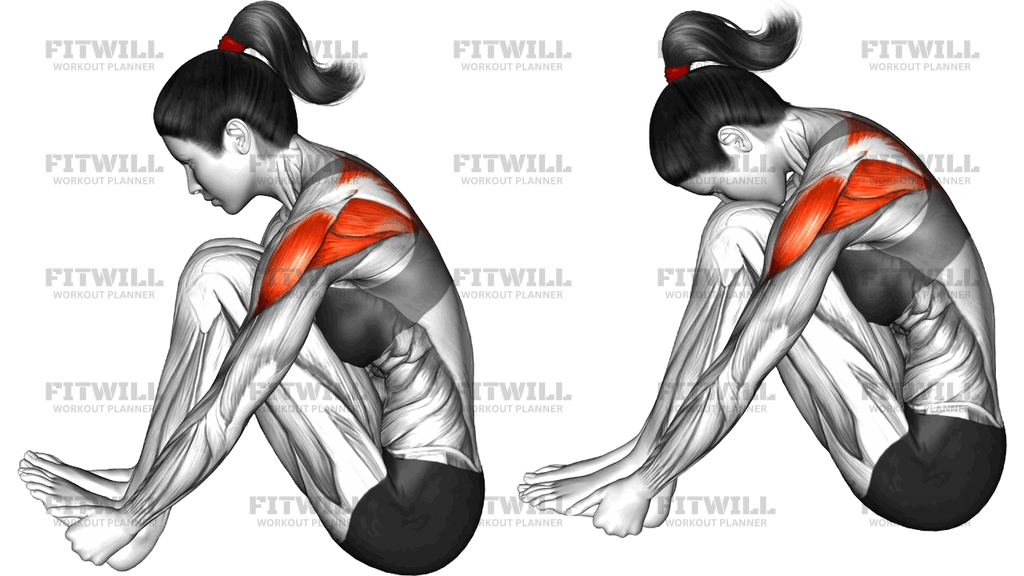
Instructions
- Sit on the floor or on an exercise mat with your knees bent and your feet flat on the floor about hip-width apart, roughly a forearm's length in front of your hips.
- Rest your hands on your knees to start, sit tall for a moment, and let your weight settle evenly onto both sitting bones.
- Take a slow breath in, then hinge forward from the hips and slide your hands down your legs toward your feet.
- Grasp the outer edges of your feet with both hands, keeping a light but firm grip so your arms can help guide the fold.
- Let your chest move toward your thighs and allow your upper and lower back to round naturally as you deepen the stretch.
- Relax your neck and let your head hang in line with the curve of your spine rather than craning it upward.
- Once you reach your comfortable end range, use gentle arm tension to hold yourself there and breathe steadily, deepening slightly with each exhale for about 20 to 30 seconds.
- Release your grip on your feet, walk your hands back up your legs, and roll your spine up one vertebra at a time to return to the tall seated position.
- Reset your posture, take a full breath, and repeat for two to three holds if you are using this as a dedicated flexibility exercise.
Tips & Tricks
- Adjust the distance between your hips and your feet before you fold: feet too close turns this into a knee-to-chest stretch, while feet too far shifts all the tension into the hamstrings.
- If your hands cannot reach your feet, hold your ankles or loop a towel around both feet and grip the ends instead of forcing the reach and collapsing your chest.
- Keep your knees soft rather than pressing them straight; the point of this stretch is the rounded spine, and locked knees change which muscles are loaded.
- Avoid pulling hard with your arms to force a deeper fold, which is the most common mistake here and often causes the shoulders to shrug up toward the ears.
- Initiate the movement by tipping the pelvis forward rather than dropping your head first, so the fold travels through the whole spine instead of just the neck and upper back.
- Keep your weight balanced over both sitting bones; leaning onto one hip shortens one side of the lower back and gives you an uneven stretch.
- Do the stretch after training or a light warm-up rather than completely cold, since warm spinal muscles lengthen more comfortably and with less guarding.
- If you feel the stretch only behind the knees and not in the back, bend the knees a little more and focus on drawing your chest closer to your thighs.
Frequently Asked Questions
Which muscles does the Seated Back Stretch Both Hands To Feet stretch?
It mainly lengthens the lower back and the erector spinae muscles along the spine, with the lats, rhomboids, glutes, and hamstrings also working into the stretch as you fold forward.
Why are the knees bent in the Seated Back Stretch Both Hands To Feet instead of kept straight?
Bent knees reduce hamstring tension so the stretch concentrates on rounding and lengthening the back itself. Straight legs shift the emphasis toward the hamstrings and make the position harder for people with tight hips.
Is the Seated Back Stretch Both Hands To Feet safe for beginners?
Yes, it is beginner-friendly because it uses body weight only and the range is easy to adjust. Beginners should bend the knees generously, reach for the ankles if the feet are out of range, and hold for shorter periods at first.
Should I feel this stretch in my hamstrings as well as my back?
A mild hamstring pull is normal since the legs are angled forward, but if your hamstrings dominate the sensation, bend your knees more and focus on bringing your chest toward your thighs.
How long should I hold the Seated Back Stretch Both Hands To Feet?
Aim for 20 to 30 seconds per hold, repeating two to three times. Longer, quiet holds with relaxed breathing work better than forcing deeper range with repeated pulling.
What is the most common mistake in this stretch?
Yanking the body forward with the arms or bouncing at the end range. Both trigger the back muscles to guard rather than relax, so build the position gradually and let the exhale do the work.
Can I do the Seated Back Stretch Both Hands To Feet every day?
Yes, most people can perform it daily as a mobility or recovery habit, especially on rest days or after long periods of sitting. Keep the intensity moderate so the tissues are lengthened, not strained.
What can I use if my hands cannot reach my feet?
Hold your ankles or shins, or loop a towel around both feet and grip the ends. Either option lets you keep the same folded position without straining to close the distance.
Who should avoid the Seated Back Stretch Both Hands To Feet?
Anyone with acute lower back pain, a recent spinal injury, or symptoms such as sharp pain, numbness, or tingling into the legs should avoid deep seated flexion and get guidance from a qualified professional first.
When is the best time to use the Seated Back Stretch Both Hands To Feet in a workout?
It fits best in the cool-down after strength training or as a standalone flexibility session, when the muscles are warm and respond better to longer holds.