Lying 90 To 90 Switch
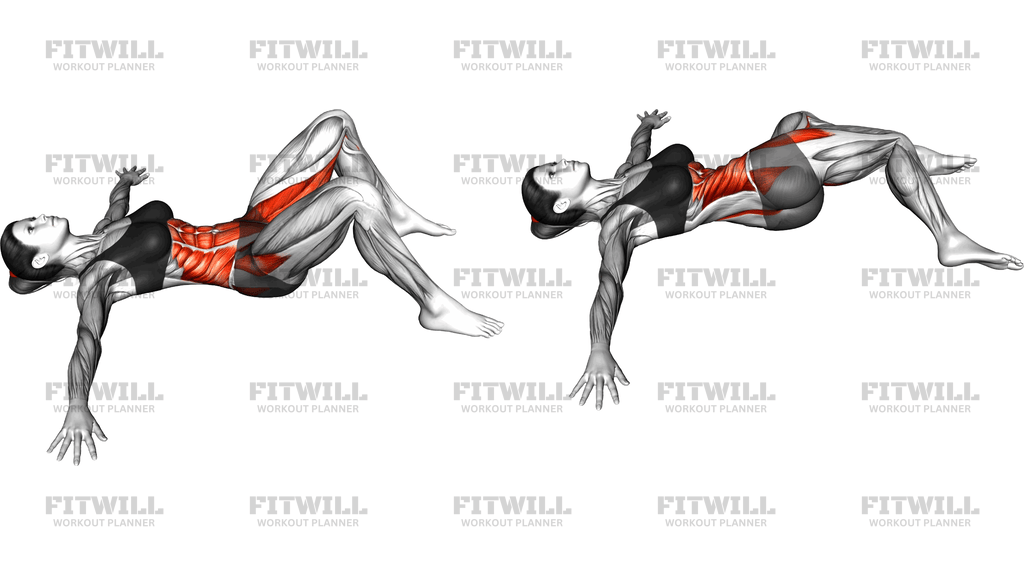
The Lying 90 To 90 Switch is a body-weight core drill performed on your back with both hips and both knees bent to 90 degrees, then rotated from one side to the other in a slow, controlled switch. Because your legs move as one unit through a rotational arc while your upper back and shoulders stay pinned to the floor, the exercise forces the trunk to resist and then produce rotation at the same time. It looks simple from the outside, but anyone who has tried it knows how quickly the midsection starts working once the knees travel away from midline.
This movement earns its place in a lot of warm-ups and core blocks because it trains the deep abdominals and obliques through rotation without any load on the spine. The arms-out, palms-up position acts like training wheels: pressing the opposite hand into the floor helps you control how far the knees drop. The glutes and deep hip rotators also work hard on the side the knees are traveling toward, which makes this a useful drill for people whose hips feel stiff or asymmetrical from sitting.
Setup matters more here than in most lying core exercises. Before the legs move at all, you need a braced trunk, a neutral lower back, and ribs that are not flared toward the ceiling. If the setup is loose, the lower back absorbs the rotation instead of the abs, and the drill loses most of its value. Think of the torso as a fixed anchor and the pelvis as the hinge that the legs swing from.
To execute it well, lift your legs into the 90/90 position, keep your knees and ankles stacked and together, and rotate both knees down toward the floor on one side only as far as your shoulder contact allows. Pause briefly, then rotate back through the middle and switch to the opposite side. The tempo should feel almost too slow; gravity will happily accelerate your legs if you let it, and that is where form breaks down.
You will see this exercise in athletic warm-ups, postpartum and general core progressions, and rehab-adjacent programs because it is low-load, scalable, and easy to regress by reducing the range. Stop at whatever depth lets you keep both shoulders on the floor and your breathing steady. If you feel twisting or pinching in the lumbar spine rather than work in the abs and hips, shorten the range before you change anything else.
[ Workout Log & Planner ]
Put your next workout in Fitwill
Keep your plan and training log ready when you are.


Instructions
- Lie on your back on a mat with your arms extended straight out to the sides at shoulder height, palms facing up.
- Draw your legs up so your hips and knees are both bent to roughly 90 degrees, thighs vertical and shins parallel to the floor, knees and feet touching.
- Brace your midsection gently, pull your ribs down toward your hips, and make sure your entire lower back can stay in contact with the floor through the whole set.
- Keeping the 90-degree angles at both hips and knees, slowly rotate both legs to the left as one block, letting the pelvis turn with them.
- Lower until the outer knee and leg approach the floor or until your right shoulder starts to lift, whichever comes first, and pause for a beat.
- Rotate back through the center without letting the legs drop or the knees separate, then continue in the same smooth arc to the right side.
- Exhale as the legs travel away from midline and inhale as you rotate back through center, keeping the breath continuous rather than held.
- Alternate sides for equal reps, resetting the braced trunk and stacked knee position every few reps if you feel your form drifting.
Tips & Tricks
- The most common fault is chasing floor contact: if the knees reach the floor but a shoulder has peeled up, you have traded core work for lumbar rotation. Limit the range to where the opposite shoulder stays heavy.
- Keep the knees squeezed together for the entire switch. Once the top knee drifts away from the bottom one, each leg starts moving independently and the anti-rotation demand drops off sharply.
- Press the palm of the arm on the side you are rotating away from into the floor. That small anchor keeps the ribcage from counter-rotating and makes the obliques do the steering.
- If your lower back arches as soon as the legs lift into the 90/90 position, the issue is usually the brace, not the rotation. Spend a few breaths flattening the back before starting the switches.
- Move at a tempo of roughly two to three seconds per side. Fast, momentum-driven swings turn this into a leg-swing drill and rob the trunk of the work.
- Limited hip range is not a flaw to force through. Restricting the depth slightly and staying symmetrical side to side beats jamming the pelvis into end range.
- If one side rotates further or smoother than the other, match the tighter side's range rather than maxing out the loose side while the imbalance works itself out.
- Place your head neutral with eyes up rather than craning to watch your knees; turning the head mid-rep tends to drag the shoulder off the floor.
Frequently Asked Questions
What muscles does the Lying 90 To 90 Switch work?
The abdominals, especially the obliques, drive the rotation, while the glutes and deep hip rotators control the leg sweep on the side the knees travel toward. The hip flexors also work to hold the thighs in the 90-degree position throughout.
Is the Lying 90 To 90 Switch suitable for beginners?
Yes, because it is body-weight and low-load. Beginners should simply reduce the range so the knees only lower partway toward the floor while both shoulders stay in contact.
Why do my hips and knees need to stay at 90 degrees during the switch?
The fixed 90/90 position keeps the legs moving as one rigid block, which is what forces the pelvis and trunk to do the rotating. If the angles change, the legs start compensating and the core demand falls away.
My lower back feels the movement more than my abs. What am I doing wrong?
You are most likely rotating too far and letting the lumbar spine take the motion instead of the pelvis rotating as a unit. Shorten the range, re-brace with ribs pulled down, and keep the opposite shoulder pressed into the floor.
How is the Lying 90 To 90 Switch different from a seated 90/90 switch?
The seated version is a hip mobility drill done upright, while the lying version is a rotational core exercise performed on your back. The supine position adds an anti-extension and anti-rotation demand on the trunk that the seated version does not have.
How far should my knees rotate toward the floor?
Only as far as you can go while both shoulder blades stay flat on the floor and your breathing stays relaxed. For many people that is well short of a floor touch, and that is fine.
Can I substitute another exercise if I find this too difficult?
A supine knee drop with the feet flat on the floor is an easier step, since shortening the lever reduces the load on the trunk. You can progress back to the full 90/90 switch once you can control that version without shoulder lift.
How many reps and sets of the Lying 90 To 90 Switch should I do?
Two to three sets of 6 to 10 slow switches per side works well, either as a warm-up primer or as part of a core circuit. Prioritize smooth, controlled reps over total volume.
Is it safe for people with lower back issues?
The exercise is gentle on the spine when the range is controlled and the trunk is braced, but anyone with a current or recurring back problem should get clearance from a qualified professional first and start with a shortened range.